Management Instructor - Russ Wakefield GTA Shivani Dave On Campus - - PDF document

management
SMART_READER_LITE
LIVE PREVIEW

Management Instructor - Russ Wakefield GTA Shivani Dave On Campus - - PDF document

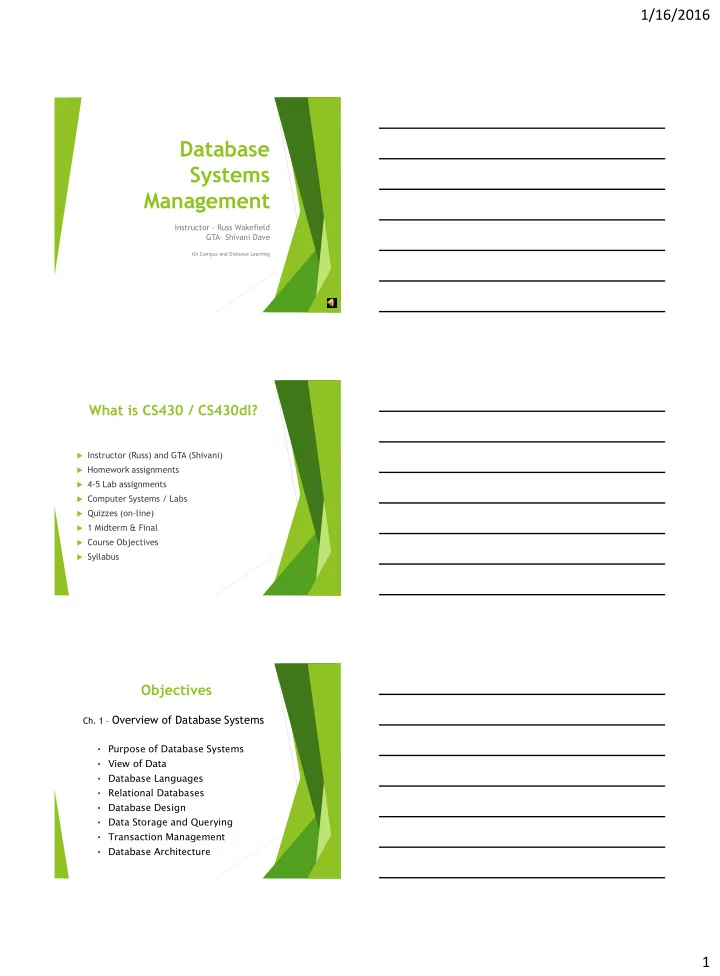
1/16/2016 Database Systems Management Instructor - Russ Wakefield GTA Shivani Dave On Campus and Distance Learning What is CS430 / CS430dl? Instructor (Russ) and GTA (Shivani) Homework assignments 4-5 Lab assignments


slide-1
SLIDE 1

1/16/2016 1

Database Systems Management

Instructor - Russ Wakefield GTA– Shivani Dave

On Campus and Distance Learning

What is CS430 / CS430dl?

 Instructor (Russ) and GTA (Shivani)  Homework assignments  4-5 Lab assignments  Computer Systems / Labs  Quizzes (on-line)  1 Midterm & Final  Course Objectives  Syllabus

Objectives

  • Ch. 1 – Overview of Database Systems
  • Purpose of Database Systems
  • View of Data
  • Database Languages
  • Relational Databases
  • Database Design
  • Data Storage and Querying
  • Transaction Management
  • Database Architecture
slide-2
SLIDE 2

1/16/2016 2

Objectives

  • Ch. 2 – Introduction to Relational Model
  • Structure of Relational Databases
  • Database Schema
  • Keys
  • Schema Diagrams
  • Relational Query Languages
  • Relational Operations

Objectives

  • Ch. 3 - Introduction to SQL
  • Overview of the SQL Query Language
  • SQL Data Definition
  • Basic Structure of SQL Queries
  • Set Operations
  • Null Values
  • Aggregate Functions
  • Nested Subqueries
  • Modification of the Database

Objectives

  • Ch. 4 – Intermediate SQL
  • Join Expressions
  • Views
  • Transactions
  • Integrity Constraints
  • SQL Data Types and Schemas
  • Authorization
slide-3
SLIDE 3

1/16/2016 3

Objectives

  • Ch. 5 – Advanced SQL
  • Accessing SQL From a Programming

Language

  • Functions and Procedures
  • Triggers
  • Recursive Queries
  • Advanced Aggregation Features

Objectives

  • Ch. 6 – Formal Relational Query Languages
  • Relational algebra
  • Relational calculus (maybe)

Objectives

  • Ch. 7 – Database design and the ER model
  • Overview of the Design Process
  • The Entity-Relationship Model
  • Constraints
  • Removing Redundant Attributes in Entity

Sets

  • Entity-Relationship Diagrams
  • Reduction to Relational Schemas
  • Entity-Relationship Design Issues
slide-4
SLIDE 4

1/16/2016 4

Objectives

  • Ch. 8 – Relational Database Design
  • Features of Good Relational Designs
  • Atomic Domains and First Normal Form
  • Decomposition Using Functional

Dependencies

  • Functional-Dependency Theory
  • Algorithms for Decomposition

Objectives

  • Ch. 9 - Application Design
  • Application Programs
  • Web Fundamentals
  • Servlets and JSP
  • Application Architectures
  • Rapid Application Development
  • Application Performance
  • Application Security
  • Encryption and Its Applications

Objectives

  • Ch. 10 - Storage and File Structure
  • Overview of Physical Storage Media
  • Magnetic Disk and Flash Storage
  • RAID
  • Tertiary Storage
  • File Organization
  • Organization of Records in Files
  • Data-Dictionary Storage
  • Database Buffer
slide-5
SLIDE 5

1/16/2016 5

Objectives

  • Ch. 11 - Indexing and Hashing
  • Basic Concepts
  • Ordered Indices
  • B+-Tree Index Files
  • B+-Tree Extensions
  • Multiple-Key Access
  • Static Hashing
  • Dynamic Hashing
  • Comparison of Ordered Indexing and

Hashing

  • Bitmap Indices
  • Index Definition in SQL

Objectives

  • Ch. 12 – Query processing
  • Overview
  • Measures of Query Cost
  • Selection Operation
  • Sorting
  • Join Operation
  • Other Operations
  • Evaluation of Expressions

Objectives

  • Ch. 14 - Transaction Management
  • Transaction Concepts
  • A Simple Transaction Model
  • Storage Structure
  • Transaction Atomicity and Durability
  • Transaction Isolation
  • Serializability
  • Transaction Isolation and Atomicity
  • Transaction Isolation Levels
  • Implementation of Isolation Levels
  • Transactions as SQL Statements
slide-6
SLIDE 6

1/16/2016 6

Objectives

  • Ch. 17 - Concurrency Control
  • Lock-Based Protocols
  • Deadlock Handling
  • Multiple Granularity
  • Timestamp-Based Protocols
  • Validation-Based Protocols
  • Multiversion Schemes 689 15.7

Snapshot Isolation

  • Insert Operations, Delete Operations,

and Predicate Reads

Objectives

  • Ch. 18 - Recovery
  • To show what steps are taken in the ARIES

method to recover from DBMS crashes

  • To describe how logs are maintained and

how they are used to recover from a crash

  • To identify the concepts behind checkpoints

and show how they are used.

  • To show how recovery interacts with

concurrency control

Computer Systems / Labs

 Assignments done using computer systems in

C120 (Linux based, multi-core boxes)

 May use home equipment – but GTA will grade

using the state capital boxes.

 If it doesn’t run in that environment, it

will be graded accordingly

 Department policy  Every student enrolled in a CS class is given

an account in the CS environment

 Our MySQL server is faure.cs.colostate.edu

slide-7
SLIDE 7

1/16/2016 7

Homework / Programming Assignments

 Homework assignments every 1-2 weeks  4-5 lab assignments  Done using the state capital machines  SQL, design and build database  Java program using the JDBC interface  XML parser

Late Policy

 Assignments are due class time on Tuesdays (both

homework and lab)

 Assignments have a 48 hour late period.  Assignments turned in during the late period will be

assessed a 20% late penalty

 All assignments will be submitted through Canvas  Questions about grading should first be discussed with

Shivani

Quizzes

 Weekly quizzes over the reading material  3 attempts  Only highest attempt counts for grade  Open book, open notes  NOT open person

slide-8
SLIDE 8

1/16/2016 8

Exams

 Midterm exam during week 7  Final exam during week 16  Series of timed online quizzes  72 hours  Sunday, Monday, Tuesday  Study guide will be published in advance

Syllabus

 http://www.cs.colostate.edu/~cs430dl

Where do I get help ?

 The book – reading is a good thing.  Your classmates – this is a large class, find

allies.

 Not TOO good of allies – cheating will be

dealt with harshly..

 The Instructor and GTA  We have office hours, use them. Our

salaries are paid by your tuition – you are entitled to our time.

 If our office hours are not timely – set up

an appt. Like all geeks, we live glued to computer screens.

slide-9
SLIDE 9

1/16/2016 9

Where do I get help?

 Discussion Board  If you have a question, odds are 20 other

people have the same question.

 The TA will check the boards regularly  Google / Stack Overflow Again – not TOO much of Google, see

above re: cheating

Sharing code, posting code is

considered cheating!!