
SLIDE 1
Charles J. Ryan, M.D. Professor of Medicine B.J. Kennedy Chair in Clinical Medical Oncology Masonic Cancer Center University of Minnesota
Management of fatigue, cognition/dementia
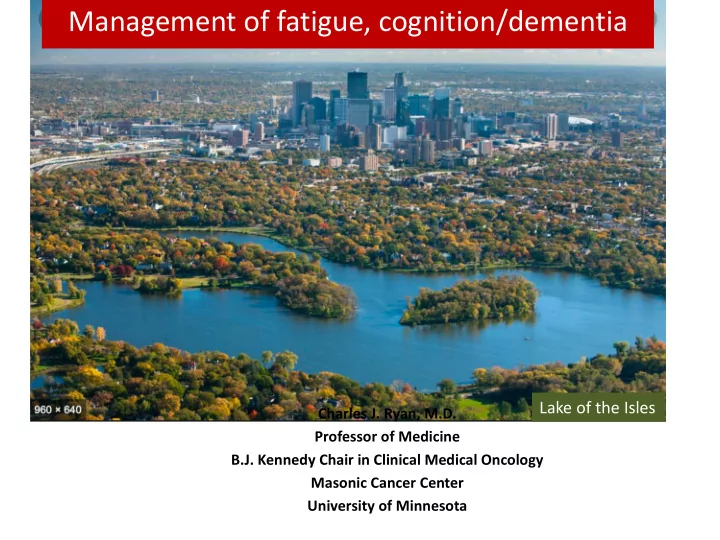
Lake of the Isles
Management of fatigue, cognition/dementia Lake of the Isles Charles - - PowerPoint PPT Presentation
Management of fatigue, cognition/dementia Lake of the Isles Charles J. Ryan, M.D. Professor of Medicine B.J. Kennedy Chair in Clinical Medical Oncology Masonic Cancer Center University of Minnesota Disclosures relevant to this talk
Charles J. Ryan, M.D. Professor of Medicine B.J. Kennedy Chair in Clinical Medical Oncology Masonic Cancer Center University of Minnesota
Lake of the Isles
– Prostate Cancer Foundation – Th!nk Different Foundation
– Bayer
– Janssen – Sanofi Genzyme – Prostate Cancer Foundation – Movember Foundation
Lake Harriet
Bde Mka Ska (formerly Lake Calhoun)
EUROPEAN UROLOGY 7 3 ( 2 01 8 ) 1 7 8 – 2 1 1 185
Selected adverse events (AE)*:
Christopher Sweeney,MBBSAll patients at anytime
TS + NSAA N=558 TS + ENZA N=563 Serious AE rate per yr of Rx exposure 0.33 95% CI: 0.28-0.39 0.34 95% CI: 0.29-0.40 AEs of Interest N % N % Hypertension: Gde 3 24 4% 43 8% Gde 2 30 5% 60 11% Fatigue: Gde 3 4 1% 31 6% Gde 2 80 14% 142 25% Falls: Gde 3 2 <1% 6 1% Gde 2 8 1% 28 5% Syncope 7 1% 20 4% Concentration Impairment: Gde 1/2 6 1% 24 4% Any Seizure 0% 7 1% *worst grade AE shown
ENZAMET ARAMIS
Khalaf, Gleave, Chi PROC ASCO 2017 “Uptick” in Depressive Symptoms Enza > Abi ( were these at risk patients to begin with?) No significant Cognitive change based on MoCA test (relatively insensitive) But! Most patients take these >24 weeks!
#benchpresstobedside One year randomized controlled trial (RCT) of varying exercise interventions in PCa patients undergoing ADT Exercise improves Fatigue/Vitality in those who need it most
Those with the highest baseline levels of fatigue and lowest vitality improved the most with exercise.
Taafe et al. Eur Urol. 2017 Aug;72(2):293-299.
Here’s the ‘vitality’ score
Taafe et al. Eur Urol. 2017 Aug;72(2):293-299.
UMN BMT Physician Shernan Holten MD - USPA national squat record and state bench and deadlift records for 82.5 kg masters Mustian et al JAMA Oncology 2017 Meta-Analysis
Stacy Kenfield
Meir Stampfer
Amyloid Rosario, Neuroobiol of Aging 2011
Following 1 year of ADT: Immediate Span of Attention: 40% gap vs healthy controls Visuo-spatial Activity 50% gap vs healthy controls Executive Function 40% gap vs healthy controls
Controls “learn” and improve ADT Patients do not
Modest Cognitive Decline after 1 year of ADT: Two studies, different instruments
Alibhai JCO 2010 Gonzalez JCO 2015 a challenge
Nead et al Limitations of these data
Alzheimer’s disease (both under- and over-reported).
impairment experienced by patients * A chronic or persistent disorder of the mental processes caused by brain disease or injury and marked by memory disorders, personality changes, and impaired reasoning. Don’t be fooled by these KM curves!
Desikan RS, et al. (2017) Genetic assessment of age-associated Alzheimer disease risk: Development and validation of a polygenic hazard score. PLOS Medicine 14(3):
Protected At Risk
Genetic Effects: PHS AR polymorphisms
Patient Effects: Age Comorbidity
Drug Effects: CNS Penetration Potency of AR blockade Etc Highest Risk Individuals
Hypothesis: Cognitive Impairment on ENZA or DARA arises from the interaction of genetic and modifiable risk factors shown here.
Alicia Morgans MD MPH
Stone Arch Bridge Across the Mississippi River
Treatment with an ADT may be associated with fatigue and cognitive dysfunction. #benchpresstobedside Speak carefully with patients! Dementia and transient reversible cognitive dysfunction are very different processes! Claims based data suggests an association between ADT and Alzheimer’s disease Measurement of cognitive function remains challenging. Include assessments of patient reported
your trials. More Potent AR antagonists, while improving disease
require detailed study.