Management of Endometrial Hyperplasia I have nothing to disclose. - - PowerPoint PPT Presentation

management of endometrial hyperplasia
SMART_READER_LITE
LIVE PREVIEW

Management of Endometrial Hyperplasia I have nothing to disclose. - - PowerPoint PPT Presentation

Management of Endometrial Hyperplasia I have nothing to disclose. Stefanie M. Ueda, M.D. Associate Clinical Professor UCSF Division of Gynecologic Oncology A 48 year old P4 obese female with poorly controlled diabetes reports irregular


slide-1
SLIDE 1

1

Management of Endometrial Hyperplasia

Stefanie M. Ueda, M.D.

Associate Clinical Professor UCSF Division of Gynecologic Oncology

I have nothing to disclose.

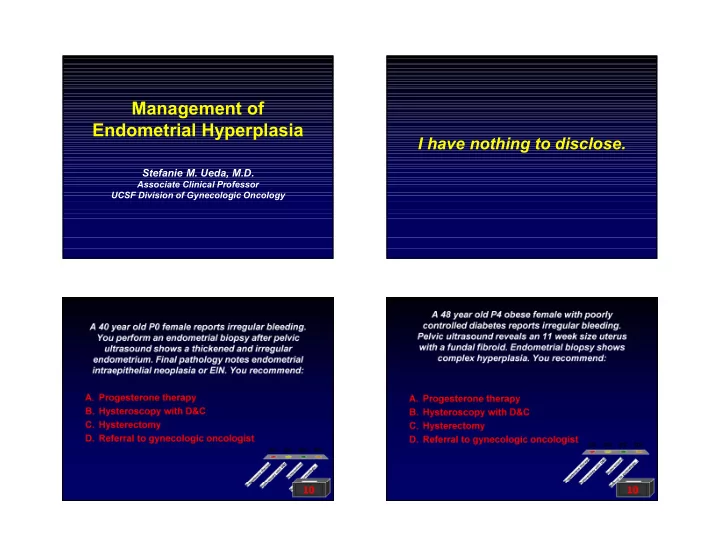
A 40 year old P0 female reports irregular bleeding. You perform an endometrial biopsy after pelvic ultrasound shows a thickened and irregular

  • endometrium. Final pathology notes endometrial

intraepithelial neoplasia or EIN. You recommend:

  • A. Progesterone therapy
  • B. Hysteroscopy with D&C
  • C. Hysterectomy
  • D. Referral to gynecologic oncologist

0% 0% 0% 0%

10 A 48 year old P4 obese female with poorly controlled diabetes reports irregular bleeding. Pelvic ultrasound reveals an 11 week size uterus with a fundal fibroid. Endometrial biopsy shows complex hyperplasia. You recommend:

  • A. Progesterone therapy
  • B. Hysteroscopy with D&C
  • C. Hysterectomy
  • D. Referral to gynecologic oncologist

0% 0% 0% 0%

10

slide-2
SLIDE 2

2

Female Malignancies in the United States

New Cases Deaths Breast 252,710 40,610 Lung/Bronchus 105,510 71,280 Colorectal 64,010 23,110 Uterine Corpus 61,380 10,920 Ovary 21,290 14,080 Cervix 12,820 4,210 Vulva 6,020 1,150

2017 American Cancer Society

Uterine Cancer

  • Death rate has increased by 1% per

year for whites and 2% for blacks

  • 2.6% lifetime risk
  • 25% premenopausal1

– 2.5%-14% younger than 40

  • 80% low grade endometrioid histology

– Unopposed estrogen major risk factor

1Gadducci A et al, Gynecol Endocrinol 2009

Factors Associated with Hyperplasia & Cancer

1Gressel GM et al, Int J Gynaecol Obstet 2015

Characteristic Increased Risk Obesity 3 –10x Nulliparity 2x Late menopause 2.4x Diabetes 2.8x Hypertension 1.5x Unopposed estrogen 9.5x

Prognosticators Prognosticators

slide-3
SLIDE 3

3

Natural History of Endometrial Neoplasia

1Pennant ME et al, BJOG 2017

Meta-analysis of 65 articles showed that with abnormal bleeding risk of atypical hyperplasia or cancer 1.31% (higher with inter-menstrual bleeding)1

ACOG Committee Opinion #631 (May 2015)

  • Endometrial intraepithelial neoplasia (EIN) better

encompasses premalignant criteria to more widely used 1994 WHO schema utilizing “atypical hyperplasia”

– Interobserver reproducibility greater with EIN

  • Hysteroscopy with directed dilatation and

curettage recommended for evaluation

  • Total hysterectomy recommended for definitive

management when appropriate

  • Systemic progesterone therapy can be used if

fertility desired or poor surgical candidate

– Serial sampling Q3-6 months

Comparing WHO and EIN Systems

  • Debate on existence of simple atypical hyperplasia,

whereas simple and complex hyperplasia thought to have high likelihood to regress with progesterone

  • EIN system proposed in 2000 but not gained widespread

acceptance due to cost and lack of experience with computerized D-scoring1 – D-score measures stromal volume as a proportion of total tissue volume (stroma + epithelium + gland lumen) – Benign (D >1), indeterminate (0< D <1), or EIN (D <0)

  • EIN classification demonstrated moderate interobserver

reproducibility and correlates with progression to endometrial carcinoma similar to WHO2

  • Adequate comparative studies between EIN & WHO lacking

1Mutter GL et al, Gynecol Oncol 2007 2Lacey JV et al, Cancer 2008

Simple Hyperplasia Complex Hyperplasia Atypical Hyperplasia

slide-4
SLIDE 4

4

Risk of Progression to Cancer Based

  • n 1994 WHO Classification
  • Hyperplasia

– Simple 1% – Complex 3% – Simple with atypia 8% – Complex with atypia 29%

Risk of having concurrent cancer ~30-40%

2015 WHO Classification

Term Synonym Genetic Changes Coexistent Cancer Progression to Cancer Hyperplasia without atypia Simple hyperplasia Complex hyperplasia Low level somatic changes <1% RR 1.01-1.03 Atypical hyperplasia

  • r

EIN CAH Simple hyperplasia with atypia MSI PAX2 PTEN KRAS CTNNB1 25-33% RR 14-45

Concurrent Carcinoma with Preoperative Hyperplasia Biopsy

  • Prospective GOG cohort study of 306 women with

preoperative community biopsy of atypical hyperplasia1

– Independent review by 3 gynecologic pathologists – Hysterectomy within 12 weeks without interval treatment

  • Change in diagnosis

– 25.6% less than atypical hyperplasia – 29.1% diagnosed as endometrial carcinoma

  • 42.6% found to have concurrent carcinoma in

hysterectomy specimens

– 30.9% myometrial invasion – 10.6% with >50% myometrial invasion

1Trimble CL et al, Cancer 2006

Endometrial Sampling

Sufficient material

  • btained in about 90.6%

with pipelle1 Diagnostic rates similar with pipelle or curettage in abnormal uterine bleeding (~95%) In up to 60% of curettages, less than half endometrium sampled

1Ben-Baruch G et al, Gynecol Obstet Invest 1994

slide-5
SLIDE 5

5

  • Detection of endometrial hyperplasia1,2

Sensitivity 76.4%-81% Specificity 76.9%-96% PPV 73.1%-87% NPV 79.1%-93%

  • Detection of endometrial cancer2,3

Sensitivity 63-83% Specificity 97-99% PPV 77% NPV 95%

Hysteroscopic Assessment in Endometrial Thickening

1Korkmazer E et al, Prz Menopauzalny 2014 2Loiacono RM et al, Gynecol Obstet Invest 2015 3Gkrozou F et al, Arch Gynecol Obstet 2015

Hysteroscopy in Estimation of Endometrial Cancer

  • Systematic review of 27 studies of 1106 patients
  • Mean risk of cancer after atypical hyperplasia

diagnosed by

– Curettage 32.7% – Hysteroscopic biopsy 45.3% – Hysteroscopic resection 5.8%

1Bordel N et al, J Minim Invasive Gynecol 2017

Ultrasound in Detection of Uterine Pathology

Sensitivity 85-95% Specificity 60-80% PPV 2-10% NPV 99%

Imaging in Workup and Surveillance

  • Diffusion-weighted imaging-T2

MRI can improve diagnostic performance in predicting deep myometrial invasion in review

  • f 15 studies1

– Age, preoperative tumor grade, and myometrial invasion<50%

  • n MRI not associated with

lymph node metastasis2 – Diagnostic accuracy in detecting myometrial involvement significantly lower in premenopausal women (0.42 versus 0.73, p=0.006), but no difference in deep myometrial invasion

1Deng L et al, IJ Comput Assist Tomogr 2015 2Son JH et al, Obstet Gynecol Sci 2015 3Lin G et al, Clin Radiol 2015

slide-6
SLIDE 6

6 Role for Conservative Management

  • Society of Gynecologic Oncology recommends

imaging be performed to exclude concurrent carcinoma

– Ultrasound, CT, MRI – Confined to corpus, exclude synchronous ovarian tumors or adenopathy

  • MRI more sensitive than ultrasound for

evaluation of myometrium but may miss up to 5% of adnexal masses1

  • Residual hyperplasia at 6 months increases

the likelihood of failure of progestin therapy2

1Gressel GM et al, Int J Gynaecol Obstet 2015 2Mentrikoski MJ et al, Am J Clin Pathol 2012

Type Dosage/Duration Provera 10-20 mg daily 12-14 days/month Depo Provera 150 mg IM Q3 months Micronized vaginal 100-200 mg daily 12-14 days/month Megace 40-200 mg daily Mirena 52 mg over 1-5 years

Hormonal Treatment Hormonal Treatment

Meta-Analysis of Progestin Therapy

  • 34 observational studies with 408 women with early

stage endometrial cancer and 151 CAH1

  • Endometrial cancer

– Pooled regression rate of 76.2% – Relapse of 40.6% – Live birth rate of 28%

  • Complex atypical hyperplasia

– Pooled regression rate of 85.6% – Relapse of 26% – Live birth rate of 26.3%

  • IVF resulted in 39.4% live birth rate compared to 14.9%

spontaneous conception

  • 1.9% progressed to higher than Stage I cancer, from

which 2 died

1Gallos ID et al, Am J Obstet Gynecol 2012

Regression of Hyperplasia with Mirena

  • Cohort study of 344 women treated with Mirena or
  • ral progesterone for CAH or complex

hyperplasia1

– Median follow-up 58.8 months (IUD) and 95.1 months (oral)

  • 221 with complex hyperplasia regressed (96.5%)

with Mirena

– BMI>35 associated with failure (32.6% relapsed) – 12.7% overall relapsed (only 3.3% with BMI<35)

  • Meta-analysis of 5 RCTs (377 patients), higher

regression rate in non-obese women than oral progesterone (1.41) and similar in obese women (RR 1.03)2

1Gallos ID et al, Obstet Gynecol 2013 2Yuk JS et al, Ann Surg Oncol 2017

slide-7
SLIDE 7

7 Oncologic Outcomes with Progestin

  • Systematic review of 45 studies of 391 patients1

– Provera (49%), Megace (25%), Mirena (19%), Makena (0.8%) – 39 months median follow-up

  • Complete, durable response in 53.2%

– Higher in hyperplasia than carcinoma (65.8% vs 48.2%) – Median time to complete response 6 months

  • Less persistent disease in hyperplasia

– 14.4% vs 25.4%

  • Recurrence after initial response higher in carcinoma

– 23.2% vs 35.4%

  • Reproductive outcomes not different between cohorts

(41.2% vs 34.8%, p=0.39)

– 117 live births recorded

1Gunderson CC et al, Gynecol Oncol 2012

Comparison of Fertility Sparing Therapies

  • Meta-analysis of 54 studies in women with CAH

and endometrial cancer1

– 6 studies with hysteroscopic resection (n=6-26)

  • Hysteroscopic resection followed by

progesterone compared to progesterone alone

– Higher pooled regression (98.1% vs 77.2%) – Increased live birth rate (52.6% vs 33.4%) – Lower recurrence rate (4.8% vs 32.2%)

  • Pooled live birth rate higher if hysteroscopic

resection followed by progesterone than if Mirena

  • nly (52.6%vs 18.1%)

– No difference in regression or recurrence

1Zhang Q et al, Oncotarget 2017

Metformin in Endometrial Neoplasia

  • 19 studies with Metformin1

– Reversion of atypical endometrial hyperplasia to normal endometrium (51.9% to 34.5%) – Decreased cell proliferation biomarker staining – Metformin using endometrial cancer patients demonstrated higher

  • verall survival (HR=0.82)
  • Phase II trial of 17 patients with CAH

and 19 with EC – MPA (400 mg/day) with metformin (750-2250 mg/day) possibly improves outcomes – 81% achieved completed response & 10% relapsed

1Meireles CG et al, Gynecol Oncol 2017 2Mitsuhashi A et al, Ann Oncol 2016

Surgical Staging in Uterine Cancer

  • Total hysterectomy, bilateral

salpingo-oophorectomy, sentinel node biopsy +/- pelvic/para-aortic node dissection

  • Risk factors to consider
  • Invasion >50% myometrium
  • High grade, serous, clear cell
  • >2 cm tumor size
  • LVSI
  • Cervical involvement
  • Clinically bulky lymph nodes
  • Successful sentinel node mapping

86%, sensitivity 97%

slide-8
SLIDE 8

8

Findings at Uterine Cancer Surgery

  • Clinical Stage I will be

upstaged 30% of the time at time of primary surgery

– 9% pelvic nodes – 6% para-aortic nodes – 5% adnexa – 12% for positive cytology – 6% other (e.g. cervical or abdominal disease)

  • Frozen section correlation

– 97.5% Histology – 88% Grade – 92.8% Myometrial invasion

Clinical Considerations

  • Progestin therapy remains the most

tested fertility-sparing option in EIN and early stage endometrial cancer

– Conservative management should be complemented with referral to an infertility specialist

  • Definitive hysterectomy remains the

standard of care if appropriate, as up to 40% of patients harbor a co-existing adenocarcinoma and up to 25% fail medical management

A 39 year old P1 female who desires future fertility reports irregular bleeding. Pelvic ultrasound reveals an enlarged uterus. Endometrial biopsy shows complex hyperplasia. You recommend:

  • A. Provera
  • B. Mirena IUD placement
  • C. Hysterectomy
  • D. Referral to gynecologic oncologist

27% 19% 1% 53%

A 40 year old P0 female who desires future fertility reports irregular bleeding. Endometrial biopsy shows complex hyperplasia. Pelvic ultrasound reveals a thickened endometrial stripe with possible 1.5 cm polypoid mass in the endometrial cavity. You recommend:

  • A. Provera
  • B. Mirena IUD placement
  • C. Hysteroscopy with possible resection
  • D. Hysterectomy

0% 4% 96% 0%