Management District Responses to Harris Restoration Council - - PowerPoint PPT Presentation

management district
SMART_READER_LITE
LIVE PREVIEW

Management District Responses to Harris Restoration Council - - PowerPoint PPT Presentation

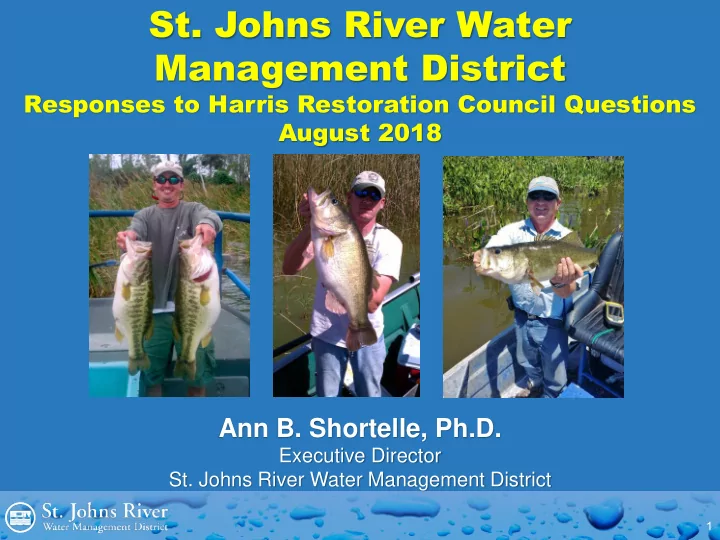
St. Johns River Water Management District Responses to Harris Restoration Council Questions August 2018 Ann B. Shortelle, Ph.D. Executive Director St. Johns River Water Management District 1 Question #1 North Shore Reconnection Council


slide-1
SLIDE 1
  • St. Johns River Water

Management District

Responses to Harris Restoration Council Questions August 2018

Ann B. Shortelle, Ph.D.

Executive Director

  • St. Johns River Water Management District

1

slide-2
SLIDE 2

Question #1 North Shore Reconnection

Council requests SJRWMD and pertinent Council technical advisory group agencies (FWC, FDEP, LCWA) to provide current scientific data in a presentation to the Council that allows the Lake Apopka North Shore(LANS) to either be connected or not connected to Lake Apopka. Council was informed several times during the 2017 Council meetings that the District will not look at reconnecting the LANS until 2021.The Council requests the District analyze or hire a firm to analyze the reconnection prior to 2021. If reconnection is an option, the presentation should include required steps, cost, and timeline.

2

slide-3
SLIDE 3

North Shore Reconnection

  • Agree. Managed connections:
  • Protect lake water quality (P load reduction)
  • Protect lake fishery
  • Provide water

storage and flood protection

3

slide-4
SLIDE 4

Why is 2018 Different than 2017?

  • Late 2017 pesticide concentrations in fish were

below ecological thresholds

  • The District presented these results to the

USFWS in a biological assessment

  • USFWS concurred with the District’s assessment,

allowing the District to begin implementing broader management actions to benefit the lake

4

slide-5
SLIDE 5

5

IRMA

Why is 2018 Different than 2017?

slide-6
SLIDE 6

Post-Irma North Shore Levee Repairs

6

Why is 2018 Different than 2017?

slide-7
SLIDE 7

Low Lake Water Levels Harm Water Quality and Habitat

7

slide-8
SLIDE 8

Flood Protection and Lake Level Augmentation

  • Discharge capacity

through Apopka-Beauclair and Dora canals is limiting during floods

  • Inlet structures allow

District to use LANS for emergency floodwater storage

  • Use stored water for lake

level augmentation, wetland restoration and aquifer recharge

8

slide-9
SLIDE 9

LANS Reconnection has Multiple Benefits

9

slide-10
SLIDE 10

2018 Question #2

  • Dr. Mike Allen proved that the harvest of

gizzard shad is not effective, in the manner that it is being done, in significantly reducing phosphorus in Lake Apopka. Why is money being wasted on continuing the harvest?

10

slide-11
SLIDE 11

Bioturbation and Foodweb Benefits

11

slide-12
SLIDE 12

Demonstr Demonstrated ted Success of Success of Shad Har Shad Harvest est

  • Harvests in

1990, 91, 92 resulted in benefits that persisted for years

  • No other

treatments

  • No change in

watershed or rainfall

Godwin et al. 2011. Lake and Reservoir Management, 27(4), 287-297

12

slide-13
SLIDE 13

Lake Apopka Gizzard Shad Harvest Cost-Effectiveness

Fiscal Year Funding Total Fish Catch (M lbs) Total P (lbs) Cost Effectiveness ($/lb P) 2007 $527,000 1.94 15,540 $34 2008 $530,000 1.57 12,590 $42 2009 $243,000 0.69 5,550 $44 2010 $388,000 0.96 7,660 $51 2011 $279,000 1.00 7,980 $35 2012 $519,000 1.14 9,100 $57 2013 $637,000 1.24 9,940 $64 2014 $637,000 0.90 7,190 $89 2015 $637,000 0.97 7,750 $82 2016 $637,000 0.99 7,880 $81 2017 $637,000 1.06 8,500 $75 Total $5,671,000 12.46 99,680 $57

13

slide-14
SLIDE 14

Apopka Shad Harvest 1993 ̶ 2017

Cumulative > 26.5M lbs of fish removed ~ 217,500 lbs of P Annually

  • ~1,000,000 lbs fish / year
  • ~7,000 lb P / year
  • $57 / lb P over past decade

14

slide-15
SLIDE 15

Apopka Shad Harvest

slide-16
SLIDE 16

Thank You

Present Absent

2018 SAV Monitoring “By-Catch”