
SLIDE 1
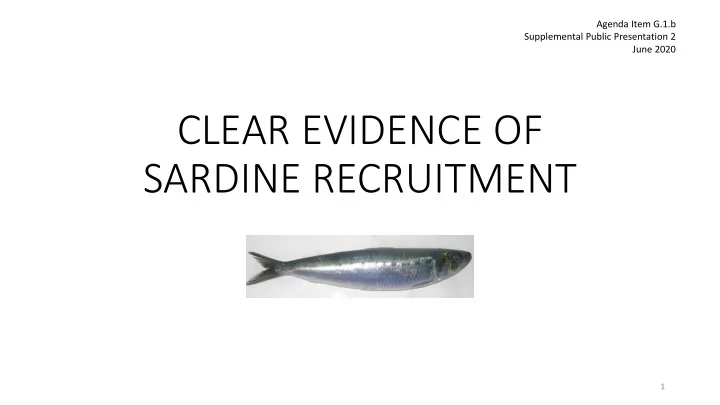
CLEAR EVIDENCE OF SARDINE RECRUITMENT
1
Agenda Item G.1.b Supplemental Public Presentation 2 June 2020
CLEAR EVIDENCE OF SARDINE RECRUITMENT 1 RANG NGE O OF FISH S - - PowerPoint PPT Presentation
Agenda Item G.1.b Supplemental Public Presentation 2 June 2020 CLEAR EVIDENCE OF SARDINE RECRUITMENT 1 RANG NGE O OF FISH S SIZES FOUN UND I IN N SARDINE C CATCH JUNE 8 8, 2020 020 2 JUNE 8 8 202 020 S 0 SARDINE L LANDING F G
1
Agenda Item G.1.b Supplemental Public Presentation 2 June 2020
RANG NGE O OF FISH S SIZES FOUN UND I IN N SARDINE C CATCH JUNE 8 8, 2020 020
2
JUNE 8 8 202 020 S 0 SARDINE L LANDING F G FURTH THER DE R DETAILS
(std dev 11gms) Avg 21cms (std dev 0.7cms)
previous photo
20gms
3
RANG NGE O OF FISH S SIZES FOUN UND I IN N SARDINE C CATCH JUNE 5 5, 2020 020
4
JUNE 5 5 202 020 S 0 SARDINE L LANDING F G FURTH THER DE R DETAILS
June 5 ’20
described as follows: Avg 72gms (std dev 16gms) Avg 20.5cms (std dev 1.1cms)
5
RANGE GE OF F OF FISH S SIZES F FOUND I IN SARDINE C CATCH JUNE 1 E 10-11, 2 2020
6
JUNE UNE 1 10-11 2 2020 S SARDINE LANDING F FUR URTHE HER D DETAI AILS
June 10-11 ’20
described as follows: Avg 58gms (std dev 20gms) Avg 19.1cms (std dev 2.0cms)
UNDER 30 GMS 2.74% 30-40GMS 13.11% 40-50GMS 7.21% 50-60GMS 14.58% 60-70GMS 7.43% 70-80GMS 34.38% 80-90GMS 18.80% 90-120GMS 1.76%
7
MIXED XED A AGE C CLASS LANDINGS ARE A E A COMMON ON T THI HING I IN THE S E SHA HALLOW INSHORE W WATER ERS W WHER ERE OUR B R BOATS FISH
sardine and anchovy fishing and studying the catches we have processed, that mixed age class landings are very common in the inshore waters where we fish.
made in coastal waters of Ventura and Santa Barbara counties – and offshore at the Channel Islands
larger / older fish migrate into the shallower waters where our boats were fishing and mix with the juvenile fish for a time, then migrate away, once again leaving primarily juvenile fish.
whether you will find that evidence, OR NOT)!!
assessments.
8
WEIGH GHT V VS LENG NGTH
9
WEIGH GHT V VS LENG NGTH
10
WEIGH GHT V VS LENG NGTH
11
WEIGH GHT V VS LENG NGTH
12
WEIGH GHT V VS LENG NGTH
13
IMPORTANCE O E OF A ALWAYS HA HAVING A AT LEAST A SMALL D DIRECTED FISHERY Y AND ND W WORKING W WITH I IND NDUS USTRY T Y TO ADVAN ANCE T THE HE S SCIENC NCE
IT IS A KNOWN THAT SARDINE AND ANCHOVY BIOMASSES VARY MOSTLY WITH ENVIRONMENTAL CONDITIONS AND ARE IN CYCLICAL IN NATURE
14
IMPORTANCE O E OF A ALWAYS HA HAVING A AT LEAST A SMALL D DIRECTED FISHERY Y AND ND W WORKING W WITH I IND NDUS USTRY T Y TO ADVAN ANCE T THE HE S SCIENC NCE
directed fishery we are participating in now will yield valuable scientific data to better inform stock assessments for the future
restrictions than ‘status quo’ management, so this EFP fishery can continue providing data to improve future stock assessments. QUESTIONS?
15