Making, Selling, Wintering Nucs Benjamin Cornect Making Nucs What - - PowerPoint PPT Presentation

making selling wintering nucs
SMART_READER_LITE
LIVE PREVIEW

Making, Selling, Wintering Nucs Benjamin Cornect Making Nucs What - - PowerPoint PPT Presentation

Making, Selling, Wintering Nucs Benjamin Cornect Making Nucs What is a Nuc? Why I sell so many Nucs. How do you make them? What is a Nuc? Nucleus Colony 4 frames of bees (both sides) 2 full frames of brood 1 frame feed 1


slide-1
SLIDE 1

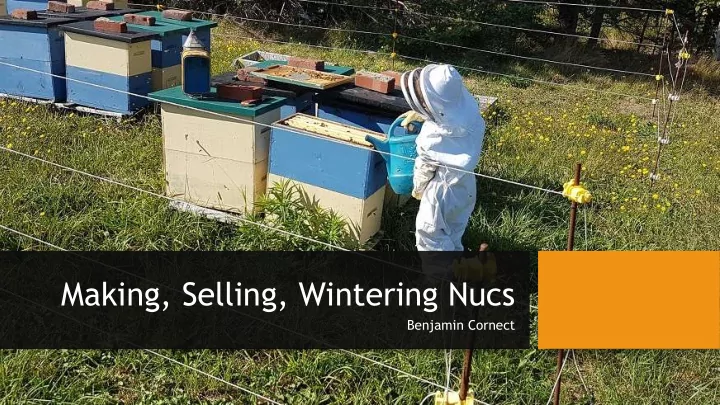
Making, Selling, Wintering Nucs

Benjamin Cornect
slide-2
SLIDE 2

Making Nucs

What is a Nuc? Why I sell so many Nucs. How do you make them?

slide-3
SLIDE 3

What is a Nuc?

Nucleus Colony

  • 4 frames of bees (both sides)
  • 2 full frames of brood
  • 1 frame feed
  • 1 mixed frame larvae, pollen,
  • pen space for queen to lay
  • New mated queen
slide-4
SLIDE 4
  • Minimum 2 full capped frames brood, no

eggs from donor/parent hive

  • Each frame covered completely both

sides with capped brood

  • 1 frame equals 2 frames of bees when

they emerge

  • Must have enough bees covering all 4

frames to keep brood warm and support colony as it grows

  • Placed in centre of nuc for protection

Brood and Bees

slide-5
SLIDE 5

Feed, Pollen & Open Space

  • 1 frame capped/cured feed and 1

frame mixed pollen/larvae-capped brood/open space

  • Feed equals Bees
  • Provides feed for both bees and

brood, prevents limiting of nuc growth by the bees

  • Food source until nucs are sold

and in-case of poor foraging weather in May

  • Ease of queen checking, limited

area to start laying

slide-6
SLIDE 6

Mated queen

  • Newly mated queen from current year (import)
  • Saskatraz Hybrid
  • Purebred Buckfast
  • Alternative options
  • Kona
  • California
  • Chilean
  • Australian
  • New Zealand
  • Local
  • Not possible to raise local queens for May
  • Would have to use stock overwintered from previous year
slide-7
SLIDE 7
  • Additional revenue stream
  • Offsets cost of queens for operation
  • Sell 25 Nucs, pay for 100 queens
  • Pays for Spring feed, pollen & meds
  • Complementary product to hive

equipment sales

  • One stop shop for bees and equipment
  • Brood comb replacement
  • 20-25% replacement per Nuc made
  • Paid swarm control prior to pollination
  • Limit Hive numbers

Why do I sell Nucs?

slide-8
SLIDE 8

Free Queens

$185 4 Frame Nuc Sale $42 Nuc Queen $143: 4 New Replacement Frames, Cardboard Nuc Box, 3 Queens for me & Coffee money

slide-9
SLIDE 9

Brood Comb Replacement (Spring)

19 Brood Frames + 1 Frame Feeder 4 New Undrawn frames from making a Nuc + 1 Undrawn to replace Frame Feeder 25% Comb replaced in Spring

slide-10
SLIDE 10

Start Early.

Feed equals bees

  • Stimulate brood production as

early as possible; pollen sub, syrup

  • Spring Miticide
  • Centre clusters, alleviate honey

bound colonies

  • Build surplus bees

Grading Hives

  • Grade and mark hives end
  • f April for Nucs or Take-away

Splits

  • Saves time when queens arrive
  • All Nucs can be made in 1 or

2 days

Simplify the process

  • Have equipment ready to go to

make all Nucs in 1 or two days

  • Easier queen installs and checks
  • All Nucs ready for sale at same

time

  • Makes sales and inspections less
  • f a time sink
slide-11
SLIDE 11

Plan ahead.

  • Order a few extra queens for

do-overs

  • Book Inspections early
  • Book late April or early

May

  • Schedule for 9-10 days

after queens are due to land

  • Have multiple contact info for

customers and give them lots

  • f notice
  • Have a cancellation list
slide-12
SLIDE 12

Consolidation saves time and labour.

  • Large holding yards cut down on

time/labour needed to install, queen check and feed Nucs.

  • Easier to equalize if drifting occurs.
  • Easier to send customers/inspectors to

known address/civic # vs random fields in middle of nowhere.

  • Schedule pickups at same time.
slide-13
SLIDE 13

Installing Queens

  • Install Queen (no attendants)
  • Spritz bees and cage
  • Feed ½ gal. light syrup
  • Queen check 4 days later
  • Release if still in cage (not balling)
  • Recheck in 3-4 days
slide-14
SLIDE 14

Selling Nucs

Inspections, paperwork & requirements for selling out of province. Packing and shipping nucs. Mentoring, education and repeat customers.

slide-15
SLIDE 15
  • Required for all bees and or used hive equipment

to be sold (The Bee Industry Act)

  • Paperwork (sales within NS)
  • BK# of purchaser
  • Inspection certificate
  • No real strict limit on time between inspection

and sale

  • Paperwork (sales outside NS)
  • Signed document stating treatment Tracheal

mites past 8-10 months (Formic Acid)

  • Inspection certificate, sometime Jason gives

you stickers

  • Time limit between Inspection and sale (SHB)
  • Purchaser must advise their Prov. Inspector of

incoming bees

Inspections

slide-16
SLIDE 16

Inspections (cont.)

  • You don't have to be there for inspection.
  • If full production hives in yard they will inspect those too.
  • Remember to Post your BK #
  • Provincial Inspector;
  • Jason Sproule
  • Angela Gourd
  • Adam Wile
  • Brood Diseases
  • Major: AFB & EFB
  • Minor: Sac & Chalkbrood
  • Small Hive Bettle
  • Signs of Mite Infestation
  • Queen Status/checks
slide-17
SLIDE 17

CSI Truro

slide-18
SLIDE 18

Three ways to pack and ship Nucs.

Pine Wooden Nuc boxes ($$$$$)

  • Screen vent on top, mesh front

entrance

  • Easy transport, no transferring after

inspection

  • Higher cost transferred to Nuc price

Coates plywood Nuc boxes ($$$)

  • Small Front Entrance need additional

vents (overheating)

  • Time consuming to make
  • Plywood never flat, bowed sides
  • Re-usable for customer if painted

Waxed Cardboard ($)

  • Little to no protection from cold May

weather, soggy bottoms

  • Bees tend to chew escape hatches if

confined too long Corrugated Plastic Nuc Boxes ($$)

  • Little to no protection from cold, water

resistant

  • Poor ROI vs Waxed cardboard
slide-19
SLIDE 19

Point New Beekeepers in the right direction.

Workshops and classes

  • We put on a free day workshop for Nuc

customers each year to cover all the Basics

  • Paid Classes; Brant's Bees, Country

Fields, Modern Beekeeper Course Mentors

  • We continue to mentor any and all

beekeepers that call.

  • List posted on NSBA website of

experienced beekeepers and their area. Farm Tours & Literary Sources

  • Beekeeping Books
  • Websites ( Scientific Beekeeping –

Randy Oliver)

  • Bee Journals/Magazines
  • Avoid YouTube 90% of the time.
slide-20
SLIDE 20

Overwintering Nucs

Everyone Should Make Overwintered Nucs. How and When to Make Them. Winter Prepping, Spring Management.

slide-21
SLIDE 21

Why even more Nucs?

  • Winter Insurance
  • Make up potential losses
  • Expansion/Increase Hive numbers
  • Easier to Overwinter the full Production

Hives

  • Weaker Nucs can be used to requeen

production colonies early Spring

  • Additional Honey production
  • Brood Comb replacement
  • 50% in Overwintered Nuc
  • 20% in donor Hive
  • Swarm Control
  • Increased Nuc production each year
  • Less Splits more Nucs
slide-22
SLIDE 22
  • 5 over 5 configuration
  • 9 Frames + Frame feeder
  • Vertical Single
  • Cheap, low input costs
  • Queen, 3 gal. Syrup & 9 New Frames
  • Easier to Overwinter then full

Production Hives

  • Overwintered in 8-way pods
  • Higher survival (communal heat)
  • Extra Foragers for installed Queen
  • Extra Nurse Bees for Self-raised Queen

Overwintered Nucs

slide-23
SLIDE 23

Equipment

  • Needed to make each Nuc:
  • 2x 5 Frame nuc boxes
  • Nuc bottom, Inner and Outer Cover
  • 9 Undrawn Frames
  • 4 for donor/Production Hive
  • 5 for Overwintered Nuc
  • Frame Feeder
slide-24
SLIDE 24

Queen vs Queenless Overwintered Nucs

Installed Queen

  • Faster Growth
  • Low risk of wasting resources
  • Usually produces 5 frame

medium of honey

  • Require less feed and

management

  • Usually self-sufficient by end
  • f July
  • Select Genetics vs Mut Queens

Raise their own Queen

  • Brood break till queen is

raised, OA Vapor chance

  • Higher risk of wasting

resources, failed/improper mating

  • Requires more feed to build up

winter stores and push bees through August dearth

  • Requires more management
  • Savings on queen purchase
  • utweighed by feed costs
slide-25
SLIDE 25

Regular vs Tear Down Nucs

Regular Overwintered Nucs

  • Surplus brood taken from full

Production Hives in July

  • Unlimited Broodchamber: resources

taken from Third Deep

  • Swarm Prevention
  • Harvest Swarm Cells for Queenless

Nucs

  • Inspect/Queencheck only Frames I

take (highly optional) Tear Down Nucs

  • Weak Hives early Spring dropped down

to singles to be broken into Nucs in July

  • Eliminate poor Genetics from

Operation, sacrificing honey for bees

  • Swarmed Hives or Hopeless Hives

broken down into resources

  • Kill old Queen or run her as her own

Nuc

slide-26
SLIDE 26
  • 7th to 14th July for mated queens
  • Make same as Spring Nuc but with

extra Foragers

  • Middle to late June if raising their own

queens

  • Make with extra capped brood and

Nurse Bees

  • At least one frame side with fresh

eggs

Timing

slide-27
SLIDE 27

Initial Management

  • Fed when queen installed, again

when queen checked and when top supered

  • Top supered week to 10 days after

queen installed

  • Top supered with undrawn

comb

  • Used to slow growth/

swarming pressure

  • Equalize weaker Nucs within yard

usually 4-5 weeks after being made

  • Swap positions to boost forager

populations

slide-28
SLIDE 28

Late Summer Management

  • Medium 5 frame Honey Super to

keep brood nest open

  • Low swarming tendencies
  • Use more Undrawn Comb to slow

prolific layers down

  • Try to keep Frame Feeder clear of

comb

  • Heft any Nucs without Honey

supers for feed.

slide-29
SLIDE 29

Fall Management

  • Pull Honey Supers of

Overwintered Nucs

  • Heft for final weight/last chance

to top up stores

  • Late September/Early October
  • Move Overwintered Nucs from

Out-yards to Production yards in 8- way pods

  • 8-16 Overwintered Nucs per

Production yard

  • Install Centre and top 1inch foam

insulation

slide-30
SLIDE 30

Winter is Coming

slide-31
SLIDE 31

Materials

  • Blue Hardwood Pallet (any solid

pallet really)

  • Common Cover for 8-way pod
  • Approx. 1 & ½ Sheets 1in Trufoam

(30$)

  • Nuc entrance reducers
  • Black Stretch Film
slide-32
SLIDE 32

Advantages of Double Nucs/8 Packs

  • Strongest Nucs in corners,

weaker Nucs in centre 4 spots

  • Larger shared surface area
  • Conserve energy, reduced

consumption of stores

  • Colonies form one large 8

colony cluster

  • Weaker colonies able to raise

more brood then normal

  • Higher Spring Turn-over
  • Re-using equipment from

Spring Nucs

slide-33
SLIDE 33

Winter Wrap

slide-34
SLIDE 34

Winter Wrap

slide-35
SLIDE 35

Spring Management

  • Leave Wrapped till early/mid-May, no

longer than that.

  • Weaker units (queen and handful of

bees) can be pulled and used to requeen production hives

  • At a slight disadvantage can only

work top box for inspections

  • Equalize feed between Nucs, some

will be honey-bound

  • Feed pollen and syrup same as

production Hives

  • Weekly syrup April into May/until

Dandelion flow

slide-36
SLIDE 36

Transferring to Double Deep

  • Early/Mid-May
  • Nucs will be 7-9 Frames Brood
  • 9 Frames + Feeder full of Bees
  • Require weekly feed till

established Dandelion flow

  • Move OW-Nucs; fill holes in yards or

set up new yard.

  • Full Nuc in Deep super set on top of

sorted Deep super (Heat rises, comb replacement)

  • Have to weaken before pollination

(partial Nuc from each – swarm prevention)

  • Reverse before pollination
slide-37
SLIDE 37

Thank You.