
SLIDE 1
Making Robots Learn
Pieter Abbeel -- UC Berkeley EECS
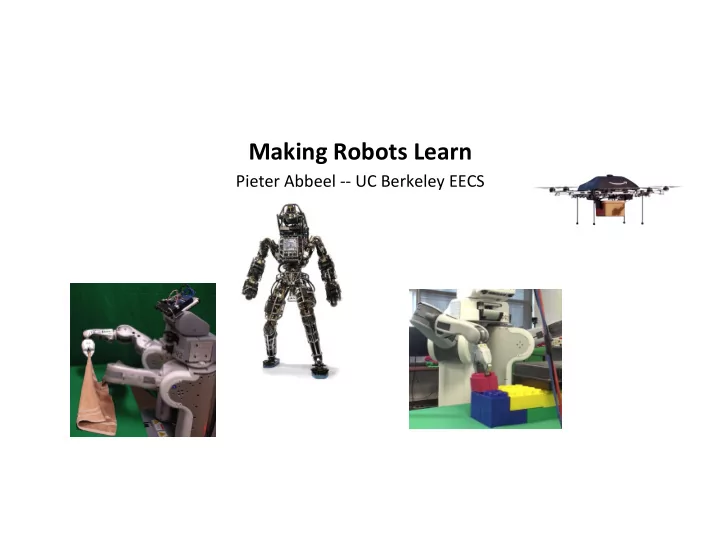
Making Robots Learn Pieter Abbeel -- UC Berkeley EECS Object - - PowerPoint PPT Presentation
Making Robots Learn Pieter Abbeel -- UC Berkeley EECS Object Detec9on in Computer Vision State-of-the-art object detec9on un9l 2012: n Support cat Hand-engineered Input Vector dog features (SIFT, Image Machine car HOG,
Pieter Abbeel -- UC Berkeley EECS
n
State-of-the-art object detec9on un9l 2012:
n
Deep Supervised Learning (Krizhevsky, Sutskever, Hinton 2012; also LeCun, Bengio, Ng, Darrell, …):
n ~1.2 million training images from ImageNet [Deng, Dong, Socher, Li, Li, Fei-Fei, 2009]
Input Image Hand-engineered features (SIFT, HOG, DAISY, …) Support Vector Machine (SVM) “cat” “dog” “car” … Input Image 8-layer neural network with 60 million parameters to learn “cat” “dog” “car” …
graph credit Matt Zeiler, Clarifai
graph credit Matt Zeiler, Clarifai
graph credit Matt Zeiler, Clarifai
AlexNet
graph credit Matt Zeiler, Clarifai
AlexNet
graph credit Matt Zeiler, Clarifai
AlexNet
graph credit Matt Zeiler, Clarifai
Is deep learning 3, 30, or 60 years old?
2000s Sparse, Probabilistic, and Energy models (Hinton, Bengio, LeCun, Ng)
Rosenblatt’s Perceptron
(Olshausen, 1996) based on history by K. Cho
n
Data
n
1.2M training examples
n
2048 (different crops)
n
90 (PCA re-colorings)
n
Compute power
n
Two NVIDIA GTX 580 GPUs
n
5-6 days of training 9me
n
Nonlinearity
Sigmoid à ReLU
n
Regulariza9on
n Drop-out
n
Explora9on of model structure
n
Op9miza9on know-how
n
State-of-the-art object detec9on un9l 2012:
n
Deep Supervised Learning (Krizhevsky, Sutskever, Hinton 2012; also LeCun, Bengio, Ng, Darrell, …):
n ~1.2 million training images from ImageNet [Deng, Dong, Socher, Li, Li, Fei-Fei, 2009]
Input Image Hand-engineered features (SIFT, HOG, DAISY, …) Support Vector Machine (SVM) “cat” “dog” “car” … Input Image 8-layer neural network with 60 million parameters to learn “cat” “dog” “car” …
n
Current state-of-the-art robo5cs
n
Deep reinforcement learning
Percepts Hand- engineered state- estimation Many-layer neural network with many parameters to learn Hand- engineered control policy class Hand-tuned (or learned) 10’ish free parameters Motor commands Percepts Motor commands
n
Goal:
θ
H
t=0
probability of taking ac9on a in state s Robot + Environment
πθ(a|s)
Pong Enduro Beamrider Q*bert
[Source: Mnih et al., Nature 2015 (DeepMind) ]
32 8x8 filters with stride 4 + ReLU 64 4x4 filters with stride 2 + ReLU 64 3x3 filters with stride 1 + ReLU fully connected 512 units + ReLU fully connected output units, one per ac9on
[ Source: Mnih et al., Nature 2015 (DeepMind) ]
n
Approach:
n
Q-learning with e-greedy and deep network as func9on approximator
n
Key idea 1: stabilizing Q-learning
n
Mini-batches of size 32 (vs. single sample updates)
n
Q-values used to compute temporal difference only updated every 10,000 updates
n
Key idea 2: lots of data / compute
n
trained for a total of 50 million frames (=38 days of game experience) and use a replay memory of one million most recent frames
Joint angles and kinematics Control Standard deviations Fully connected layer 30 units Input layer Mean parameters Sampling
Neural network architecture: Input: joint angles and veloci9es Output: joint torques Robot models in physics simulator (MuJoCo, from Emo Todorov)
n How to score every possible ac9on? n How to ensure monotonic progress?
n
Oqen simpler to represent good policies than good value func9ons
n
True objec9ve of expected cost is op9mized (vs. a surrogate like Bellman error)
n
Exis9ng work: (natural) policy gradients
n Challenges: good, large step direc9ons
θ
H
t=0
n Trust Region:
n Sampled evalua9on of gradient n Gradient only locally a good approxima9on n Change in policy changes state-ac9on visita9on frequencies
θ
H
t=0
[Schulman, Levine, Moritz, Jordan, Abbeel, 2015]
[Schulman, Levine, A.]
n
Deep Q-Network (DQN) [Mnih et al, 2013/2015]
n
Dagger with Monte Carlo Tree Search [Xiao-Xiao et al, 2014]
n
Trust Region Policy Op9miza9on [Schulman, Levine, Moritz, Jordan, Abbeel, 2015]
Pong Enduro Beamrider Q*bert
n
Generalized Advantage Es9ma9on
n Exponen9al interpola9on between actor-cri9c and Monte Carlo es9mates n Trust region approach to (high-dimensional) value func9on es9ma9on
θ
H
t=0
[Schulman, Moritz, Levine, Jordan, Abbeel, 2015]
Objec9ve: Gradient: single sample es9mate of advantage
H
t=0
k=t
[Schulman, Moritz, Levine, Jordan, Abbeel, 2015]
Supervised learning
trajectory op9miza9on
general-purpose neural network controller
[Levine & Abbeel, NIPS 2014]
[Levine*, Finn*, Darrell, Abbeel, 2015, TR at: rll.berkeley.edu/deeplearningrobo9cs]
[Levine*, Finn*, Darrell, Abbeel, 2015, TR at: rll.berkeley.edu/deeplearningrobo9cs]
end-to-end training pose predic9on
pose features
coat hanger success rate pose predic9on 55.6% pose features 88.9% end-to-end training 100% shape sor9ng cube success rate pose predic9on 0% pose features 70.4% end-to-end training 96.3% toy claw hammer success rate pose predic9on 8.9% pose features 62.2% end-to-end training 91.1% bowle cap success rate pose predic9on n/a pose features 55.6% end-to-end training 88.9% Meeussen et al. (Willow Garage)
2 cm
Provide image that defines goal Train controller in visual feature space
[Finn, Tan, Duan, Darrell, Levine, Abbeel, 2015]
[Finn, Tan, Duan, Darrell, Levine, Abbeel, 2015]
[Finn, Tan, Duan, Darrell, Levine, Abbeel, 2015]
n
Vision-based flight
n
Locomo9on
n
Manipula9on
n
Natural language interac9on
n
Dialogue
n
Program analysis
n
Shared and transfer learning
n
Explora9on
n
Tools / Experimenta9on
n Stochas9c computa9on graphs n Computa9on graph toolkit (CGT)
n
Memory
n Es9ma9on n Temporal hierarchy / goal
seyng