
SLIDE 1
1
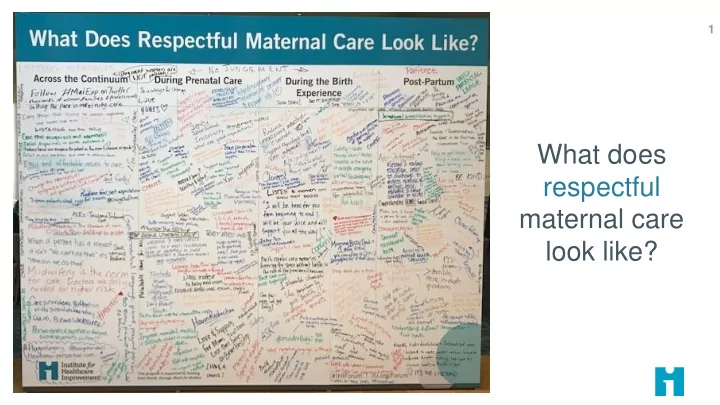
What does respectful maternal care look like? Better Maternal - - PowerPoint PPT Presentation
1 What does respectful maternal care look like? Better Maternal Outcomes: IHI Rapid Improvement Network Informational Call WebEx Quick Reference 3 Please use chat to All Participants for discussion & questions Raise your
1
Informational Call
3
Enter Text Select Chat recipient Raise your hand
4
5
Please send your message to All Participants
6
Jill Duncan, RN, MS, MPH
Executive Director, IHI
Deborah Bamel, MPH
Senior Project Manager
Christina Gunther-Murphy, MBA
Improvement Advisor, IHI
7
8
Where are you joining from today?
9
10
Support national efforts to implement reliable evidence- based care for women and newborns around the time of birth, leading to a reduction in maternal mortality in the United States (US) in 2021 compared to 2016.
Facilitate locally driven, co-designed, rapid improvements in 2-5 communities targeting the interface of health care delivery, the experience of birthers, and community support
test and scale up maternal care supports and to create a learning network to test and learn across participating communities aimed at improving equity, dignity, and safety while reducing racial inequities in maternal outcomes.
Jodi Abbott, MD, MHCM Amy Bell, DNP, RNC- OB, NEA-BC, CPHQ Debra Bingham, DrPH, RN, FAAN Tara E. Bristol, MA Andria Cornell, MSPH Joia Crear-Perry, MD Kate Hilton, JD, MTS Rick Foster, MD Daisy Goodman, APRN, DNP, MPH Victoria Green, MD, MHSA, JD, MBA Deborah Kilday, RN, MSN Kevin Little, PhD Monica McLemore, PhD, MPH, RN Audra R. Meadows, MD, MPH Patricia A. McGaffigan, RN, MS, CPPS Neel Shah, MD, MPP, FACOG Joseph Thompson, MD, MPH
Support national efforts to implement reliable evidence- based care for women and newborns around the time of birth, leading to a reduction in maternal mortality in the United States (US) in 2021 compared to 2016.
The Better Maternal Outcome Rapid Improvement Network is a free initiative aimed at connecting hospitals and providers from across the country who are committed to improving health
respectful care of women and their babies. The goal of the Network is to equip participants with the knowledge and skills needed to reliably implement promising practices and improve care delivery for all women and newborns.
issues,
navigating similar work,
providers, hospitals, and delivery centers,
and build local improvement skills to bridge the gap between “what we know” and “what we do”, and,
from IHI.
D R I V I N G L O C A L C H A N G E
23
Quality Improvement science & methods AIM bundle implementation strategies Emerging evidence & promising practices Respectful care Racism & implicit bias Designing for dignity in care Psychology of change Leadership Data & Measures Cohort coaching Peer-to-peer networking Expert faculty
D R I V I N G L O C A L C H A N G E
24
Quality Improvement science & methods AIM bundle implementation strategies Emerging evidence & promising practices Respectful care Racism & implicit bias Designing for dignity in care Psychology of change Leadership Data & Measures Cohort coaching Peer-to-peer networking Expert faculty
D R I V I N G L O C A L C H A N G E
improvement-oriented efforts,
health and equitable, respectful maternal care,
segmenting data by race/ethnicity (where possible),
experience for future waves.
D R I V I N G L O C A L C H A N G E
D R I V I N G L O C A L C H A N G E
Debra Bingham, DrPH, RN, FAAN
Founder and Executive Director, Institute for Perinatal Quality Improvement (PQI)
Audra R. Meadows, MD, MPH
OB/GYN, Brigham and Women's Hospital Leadership, Perinatal-Neonatal Quality Improvement Network of Massachusetts (PNQIN)
Christina Gunther-Murphy, MBA
Improvement Advisor, IHI
Jill Duncan, RN, MS, MPH
Executive Director, IHI
28
Jill Duncan, RN, MS, MPH Executive Director Christina Gunther-Murphy, MBA Improvement Advisor Trissa Torres, MD, MSPH, FACPM
Chief Operations & North America Programs Officer
Cami Clifford, Project Assistant Quin Bottom-Johnson, Project Coordinator Dorian Burks, Project Manager Marian Bihrle Johnson, MPH Director Lauren Magoun, MPH Director Deborah Bamel, MPH Senior Project Manager Haley Ladd, Project Coordinator
http://www.ihi.org/maternalhealth
Targeting health care delivery centers and networks with >1000 deliveries/year