1
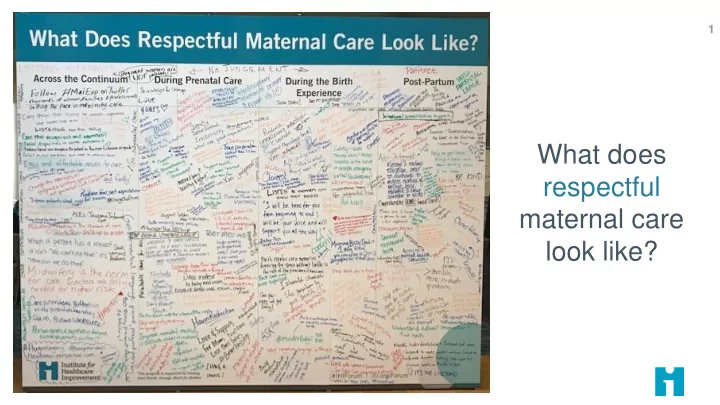
What does respectful maternal care look like? Better Maternal - - PowerPoint PPT Presentation
1 What does respectful maternal care look like? Better Maternal Outcomes: IHI Rapid Improvement Network Informational Call for Wave 2 August 6, 2019 WebEx Quick Reference 3 Please use chat to All Participants for discussion
Better Maternal Outcomes: IHI Rapid Improvement Network
Informational Call for Wave 2 August 6, 2019
WebEx Quick Reference
3
- Please use chat to “All
Participants” for discussion & questions
- For technology issues only,
please chat to “Host”
Enter Text Select Chat recipient Raise your hand
Microphone Feature
To mute your line, please press the microphone icon Press it again to unmute.
4
Able to speak Muted
Where are you today?
6
Please type your name and the organization you represent (or most closely align yourself with) in the chat box Example: Mara Lee, Midwest Health
Please send your message to All Participants
Today’s Hosts
7
Kelly McCutcheon Adams, LICSW
Senior Director, IHI
Deborah Bamel, MPH
Senior Project Manager
Haley Ladd
Project Coordinator
- Welcome & Introductions
- Background: IHI Better Maternal Outcomes Initiative
- Better Maternal Outcomes: Rapid Improvement Network
– What we are trying to achieve – An invitation to join – What participants can expect – How we will work together
- Questions and Next Steps
8
Today’s Agenda
9
When you think about the care of women and babies in your community, what keeps you up at night?
Merck for Mothers has an ambitious 10-year goal to end preventable maternal deaths worldwide. The Institute for Healthcare Improvement (IHI) has an aligned mission to improve health and health care worldwide and a deep commitment to improving maternal health and equity.
Network Relationships
- IHI would like to thank our partner, the American Hospital Association
(AHA), for their leadership and support of the IHI Better Maternal Outcomes Rapid Improvement Network initiative. Learn more about AHA’s work in maternal health at https://www.aha.org/better-health-for- mothers-and-babies
- IHI is working closely with the Alliance for Innovation in Maternal
Health (AIM) program to actively communicate regarding both efforts for the purpose of better meeting the needs of states, hospitals, and health care professionals in service of improvement maternal and infant outcomes. Learn more about the AIM program at www.safehealthcareforeverywoman.org
13
The First “Law” of Improvement
“Every system is perfectly designed to get the results it gets”
Paul Batalden, MD
We must change the system to expect different results.
Rapid Improvement Network Support national efforts to implement reliable evidence-based care for women and newborns around the time of birth, leading to a reduction in maternal mortality in the United States (US) in 2021 compared to 2016.
Better Maternal Outcomes Initiative Overview
Redesigning Systems with Black Women Facilitate locally driven, co-designed, rapid improvements in 2-5 communities targeting the interface of health care delivery, the experience of birthers, and community support systems. The goal of these projects is to test and scale up maternal care supports and create a learning network across participating communities aimed at improving equity, dignity, and safety while reducing racial inequities in maternal outcomes.
Advisory Network
Jodi Abbott, MD, MHCM Amy Bell, DNP, RNC- OB, NEA-BC, CPHQ Debra Bingham, DrPH, RN, FAAN Tara E. Bristol, MA Andria Cornell, MSPH Joia Crear-Perry, MD Kate Hilton, JD, MTS Rick Foster, MD Daisy Goodman, APRN, DNP, MPH Victoria Green, MD, MHSA, JD, MBA Deborah Kilday, RN, MSN Kevin Little, PhD Monica McLemore, PhD, MPH, RN Audra R. Meadows, MD, MPH Patricia A. McGaffigan, RN, MS, CPPS Neel Shah, MD, MPP, FACOG Joseph Thompson, MD, MPH
Rapid Improvement Network
The Better Maternal Outcomes: Rapid Improvement Network is a free initiative aimed at connecting hospitals and providers from across the country who are committed to improving health
- utcomes by delivering safe, equitable,
respectful care of women and their babies. The goal of the Network is to equip participants with the knowledge and skills needed to reliably implement promising practices and improve care delivery for all women and newborns.
Please join us!
Engagement in the Network will build on IHI's experience in improvement; connecting like- minded frontline providers around the tactics required to make changes work, support in prioritizing where to work based on local data and
- ffering learning experiences
focused on practical ways
- rganizations are putting
improvements into practice.
As a participant in the Rapid Improvement Network you will receive support aimed at driving testing, adoption, and improvement in your local settings.
What you can expect (IHI’s commitments)
- Bimonthly webinars on critical quality improvement and maternal
safety topics
- Drop-in virtual coaching sessions with expert faculty from the field
- Connections to other providers, organizations, and communities
navigating similar work
- Real-world examples and case studies from a diverse set of
providers, hospitals, and delivery centers
- Roadmaps and tools customized to support implementation of best
practices and build local improvement skills to bridge the gap between “what we know” and “what we do”
- Access to selected online quality improvement tools and courses
from IHI
D R I V I N G L O C A L C H A N G E
Working together (your commitment)
- Engage a cross-disciplinary team in the virtual shared learning and
improvement-oriented efforts
- Secure support from physician and nursing leadership for participation
- Collaborate with women who represent those you serve and commit to
working towards equitable outcomes for all women
- Identify at least one 1 improvement goal related to improving maternal
health and equitable, respectful maternal care,
- Participate - at least 1 team member should attend each virtual
program
- Share your learning with the other participating teams
- Participate in mid and post-session surveys and interviews to improve
the experience for future waves
D R I V I N G L O C A L C H A N G E
21
Wave 2 Call Schedule
Virtual programming will be on Tuesdays from 1:00-2:00 PM ET *Additional special interest webinars will be offered monthly
Call Type Date
Content Call 1 October 8th Content Call 2 October 22nd Optional Coaching November 5th Content Call 3 November 19th Content Call 4 December 3rd Optional Coaching December 17th Content Call 5 January 7th Content Call 6 January 21st Optional Coaching February 4th Content Call 7 February 18th Content Call 8 March 10th
Content and Coaching Call Topics
22
Content and coaching calls will focus on best practices for improving outcomes in clinical areas including:
Hemorrhage Severe Hypertension Reduction of Primary C-sections VTE (Venus Thromboembolism) Substance Use Disorders Reducing Inequities in care and outcomes
Content and coaching calls will highlight core quality improvement topics, including:
Developing project aims Testing changes using PDSA (plan-do- study-act) cycles Measurement and data Teamwork and communication Reliability and sustainability
FAQ’s
- How much does it cost to join?
- How do I enroll myself or my team?
- Who are the program faculty?
- What kind of coaching can I expect?
- What data do I need to commit to sharing?
- How is this related to the work I do in my (state)
Perinatal Quality Collaborative?
http://www.ihi.org/maternalhealth
FAQ’s
- How much does it cost to join?
- How do I enroll myself or my team?
- Who are the program faculty?
- What kind of coaching can I expect?
- What data do I need to commit to sharing?
- How is this related to the work I do in my (state)
Perinatal Quality Collaborative?
http://www.ihi.org/maternalhealth
Targeting Community and Safety-Net Hospitals
FAQ’s
- How much does it cost to join?
- How do I enroll myself or my team?
- Who are the program faculty?
- What kind of coaching can I expect?
- What data do I need to commit to sharing?
- How is this related to the work I do in my (state)
Perinatal Quality Collaborative?
Wave 2: Core Faculty
Debra Bingham, DrPH, RN, FAAN
Founder and Executive Director, Institute for Perinatal Quality Improvement (PQI)
Audra R. Meadows, MD, MPH
OB/GYN, Brigham and Women's Hospital Leadership, Perinatal-Neonatal Quality Improvement Network of Massachusetts (PNQIN)
FAQ’s
- How much does it cost to join?
- How do I enroll myself or my team?
- Who are the program faculty?
- What kind of coaching can I expect?
- What data do I need to commit to sharing?
- How is this related to the work I do in my (state)
Perinatal Quality Collaborative?
29
FAQ’s
- How much does it cost to join?
- How do I enroll myself or my team?
- Who are the program faculty?
- What kind of coaching can I expect?
- What data do I need to commit to sharing?
- How is this related to the work I do in my (state)
Perinatal Quality Collaborative?
31
FAQ’s
- How much does it cost to join?
- How do I enroll myself or my team?
- Who are the program faculty?
- What kind of coaching can I expect?
- What data do I need to commit to sharing?
- How is this related to the work I do in my (state)
Perinatal Quality Collaborative?
33
Please join us! To enroll: www.ihi.org/maternalhealth Questions: maternalhealth@ihi.org
Upcoming Program
- Learn more about IHI’s Better Maternal Outcomes
Initiative on an upcoming session of WIHI (IHI’s free audio program):
- Black Women and Maternal Care: Redesigning
for Safety, Dignity, and Respect
- Thursday August 8th at 2 pm ET
- To Enroll, go to:
http://www.ihi.org/education/AudioVideo/WIHI
35