
SLIDE 1
MAKING RESEARCH MATTER
democratizing science & other lofty goals
Michigan Tech Research Forum • October 13, 2016 RichelleWinkler, Associate Professor of Sociology & Demography, Dept of Social Sciences
MAKING RESEARCH MATTER democratizing science & other lofty goals - - PowerPoint PPT Presentation
MAKING RESEARCH MATTER democratizing science & other lofty goals Michigan Tech Research Forum October 13, 2016 RichelleWinkler, Associate Professor of Sociology & Demography, Dept of Social Sciences AGENDA 1. Democratic science 2.
Michigan Tech Research Forum • October 13, 2016 RichelleWinkler, Associate Professor of Sociology & Demography, Dept of Social Sciences
Gives voice Answers peoples’ questions/problems Engage with people Shared and accessible results
People ask the questions Skills and collaboration-empowers people Shared knowledge
Interdisciplinary/Transdisciplinary Share data
Data repositories Websites Research briefs Press Infographics
Choosing the research question Work with people to answer the question
Service to community: Campus-community partnerships Involve students as partners
Data repositories Websites Research briefs Press Infographics
Choosing the research question Work with people to answer the question
Service to community: Campus-community partnerships Involve students as partners
Funded by NIH- NICHD Over 185,000 maps created Over 5,000 data downloads
http://www.icpsr.umich.edu/icpsrweb/ Help with metadata and archiving
Open source? Demographic Research; Demography Researchgate- connect the world of science and make research open to all
http://w3001.apl.wisc.edu/b03_16 http://scholars.unh.edu/carsey/192/ - 500+ downloads
http://www.ssc.wisc.edu/cde/cdewp/home.php
Do press releases! UMC can help Self promotion or knowledge sharing?
Lighter bars represent seasonal resident rates, darker permanent.
ICPSR Websites Research briefs Press Infographics
Choosing the research question Work with people to answer the question
Service to community: Campus-community partnerships Involve students as partners
course-based students get free entry challenging to do a good job in one semester
MTU cares?
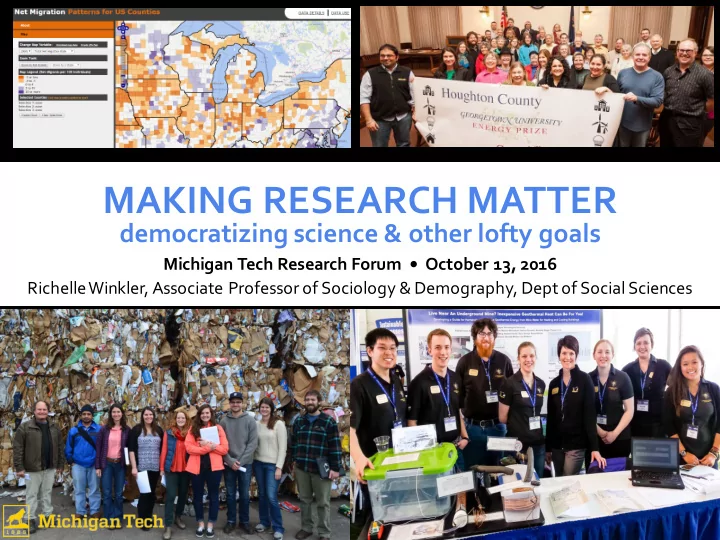
Curbside recycling Sustainability Director Houghton semifinalist in GUEP- reduced gas/electric consumption ~5% Journal article published in Sustainability EPA P3 Honorable mention award Most community engaged and likely to promote real sustainability KNHP exhibit on minewater geothermal Community Guide to MinewaterGeothermal book in development MS thesis (Edward Louie) I got tenure doing this stuff! Growing interest Fun, motivating
Wo Won the American Institute of Chemical Engineers’ Youth Council on Su Sustainable Sc Science and Technology Award for most interdisciplinary and co community engaged project ct with potential to improve lives and su sust stainability
Needed data! Were organized.
Hugh Gorman & Susan Burack
Data/cities/companies/cases Pulling together information It was the right time! Report on web Presentation @ library (press!) Presentation to MTU senate
Picture Source: Keweenaw National Historic Park
Photo by Edward Louie
Jay Meldrum & Chris Green, KRC David Geisler and Elmore Reese, Main Street Calumet Paul Lehto, Calumet Township Darryl Pierce and Mike Hale, CLK Schools Tom Tikkanen, Houghton County Board John Rosemurgy, KNHP Brian Taivalkoski, Calumet Electronics Lorri Oikarinen, Village of Calumet DDA Sam Lockwood and Kraig Marley, KGRG Laura Smyth, SmythtypeDesigns Kathleen Harter & Drew Cramer, KNHP Edward Louie, MS, env & energy policy Carrie Karvakko, MS, social science ed Amanda Kreuze, MS, env & energy policy EPA- People, Prosperity, and Planet Rahul Bose, undergrad mechanical engineering Gabriela Shirkey, undergrad science and tech comm Travis Wakeham, undergrad, biology Margaret Morrison, MS, env & energy policy Mayra Sanchez Gonzalez, PhD, env & energy policy Eric MacLeod, MS, geology Adrienne Masterton, MS, env engineering Melissa Michaelson, undergrad, anthropology Deanna Occhietti, undergrad, env engineering Nicolette Slagle, MS, env engineering science Theresa Tran, undergrad, science and tech comm David Anna, undergrad, mechanical engineering Krista Blumberg, undergrad, chemical engineering Andrew Garrod, undergrad, mechanical engineering Dana Savage, undergrad, chemical engineering Kayla Warsko, undergrad, chemical engineering
Photo by Edward Louie, of Red Jacket Shaft
https://www.google.com/maps/d/edit?hl=en&authuser=0& mid=1EE0kxJHNS-nIZoJ164wWJ2JEcp4
Shaft Building Distance (FT) Calumet 1 Township Office Building 106 CLK Schools 210 Mishawaubik Club 250 National Park Warehouse 280 Colloseum 330 National Park Headquarters 400 National Park Visitor Center 750 Calumet 3 CLK School 80 Michigan House Cafe 1,530 Calumet 5 Golden Horizon Apartments 50 GardenView Assisted Living 215 Hecla 1 National Park Library 30 Calumet Electronics -Business center 95 Barbara Kettle Gundlach Shelter 165 National Park Warehouse 205 National Park Visitor Center 1,000 Hecla 2 Calumet Fire Department 175 Calumet Electronics-Roundhouse 310 Osceola 15 Aspirus Keweenaw Hospital 1,250 V ertin Gallery 1,850 Red Jacket Shaft REL Building 230
Natural: Renewable energy source, reduce dependence on fossil fuels and carbon dioxide emissions. Turns a negative into a positive. Cultural: Reinforces community identity and celebrates cultural connections to mining. People feel the community owns the water and the legacy. Much interest. Human: Some opportunity for training and cultivating interest and skills in renewable energy systems. Political: Would require political will and coordination between several political entities: Village, Township, NPS, School District, etc. Concerns about who benefits/who pays/who controls. Social: Could reinforce and build social relationships and connections b/t organizations. Financial: How to finance initial costs? Not currently favorable economically in comparison to natural gas. Built: New infrastructure that would need to be maintained; questions about who benefits and who pays.
It makes research matter! (relevance & impact) Community demand Experiential learning enriches students’ learning & prepares for civic life Super rewarding Can drive other research questions Sometimes you really can facilitate positive change Makes MTU look good- brings value to the region Increase diversity/attract female and minority scholars Legitimizes the academy & broadens financial support University Learning Goal If we don’t do it, someone else (with interests) will!
Don Lafreniere & Sarah Scarlett-Keweenaw Time Traveler Sarah Green- Skeptical Science website-http://www.skepticalscience.com/ Joshua Pearce-Open Sustainability Technology lab Carol MacLennan & Noel Urban- Torch Lake projects Lorelle Meadows & the Honors College crew Susan Amato-Henderson- service learning