Making LID the preferred and commonly-used approach to site - - PowerPoint PPT Presentation

making lid the preferred and commonly used approach to
SMART_READER_LITE
LIVE PREVIEW

Making LID the preferred and commonly-used approach to site - - PowerPoint PPT Presentation

Making LID the preferred and commonly-used approach to site development February 3, 2016 City of Olympia | Capital o f Washing to n State An Overview of LID for Olympia 1. Olympias LID code revision process 2. What is being proposed for City


slide-1
SLIDE 1

Making LID the preferred and commonly-used approach to site development

City of Olympia | Capital o f Washing to n State
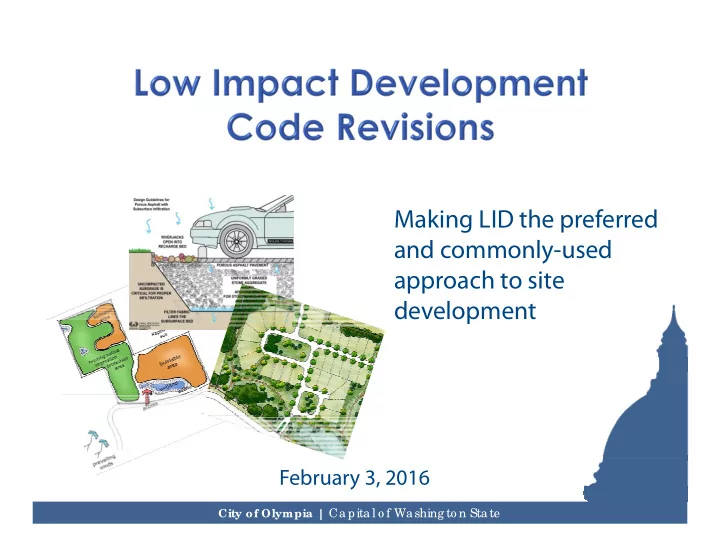
February 3, 2016

slide-2
SLIDE 2

An Overview of LID for Olympia

  • 1. Olympia’s LID code

revision process

  • 2. What is being

proposed for City

  • f Olympia
  • 3. Status of that

proposal

slide-3
SLIDE 3

Permeable Pavements Olympia’s LID Regulations

Municipal Code Titles 16 & 18 Engineering Design and Development Standards Drainage Design and Erosion Control Manual

slide-4
SLIDE 4

LID Best Management Practices

Preserve Native Vegetation/Soil Minimize Grading Compost‐Amended Soil Bioretention/Rain Gardens Permeable Pavements Minimal Excavation Foundation

slide-5
SLIDE 5

LID Experience

ORLA Yauger Park

slide-6
SLIDE 6

LID Challenges & Opportunities

slide-7
SLIDE 7

Elements Evaluated

Gr

  • up 1: R

educ ing Site Distur banc e

E le me nt 1: Minimize Site Disturbanc e E le me nt 2: Re tain and Plant Native Ve g e tatio n

Gr

  • up 2: Minimize Imper

vious Ar ea – Sites

E le me nt 3: Zo ning Bulk and Dime nsio nal Standards E le me nt 4: Re stric t Maximum I mpe rvio us Surfac e Co ve rag e E le me nt 5: Re duc e I mpe rvio us Surfac e Asso c iate d with On-site Parking

Gr

  • up 3: Minimize Imper

vious Ar ea – Str eet

E le me nt 6: Minimize Size o f Cul-de -Sac s E le me nt 7: Minimize Stre e t Width E le me nt 8: I nc re ase Blo c k Spac ing E le me nt 9: Re quire Side walks o n Only One Side

  • f Stre e t Whe re Appro priate

E le me nt 10: Minimize Drive way Surfac e

Gr

  • up 4: Inc r

eased Infiltr ation

E le me nt 11: Bio re te ntio n Stre e t Se c tio n E le me nt 12: Sto rmwate rUse o f L andsc aping E le me nt 13: Do wnspo ut I nfiltratio n Syste ms E le me nt 14: Pe rme able Paving E le me nt 15: I mpe rvio us Pave me nt with Unde rdrains

Gr

  • up 5: Pr
  • c edur

es, Pr

  • c ess and

Codes

E le me nt 16: De finitio ns E le me nt 17: Ado pt a Ne w Drainag e De sig n and E ro sio n Co ntro l Manual (DDE CM) E le me nt 18: L I D Site Asse ssme nt E le me nt 19: Pre and During Co nstruc tio n I nspe c tio ns E le me nt 20: Mainte nanc e Standards and I nspe c tio ns E le me nt 21: Varianc e s, De viatio ns and E xc e ptio ns

E lement 22: Gre e n Ro o fs, Rainwate r Re use ,

L I D F

  • undatio ns
slide-8
SLIDE 8
  • Joint Community Planning and Public Works staff team
  • Consultants retained by City
  • Technical Workgroup (architects, engineers, landscape architects,

bankers, foresters, etc.)

  • Interjurisdictional Workgroup
  • LID Symposium hosted by Northwest EcoBuilding Guild
  • Citizen Focus Group – selected by City staff
  • Utility Advisory Committee
  • Planning Commission
  • City Council

Permeable Pavements Review Participants

slide-9
SLIDE 9

LID Public Meetings 2014 and 2015

2014 2015 City Council Land Use & Environment Committee

  • Jan. 23, Nov. 20

June 23, Dec. 10 City Council June 3 Planning Commission

  • Aug. 18
  • Dec. 7

Utility Advisory Committee May 7, Sept. 3,

  • Oct. 1, Nov. 5,
  • Dec. 3
slide-10
SLIDE 10

Administrative Elements

Gr

  • up 5: Pr
  • c edur

es, Pr

  • c ess and Codes

E le me nt 16: De finitio ns E le me nt 17: Ado pt a Ne w Drainag e De sig n and E ro sio n Co ntro l Manual (DDE CM) E le me nt 18: L I D Site Asse ssme nt E le me nt 19: Pre and During Co nstruc tio n I nspe c tio ns E le me nt 20: Mainte nanc e Standards and I nspe c tio ns E le me nt 21: Varianc e s, De viatio ns and E xc e ptio ns

slide-11
SLIDE 11

Little or No Change Proposed

Gr

  • up 3: Minimize Imper

vious Ar ea – Str eet E le me nt 6: Minimize Size o f Cul-de -Sac s E le me nt 7: Minimize Stre e t Width E le me nt 8: I nc re ase Blo c k Spac ing E le me nt 9: Re quire Side walks o n One o r Bo th Side s

  • f Stre e t Whe re Appro priate

E le me nt 10: Minimize Drive way Surfac e Gr

  • up 4: Inc r

eased Infiltr ation E le me nt 13: Do wnspo ut I nfiltratio n Syste ms E le me nt 15: I mpe rvio us Pave me nt with Unde rdrains E lement 22: Gre e n Ro o fs, Rainwate r Re use , L I D F

  • undatio ns
slide-12
SLIDE 12

Substantive Elements

Gr

  • up 1: R

educ ing Site Distur banc e

E le me nt 1: Minimize Site Disturbanc e E le me nt 2: Re tain and Plant Native Ve g e tatio n

Gr

  • up 2: Minimize Imper

vious Ar ea – Sites

E le me nt 3: Zo ning Bulk and Dime nsio nal Standards E le me nt 4: Re stric t Maximum I mpe rvio us Surfac e Co ve rag e E le me nt 5: Re duc e I mpe rvio us Surfac e Asso c iate d with On-site Parking

Gr

  • up 4: Inc r

eased Infiltr ation

E le me nt 11: Bio re te ntio n Stre e t Se c tio n E le me nt 12: Sto rmwate r Use o f L andsc aping E le me nt 14: Pe rme able Paving

slide-13
SLIDE 13

Stormwater Regulations

 Flow control (50% of 2‐year storm)  Water quality treatment  Low Impact Development

 Compost‐amended soils  Roof downspout control (dispersion,

infiltration trenches

 Permeable pavements or bioretention for

  • ther “hard surfaces”

 PERFORMANCE ‐ Any combination of LID

BMPs demonstrated with hydrologic modeling to achieve a higher flow control standard (8% of 2‐year storm)

  • r rain gardens)
slide-14
SLIDE 14

LID Hydrologic Impacts

slide-15
SLIDE 15

Minimizing Site Disturbance

  • Require more info with development applications
  • Lower thresholds for requiring a grading permit

– 7,000 square feet of disturbance, 10 cubic yards of material

  • Limit ‘mass‐grading’ (50% of site, elevation changes no more

than 4 feet)

  • Further limit grading within 100 feet of property boundary
  • Limit grading near protected areas, e.g., tree tracts, critical

areas

slide-16
SLIDE 16

Reduce Development ‘Footprints’

  • Encourage cottage housing by allowing

50% private parking and 1600 square‐ foot 2‐story housing

  • Allow alternative housing forms in

‘planned residential developments’ if 65% soil/vegetation protected & 10% maximum impervious

  • Continue to allow 4,000 square foot lots, but only allow

reduced side yards for lots with alleys

  • Provide more flexibility in parking lot designs & reduce drive

aisle widths, but require appropriate landscaping, limit small spaces to 15%, and prohibit parking that backs onto arterials

  • Allow senior‐housing parking to be half of apartment standard
slide-17
SLIDE 17

Retain & Plant Native Vegetation

Note: Native vegetation includes both species that

  • ccur naturally and species well adapted to current

and anticipated environmental conditions.

  • Redefine tree tracts as ‘Soil and Vegetation

Protection Areas’ (SVPA’s)

  • Require SVPA’s in multi‐family projects
  • A minimum of 50% of required open space is

preserved as an SVPA

  • Adopt criteria for plants in SVPA’s, including

percentage of evergreen vs. deciduous trees

slide-18
SLIDE 18

Restrict Maximum Impervious Surface Coverage

  • In low‐density residential areas,

lower impervious surface to the building coverage limit (about 7/10 of City)

  • In medium‐density areas lower

impervious limit by 5 to 10% (about 1/10 of City)

  • Do not change other high‐density

areas (about 2/10 of City)

slide-19
SLIDE 19
  • Facilitate and encourage the use of permeable

pavements on private property (e.g., parking lots, sidewalks, driveways).

  • Continue to install permeable public sidewalks

as feasible throughout the City. Restrict use of permeable paving for streets.

  • Anticipate increased use of permeable

pavement in the future as the technology improves.

Permeable Pavements Permeable Pavements

slide-20
SLIDE 20
  • PW Transportation considers the use of permeable

pavements in public streets to be too great a risk at this

  • time. Therefore, to achieve the LID standard for streets,

bioretention swales will be installed instead.

  • Staff is developing street

sections that include bioretention swales within the landscaping strips or median.

Bioretention

slide-21
SLIDE 21
  • Construction inspections to monitor soil

compaction and sedimentation

  • Post‐construction inspections to verify

facilities are maintained and perform as designed (e.g. permeable pavement unclogged, bioretention draining).

  • Maintenance of bioretention swales will

be a challenge. The SSW Utility proposes to maintain bioretention swales within the right‐of‐way at a functional level of

  • service. A higher level of service for

aesthetics would be the property owner's

  • r HOA's discretion.

Inspection and Maintenance

Inspection & Maintenance

slide-22
SLIDE 22
  • Thresholds for requiring stormwater retrofits with redevelopment

and roadway projects.

  • More conservative methods of determining infiltration rates.
  • Required testing to verify infiltration facility performance.
  • “Enhanced” water quality treatment for commercial and multi-

family projects regardless of the proximity to surface waters.

  • Required “Agreement to Maintain Stormwater Facilities.”
  • Use of bioretention facilities to achieve LID in lieu of permeable

pavements for public streets.

  • Greater guidance for maintenance and pollution source control.

Drainage Design and Erosion Control Manual

slide-23
SLIDE 23

Olympia Planning Commission

  • January 4 & 25 – Briefings
  • February 1 ‐ Public Hearing
  • Public Comment Period: January 4 – February 12
  • February 22, March 7 and March 21 – Deliberations

City Council

  • Late Spring – Summer 2016
  • Revised codes and standards approximately 6 months

prior to Ecology deadline of December 31, 2016

Next Steps

slide-24
SLIDE 24

L ID Code R evisions

City of Olympia | Capital o f Washing to n State

Eric Christensen, Water Resources Engineering and Planning Manager, 570‐3741, echriste@ci.olympia.wa.us Laura Keehan, Water Resources Senior Planner, 753‐8321, lkeehan@ci.olympia.wa.us Nicole Floyd, Community Planning and Development Program Senior Planner, 570‐3768, nfloyd@ci.olympia.wa.us

  • lympiawa.gov/LIDcodes