- Prof. Dr. Konstantinos Chassapis
- Maria Exarchakou
- Dr. Maria Roulia
- Eva Kontezaki MSc.
NATIONAL AND KAPODISTRIAN UNIVERSITY OF ATHENS, DEPARTMENT OF CHEMISTRY, SECTION ΙΙΙ, INORGANIC, ENVIRONMETAL CHEMISTRY AND TECHNOLOGY HELLENIC REPUBLIC
Main Typical OMWW characteristics of composition by OMWW: - - PowerPoint PPT Presentation
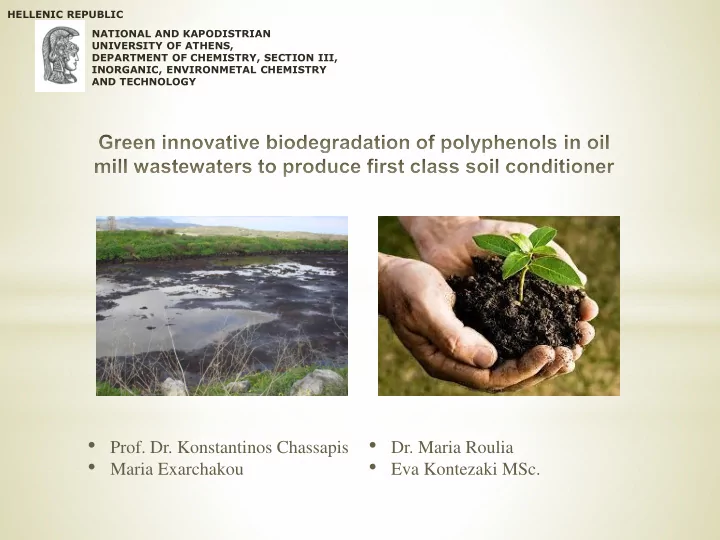
HELLENIC REPUBLIC NATIONAL AND KAPODISTRIAN UNIVERSITY OF ATHENS, DEPARTMENT OF CHEMISTRY, SECTION , INORGANIC, ENVIRONMETAL CHEMISTRY AND TECHNOLOGY Prof. Dr. Konstantinos Chassapis Dr. Maria Roulia Maria Exarchakou Eva
NATIONAL AND KAPODISTRIAN UNIVERSITY OF ATHENS, DEPARTMENT OF CHEMISTRY, SECTION ΙΙΙ, INORGANIC, ENVIRONMETAL CHEMISTRY AND TECHNOLOGY HELLENIC REPUBLIC
worldwide.
70% since 1987 2,861,500 tons for the 2009/2010 period 75% comes from Mediterranean Region Serious environmental problems : High amounts of by-products
3 – phase systems 2 – phase systems
high chemical
(COD) concentration (45–220 mg/L) low pH (4–5), high suspended solids concentration (up to 50 g/L)
water-soluble phenols and polyphenols
83–94% water, 4–16% organic compounds
polyalcohols, pectins, and lipids, nitrogenous compounds, organic acids, carotenoids, tannins 0.4–2.5% mineral salts
phosphates, potassium, calcium, iron, magnesium, sodium, copper.
infiltration rate
in soil microbial activity as well as contamination of surface- and groundwater.
systems
induction of anaerobic conditions
Need for large land area Time consuming process (8-12 months) Product is
expected due to dependence
parameters.
Integrated
wastes management Reduction of
pollutants End-product is a neutralised compost material
Olive mill waste waters from 3-phase mill They may be replaced by 2-phase mill wastes All plant materials that remains in
They may be replaced by other green residues. Biocatalyst
Mixture of OMWW and crushed plant residues, 50:50 Addition of biocatalyst Stacking of the composting mixture to piles Monitoring of physicochemical parameters Aeration of the mixture Wetting whenever moisture < 50% Biostabilization for 2 months
Parameter OMWW Initial mixture Soil conditioner (60 days) Moisture (%) 90.3 68.1 48.9 Electrical conductivity (mS/cm) 41 1.92 1.8 pH 5.48 5.7 7.3 Bulk density (g/ml) 0.98 0.33 0.4
Electrical conductivity for initial mixture and soil conditioner has measured in ratio 1:5 in water and pH in 1:10.
Parameter OMWW Initial mixture Soil conditioner (60 days) Ash (% w/w) 7.3 14.0 21.9 Organic matter (% w/w) 92.7 86.0 78.1 Total organic carbon (% w/w) 53.8 49.9 45.3 Total Kjeldahl nitrogen (% w/w) 1.7 1.3 1.3 C/N 31.6 38.4 34.8 Humic acids (% w/w) n.d 5.8 8.0 Total phenols mg/kg 374.3 80.3 32.3
Changes in some critical parameters during composting (dry weight basis) 91.4% reduction of polyphenols 10%
Parameter
Mean value of produced Soil Conditioner Soil Substrates /media (Optimum values) Soil Substrates of sowing /nurseries (Optimum values) Total organic content (TOC) % w/w 78,1
pH 7,3 5 – 7,5 5,5-7 Εlectrical conductivity (EC) (dS m-1) 1,8 ≤3.5 a ≤0,5a Total Ν % w/w 1.3 Cu (mg kg-1) 40 <500 b Zn (mg kg-1) 123 <1500 b Cd (μg kg-1) 0,20 <5 b Cr (μg kg-1) 0,10 <200 b Ni (μg kg-1) 28 <100 b Pb (mg kg-1) 0,05 <1000 b
Soil Medium for growing plants Produced OMW soil conditioner Optimum Soil Substrate EAW (vol %) + WBC (vol%) 49,8-60,0 55-65 AS (vol%) 15,6-30,8 20–30 TPS (vol%) 73,5-80, 7 85 Bulk density
440-500 400
EAW: easily available water, AS: air space, WBC: water buffering capacity and TPS: total pore space
Parameter Produced Soil Conditioner Compost from OMW Greek -1st Compost from OMW Greek-2nd water buffering capacity (%) Humic Acids (%) Εlectrical conductivity (dS / m) pH Organic Matter (%) Microrganisms (c.f.u. / g ) N % P (ppm) K (%) Zn (ppm) Cu (ppm) Ni (ppm) Cd (ppm) Pb (ppm) Cr (ppm) Hg Escherichia coli, Salmonella Spp. (Enterobacteriaceae) 147.8 8 1,7 7.3 78.1 23 .108 1.3 n.a. n.a. 123 40 28 0,18 0,05 0,1 Ø Ø 248,7 5,84 2,2 7,7 74,1 3,6 .108 1,0 445 0,7 49.7 26.7 n.a. n.a. n.a. n.a. n.a. n.a. n.a. n.a. 1,1 7,5 39 n.a. 1,4 48,7 0,32 20.1 6.9 n.a. n.a. n.a. n.a. n.a. n.a.
Used as a growth substrate 4 mixtures
a- 100 % v/v Perlite b- 50 % v/v Perlite : 50 % v/v OMW produced soil conditioner c- 66.66 % v/v Perlite : 33.33% v/v OMW produced soil conditioner d- 100 % v/v OMW produced soil conditioner
Germination rates
Units percentage %
substrate
٭University of Athens
Department of Biology, Plant Ecophysiology Laboratory
Preliminary experiments on lettuce, Lactuca sativa (Asteraceae) seedlings growth under the influence of the produced OMW soil conditioner, based on weight of Chlorophyll / plant tissue
Used as development substrate 4 mixtures
μg Chlorophyll / g fresh plant tissue
a- 100 % v/v Perlite b- 50 % v/v Perlite : 50 % v/v OMW produced soil conditioner c- 66.66 % v/v Perlite : 33.33% v/v OMW produced soil conditioner d- 100 % v/v OMW produced soil conditioner
growth /weight μg of underground part of the seedlings
Units percentage %
Time / days
During the planting seedlings on the line: 50 plants by adding 250g «produced soil conditioner" in the planting pit, 50 plants by adding 250g other compost from OMWW in planting pit 50 plants by adding 500g «produced soil conditioner" 50 plants by adding 500g other compost from OMWW in planting pit; 50 plants without any soil conditioner (control)
Usage in containers filling with roses, geranium, bougainvillea, jasmine as a supportive medium with red soil about 30%, in flower beds of herbaceous sensitive floriculture, palm trees, Benjamin, etc. to improve soil structure. The above was used instead of classical peat
Experiments performed in the farms of the Union of Agricultural Cooperatives