Phase Contrast Imaging vs. Conventional Radiology Refractive index: n - - PowerPoint PPT Presentation

phase contrast imaging vs conventional radiology
SMART_READER_LITE
LIVE PREVIEW

Phase Contrast Imaging vs. Conventional Radiology Refractive index: n - - PowerPoint PPT Presentation

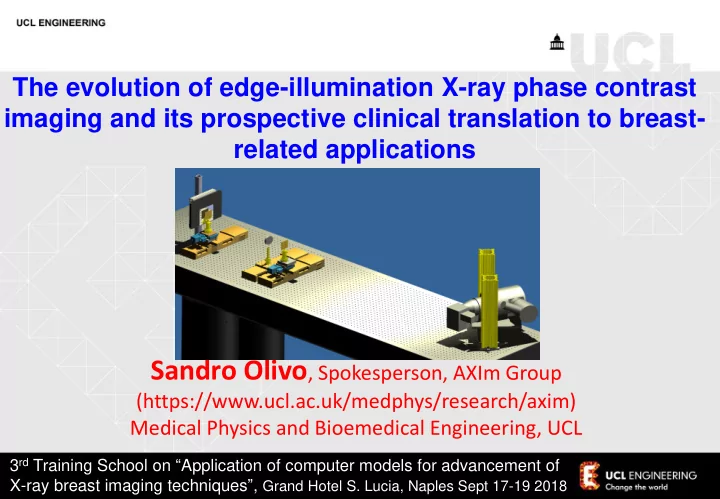
The evolution of edge-illumination X-ray phase contrast imaging and its prospective clinical translation to breast- related applications Sandro Olivo , Spokesperson, AXIm Group (https://www.ucl.ac.uk/medphys/research/axim) Medical Physics and


slide-1
SLIDE 1

Sandro Olivo, Spokesperson, AXIm Group

(https://www.ucl.ac.uk/medphys/research/axim) Medical Physics and Bioemedical Engineering, UCL

The evolution of edge-illumination X-ray phase contrast imaging and its prospective clinical translation to breast- related applications

3rd Training School on “Application of computer models for advancement of X-ray breast imaging techniques”, Grand Hotel S. Lucia, Naples Sept 17-19 2018

slide-2
SLIDE 2

Phase Contrast Imaging vs. Conventional Radiology

Two possible approaches:

  • detect interference patterns
  • detect angular deviations

Refractive index: n = 1 - di b; d>>b -> phase contrast (DI/I0~ 4pdDz/l) >> absorption contrast (DI/I0 ~ 4pbDz/l

slide-3
SLIDE 3

Note 1) ~ 3 orders of magnitude larger 2) decreases more slowly with x-ray energy

slide-4
SLIDE 4

zso zod x y x y x y (x, y) (x, y) (x, y )

source sample image

E(x,y) = 1 ilzsozod (zso + zod ) exp{2pi l [zso + zod + (y - y )2 2(zso + zod )]× dx exp{pi l

  • ¥

ò

[(x -x)2 zso + (x - x)2 zod ]}exp[iF(x)]

How can we model it?

  • 1. This is not

a point source

  • 2. This is not

an infinite spatial resolution detector with the object in, it is effectively described by the Fresnel/Kirchoff integral

E(x,y) = 1 r exp(i2pr/l)

without the object:

  • A. Olivo NIM A 548 (2005) 194-9
slide-5
SLIDE 5

b) phase contrast a) absorption

DiMichiel et al Proceedings of MASR1997

slide-6
SLIDE 6

Which led to the realization of a dedicated mammography system in TS

Castelli et al. Radiology 259 (2011) 684-94

slide-7
SLIDE 7
  • It suffer immensely when transferred to conventional sources:

the spread associated with projected source size becomes too large and kills the signal.

Moreover:

The system has little flexibility - only dsd can be changed

But:

Amazing stuff @ synchrotrons, e.g. check out Cloetens’ work at the ESRF + straightforward use e.g. coupled with Paganin’s single distance phase retrieval

Olivo et al. Med. Phys. 28 (2001)1610-19

FSP works wonders when implemented with a spatially coherent source – why ask for more?

slide-8
SLIDE 8

Remember from a few slides ago: I can also exploit small angular deviations (x-ray refraction)

When crossing an object with negligible absorption (b~0) but with d≠0, the X-ray wavefield changes from to with The new wavevector is therefore: and the angular deviation (relative to the Initial propagation direction) is given by: (re classical electron radius, l incident radiation wavelength, re electron density)

slide-9
SLIDE 9
slide-10
SLIDE 10

NB you can also model FSP on the same basis; if coherence is relaxed, you will get approximately the same results.

slide-11
SLIDE 11

Other methods to perform phase contrast imaging: “Analyzer Based Imaging” (ABI)

Davis et al, Nature 373 (1995) 595-8; Ingal & Beliaevskaya, J. Phys. D 28 (1995) 2314-7, Chapman et al, Phys. Med. Biol. 42 (1997) 2015-25 - but even before that Forster 1980!

slide-12
SLIDE 12

A different way to obtain a similar effect: The Edge Illumination Technique

Olivo et al. Med. Phys. 28 (2001)1610-19

Provides results similar to ABI but opens the way to the use of divergent and polychromatic beams

slide-13
SLIDE 13

detector 300 µm 100 µm 120 µm sample scanning direction incoming beam 100 µm 0.6 0.8 1 1.2 1.4

  • 100
  • 50

50 100 full beam

1 2 3 1 2

How did the idea come about? (1)

A Olivo PhD dissertation University of Trieste, 1999

slide-14
SLIDE 14

beam 1 beam 2 20 µm 20 µm 80 µm sample scanning direction detector 300 µm 100 µm 0.6 0.8 1 1.2 1.4

  • 100
  • 50

50 100 two beams beam 1 20 µm sample scanning direction detector 300 µm 100 µm 0.6 0.8 1 1.2 1.4

  • 100
  • 50

50 100

  • ne beam

How did the idea come about? (2)

PLUS you become independent from the pixel size!

A Olivo PhD dissertation University of Trieste, 1999

slide-15
SLIDE 15

THE METHOD CAN BE ADAPTED TO A DIVERGENT AND POLYCHROMATIC (=conventional) SOURCE

NB for those of you who are familiar with grating (or Talbot, or Talbot-Lau) interferometers this isn’t one!

Olivo and Speller Appl. Phys. Lett. 91 (2007) 074106 polychromatic, divergent beam (pre- shaping) pre-sample apertured mask detector apertured mask detector pixels photons creating increased signal photons creating reduced signal detail sample rotating anode x-ray source (focal spot 100 mm)

slide-16
SLIDE 16

Interlude: the TALBOT/LAU interferometer: much smaller pitches, and based on a coherent effect

The used gratings, obtained through microfabrication techniques

Synchrotron: David et al APL 81 (2002) 3287-9, Momose et al Jpn J Appl Phys 42 (2003) L866-8; Lab source Pfeiffer et al, Nature Physics 2 (2006) 258-61

The classic, “Bonse-Hart” interferometer The shearing interferometer

slide-17
SLIDE 17
  • 1. Phase stepping
  • 2. Moirè fringes
slide-18
SLIDE 18

The used gratings, obtained through microfabrication techniques

  • increased exposure times (source grating covering most of the

source, silicon substrates, limited angular acceptance)

  • chromaticity (reduced fringe visibility away from design energy)
  • the sensitivity to environmental vibrations (pitches of a few mm
  • > required tolerance pitch/10 (Weitkamp et al, 2005), plus phase

stepping -> tens of nm (!) (Zambelli et al, 2010)

  • inefficient dose delivery: detector grating ->50% fill-factor, +

absorption in Si (40% through 1x300 µm wafer, 60% through 2 wafers, and normally wafers are THICKER)

  • the field of view is currently limited to ~6x6 cm2
slide-19
SLIDE 19

THE METHOD CAN BE ADAPTED TO A DIVERGENT AND POLYCHROMATIC (=conventional) SOURCE

Olivo and Speller Phys. Med. Biol. 52 (2007) 6555-73 and 53 (2008) 6461-74

Masks can be: OR: For 2D sensitivity (see Olivo

et al APL 94 (2009) 044108) AND are fully achromatic (Endrizzi et al, Opt Exp 23, 2015)

detail

no source grating LARGE mask pitch (e.g. 50-200 mm)

  • easy to fabricate
  • large size available
  • easy to keep aligned (tolerance 1-2 mm)
  • on low-absorbing graphite substrate
  • pre-sample, protects sample!
  • only source of extra dose, can be kept to a small fraction!

(even zero – see Olivo et al Med Phys 40 (2013) 090701) Focal spot ~100 mm, plus full poly spectrum; coherence length at 1st mask <1 mm, while pitch at least 100x larger -> incoherence

slide-20
SLIDE 20

Compared to grating interferometry, we use much larger periods, which has important consequences:

Olivo and Speller Phys. Med. Biol. 53 (2008) 6461-74; Diemoz et al Appl. Phys. Lett. 103 (2013) 244104

1) Beamlets do not overlap/interfere (NB they

wouldn’t anyway as beam not sufficiently coherent)

2) The mask period has no influence whatsoever on the sensitivity – only on the

spatial resolution.

3) The sensitivity is an issue of the individual beamlet, in particularly of the slopes of its shape. the aim of the mask is simply to repeat the EI condition multiple times in space

note also that typically we have extremely low

  • ffsets e.g. what in GI would be called “100%

visibility”

slide-21
SLIDE 21

Other consequences of the “large” mask period:

1) Large, substrate-less masks can be fabricated at very low cost by laser ablation on tungsten foil. Early tests show a) negligible

  • ffset and b) image quality

comparable to that of masks

  • btained via lithography.

Courtesy K. Jefimovs &

  • R. Brönnimann, EMPA

Modregger et al Phys. Rev. Lett. 118 (2017) 265501; Schröter et al J. Phys. D: Appl. Phys. 50 (2017) 225401

2) Whatever the fabrication method, flat fields are flat! This is what enables easy access to single-shot methods, as the same illumination level can be assumed throughout the field

  • f view (more later).

EI (non-tiled masks) GI (tiled gratings)

slide-22
SLIDE 22

Little loss of signal intensity for source sizes up to 100 µm Which can be achieved with state-of-the-art mammo sources

Why?

Olivo and Speller Phys. Med. Biol. 52 (2007) 6555-73

1) Because we are only relying on refraction, which survives under relaxed coherence conditions; 2) Because we are use aperture pitches matching the pixel size, i.e. BIG: the projected source size remains < pitch, and therefore blurring does “not” occur.

slide-23
SLIDE 23

experimental setup

slide-24
SLIDE 24

experimental setup

slide-25
SLIDE 25

Preliminary results: the “usual” insects (but a bit faster)

slide-26
SLIDE 26

Preliminary results: the “usual” insects (but a bit faster)

Nature 472 (2011) p. 392

slide-27
SLIDE 27

Scientific American 305 (2011) p. 14

slide-28
SLIDE 28

Olivo et al Med. Phys. (letters) 40 (2013) 090701

Preliminary results - mammo

(a): GE senographe Essential ADS 54.11; 25 kVp, 26 mAs (b): coded-aperture XPCi, 40 kVp, 25 mA – ENTRANCE dose 7 mGy (< mammo!)

It has to be said the tissue was 2.5 cm thick -> we expect ~ same dose for thicker tissues

slide-29
SLIDE 29

Olivo et al Med. Phys. (letters) 40 (2013) 090701

Preliminary results - mammo

(a): GE senographe Essential ADS 54.11; 25 kVp, 26 mAs (b): coded-aperture XPCi, 40 kVp, 25 mA – ENTRANCE dose 7 mGy (< mammo!)

It has to be said the tissue was 2.5 cm thick -> we expect ~ same dose for thicker tissues

slide-30
SLIDE 30

Unpublished – a similar result can be found in Olivo et al Med. Phys. (letters) 40 (2013) 090701

Low dose mammo – thin tumour strands

(a): GE senographe Essential ADS 54.11; 25 kVp, 26 mAs (b): lab-based EI XPCi, 40 kVp, 25 mA – entrance dose 7 mGy

Tissue 2 cm thick

slide-31
SLIDE 31

Preliminary results - cartilage imaging

Rat cartilage, ~ 100 µm thick, invisible to conventional x-rays

under submission

Marenzana et al, Phys. Med. Biol. 57 (2012) 8173-84

slide-32
SLIDE 32

Quantitative phase contrast imaging

Munro et al Opt. Exp. 21 (2013) 647-61

“SLOPE +” “SLOPE -” Titanium Aluminum PEEK

Highly precise retrieval, for both high and low Z materials, up to high gradients where other methods break down

slide-33
SLIDE 33
  • P. Munro et al, PNAS 109 (2012) 13922-7

Quantitative phase contrast imaging

slide-34
SLIDE 34

Phase retrieval with synchrotron and conventional sources:

Munro et al, PNAS 109 (2012) 13922-7

Ti filament: retrieved @ synchrotron and with conventional source!

@ conventional source: incoherence modelled as beam spreading – the movement of the “spread” beam is then tracked and referred back to the phase shift that caused it.

But with lots of care as far as “effective energy” is concerned!

(See Munro & Olivo Phys. Rev. A 87 (2013) 053838)

slide-35
SLIDE 35

1 mm

(a) (b)

6 4 2

  • 2
  • 4
  • 6

2 mm µrad

  • 1.0
  • 0.5

0.0 0.5 1.0 µrad

Diemoz et al, Appl. Phys. Lett. 103 (2013) 244104

More on the sensitivity of the lab system:

This gives a phase sensitivity of ~ 270 nRad, with only 2 images x 7s exposure each; same as reported by Thuring (Stampanoni’s group) for GI. Revol reported a sensitivity of about 110 nRad but with 12 x 7s frames – as one can expect the value to scale with sqrt(exp time), that also fits.

  • 5
  • 4
  • 3
  • 2
  • 1

1 2 3 4 5 200 400 600

Refraction angle (µrad) Position (µm) Theory Retrieved

  • 0.6
  • 0.4
  • 0.2
0.0 0.2 0.4 0.6

6

  • 6
  • 1.0
  • 0.8
  • 0.6
  • 0.4
  • 0.2

0.0 0.2 0.4 0.6 0.8 1.0 200 400 600

Refraction angle (µrad) Position (µm) Theory Retrieved

(a) (b) (c) (f) (d) (e) (g) (h)

µrad 2

  • 2

µrad 2 1

slide-36
SLIDE 36

Following Munro’s PNAS paper,

  • ther retrieval methods were developed:

1) Inversion of the illumination curve (Munro et al Opt. Exp. 21 (2013) 11187; Diemoz et al Phys. Rev. Lett. 110 (2013) 138105): does not impose restricting conditions, simpler, requires experimental measurement of IC. 1) “Reverse Projections” (Hagen et al J. Phys. D: Appl. Phys. 49 (2016) 255501): CT only, exploits symmetry between projections acquired at angles q and q+180o – inspired by work from Zhang and Zhu. 1) “Single Shot” (Diemoz et al J. Synchrotron Rad. 22 (2015) 1072): an adaptation to EI of Paganin’s approch, requires simplifications but works reliably in many cases, recently adapted to lab setup allows ultra-fast phase CT acquisitions (minutes; Diemoz et al

  • Phys. Rev. Appl. 7 (2017) 044029).
slide-37
SLIDE 37

Endrizzi et al, Appl. Phys. Lett. 104 (2014) 024106

Three-shot DARK FIELD IMAGING retrieval

slide-38
SLIDE 38

Millard et al. Appl. Phys. Lett. 103 (2013) 114105 bubbles no bubbles bubbles no bubbles

absorption dark field

Microbubbles: a new concept of “phase-based” x-ray contrast agent

slide-39
SLIDE 39

Endrizzi et al, Appl. Phys. Lett. 104 (2014) 024106

DARK FIELD IMAGING of breast calcifications 3 images only, still within clinical dose limits!

ENTRANCE dose 12 mGy (still compatible with mammo)

slide-40
SLIDE 40

Non-medical applications:

testing of composite materials/2

Unpublished – courtesy of M. Endrizzi

slide-41
SLIDE 41

Modregger et al. Phys. Rev. Lett. 118 (2017) 265501

It can be made quantitative:

(validation obtained by segmenting nano-CT images of the powders and extracting average size) Theoretical curve fits experimental data; inversion point depends on aperture size

  • > can be selected in advance

The experimentally validated model can be used to calibrate the system and extract size parameter directly from USAXS data

slide-42
SLIDE 42

Endrizzi et al, Appl. Phys. Lett. 107 (2015) 124103

Importantly, the 3-image retrieval method removes the need to align the masks…

slide-43
SLIDE 43

But you still need to displace the pre-sample mask at each step; in scanned acquisitions, use ASYMMETRIC masks!

Endrizzi et al, Sci. Rep. 6 (2016) 25466

slide-44
SLIDE 44

Astolfo et al. Sci. Rep. 7 (2017) 2187

Used to build large FoV (20 x 50 cm2), high-energy pre-commercial prototype (results will be presented at IEEE 2016)

slide-45
SLIDE 45

Astolfo et al. Sci. Rep. 7 (2017) 2187

…but OK I’ll show you a snippet…

slide-46
SLIDE 46

Diemoz et al, Phys. Med. Biol. 61 (2016) 8750

Use of ultra-high sensitivity to obtain significant dose reductions in mammography

Total entrance dose = 0.115 mGy

slide-47
SLIDE 47

Astolfo et al Sci. Rep. 7 (2017) 2187

First attempt at translation (on realistic, 5 cm thick mammo phantom)

The pre-commercial system shown in the previous slide was used in two ways: a-c) multimodal use (attenuation, differential phase, dark field); entrance dose 2 mGy; d) “single-shot” retrieval, entrance dose 0.15 mGy. To be compared with standard entrance doses in mammo of 10-12 mGy.

slide-48
SLIDE 48

Hagen et al, Med. Phys. (letters) 41 (2014) 070701

Early CT results Soft tissue inside wasp thorax resolved Dose tens of mGy, instead

  • f tens of Gy!
slide-49
SLIDE 49

Hagen et al, Med. Phys. (letters) 41 (2014) 070701

preliminary CT results Soft tissue inside wasp thorax resolved Dose tens of mGy, instead

  • f tens of Gy!

AVAILABLE ONLINE—See http://www.medphys.org July 2014 Volume 41, Number 7

The International Journal of Medical Physics Research and Practice

Published by the American Association of Physicists in Medicine (AAPM) with the association of the Canadian Organization of Medical Physicists (COMP), the Canadian College of Physicists in Medicine (CCPM), and the International Organization for Medical Physics (IOMP) through the AIP Publishing

  • LLC. Medical Physics is an offi

cial science journal of the AAPM and of the COMP/CCPM/IOMP. Medical Physics is a hybrid gold open-access journal.

First experimentally acquired x-ray phase-contrast images acquired with ordinary x-ray source using edge-illumination method (EI PCi). (1) 3D schematic view of the laboratory implementation of tomographic EI XPCi. (a) Views from top showing two opposing edge illumination conditions, (b,c), achie ved by shifting the sample mask appropriately. (2) Coronal tomographic images of a w asp showing the phase shift (a) and attenuation (b) images within the insect with profi les extracted across the indicated thorax region. (3) 3D volume rendering of the wasp derived from phase shift images. [Figures 1, 2, and 3 from Hagen, Munro, Endrizzi, Diemoz, and Oli vo, “Low-dose phase contrast tomography with conventional x-ray sources,” Med. Phys. 41, 070701 (5pp.) (2014)].
slide-50
SLIDE 50

First CT results

another example, fully decellularized tissue

Hagen et al, Sci. Rep. 5 (2015) 18156

slide-51
SLIDE 51

Rat heart

axial reslice

Zamir et al, Sci. Rep. 6 (2016) 31197

slide-52
SLIDE 52

Rat heart – “single shot” lab CT version

Diemoz et al Phys. Rev. Appl. 7 (2017) 044029

This was obtained through Diemoz’s further adaptation of Paganin’s single-shot retrieval to the polychromatic case with laboratory sources. 3’ acquisition

  • time. Previous

record (EI +

reverse projections, Hagen et al J. Phys. D:

  • Appl. Phys. 49

(2016) 255501)

was 25’. Most acquisitions reported in the literature take several hours.

slide-53
SLIDE 53

Diemoz’s method recently extended to non- homogeneous materials following the work of Beltran et al

Zamir et al Opt. Exp. 25 (2017) 11984-96

a) air-cylinder interface, b) intra-soft tissues, c) bone- soft tissue, d) spliced

  • image. The paper also

shows that the retrieved values are reliable through phantom work.

slide-54
SLIDE 54
  • 15 projections at 1o steps
  • reconstructed with Dexela’s

proprietary “Separable Paraboidal Surrogates” iterative algorithm

  • Sample thickness 3.4 cm
  • TOTAL entrance dose 11

mGy (compatible with mammo)

Szafraniec et al Phys. Med. Biol. 59 (2014) N1-N10

Phase-enhanced tomosynthesis:

slide-55
SLIDE 55

Vittoria et al Appl. Phys. Lett. 104 (2014) 134102

“virtual” edge/beam tracking

slide-56
SLIDE 56

Vittoria et al Appl. Phys. Lett. 104 (2014) 134102

R abs B |refr| G scatt

slide-57
SLIDE 57

Vittoria et al, Sci. Rep. 5 (2015) 16318

Absorption Phase

beam tracking – can be extended to CT via a mask

0,00E+00 2,00E-08 4,00E-08 6,00E-08 8,00E-08 1,00E-07 1 2 3 4 beta_th beta_re 0,00E+00 2,00E-06 4,00E-06 6,00E-06 8,00E-06 1,00E-05 1 2 3 4 delta_th delta_re

slide-58
SLIDE 58

Vittoria et al, Sci. Rep. 5 (2015) 16318

beam tracking – can be extended to CT via a mask attenuation phase scattering

slide-59
SLIDE 59

Vittoria et al. Phys. Rev. Appl. 8 (2017) 064009

translated to the lab, seems to work even better than the synchrotron! (trying to understand why before we publish…)

NB: here visibility is low because there just isn’t enough contrast.. While here it it low because contrast is high, the number of scattered photons is low! (however it shows complementary features) This is best of both worlds – as many photons as in the attenuation image, plus the enhanced contrast coming from the phase…

slide-60
SLIDE 60

Vittoria et al. Phys. Rev. Appl. 8 (2017) 064009

translated to the lab, seems to work even better than the synchrotron! (trying to understand why before we publish…)

slide-61
SLIDE 61

Vittoria et al. Phys. Rev. Appl. 8 (2017) 064009

translated to the lab, seems to work even better than the synchrotron! (trying to understand why before we publish…)

slide-62
SLIDE 62

Conclusions

XPCI has transformative potential on a range of applications – medical and not. For years it has been considered restricted to synchrotrons, but techniques have emerged that enable implementations with conventional sources – opening the way to translation opportunities. Several hurdles must be overcome - including system stability, scalability, alignment etc. The key ones are arguably excessive dose and acquisition time. Our group is focusing on edge-illumination XPCi because we find that its non- interferometric, virtually incoherent nature (while remaining quantitative) makes it suitable for translation into real-world systems. One key aspect is the possibility to implement single-shot methods, avoiding having to displace optical elements between acquisitions etc. We see this as absolutely essential in CT – e.g. continuous sample rotation is otherwise impossible. By exploiting these properties, we managed to reach delivered doses and acquisition times compatible with real-world uses.

slide-63
SLIDE 63

BIG THANKS TO:

https://www.ucl.ac.uk/medphys/research/axim