Magnetism Slide 3 / 49 Slide 4 / 49 Magnets Magnetic Poles Since - - PDF document

magnetism
SMART_READER_LITE
LIVE PREVIEW

Magnetism Slide 3 / 49 Slide 4 / 49 Magnets Magnetic Poles Since - - PDF document

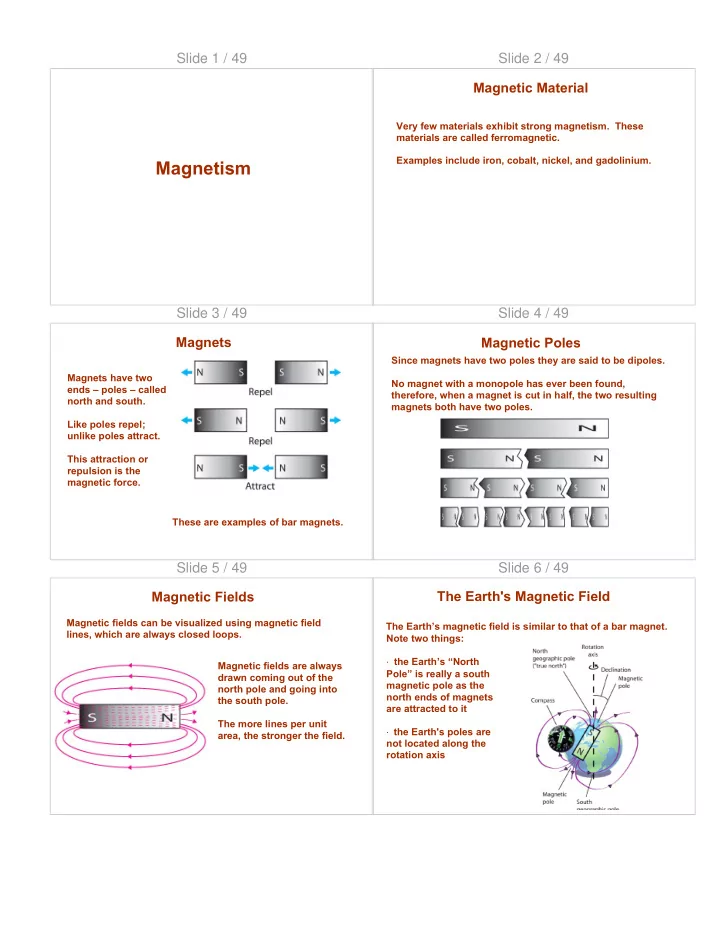
Slide 1 / 49 Slide 2 / 49 Magnetic Material Very few materials exhibit strong magnetism. These materials are called ferromagnetic. Examples include iron, cobalt, nickel, and gadolinium. Magnetism Slide 3 / 49 Slide 4 / 49 Magnets Magnetic


slide-1
SLIDE 1

Slide 1 / 49

Magnetism

Slide 2 / 49 Magnetic Material

Very few materials exhibit strong magnetism. These materials are called ferromagnetic. Examples include iron, cobalt, nickel, and gadolinium.

Slide 3 / 49 Magnets

Magnets have two ends – poles – called north and south. Like poles repel; unlike poles attract. This attraction or repulsion is the magnetic force. These are examples of bar magnets.

Slide 4 / 49 Magnetic Poles

Since magnets have two poles they are said to be dipoles. No magnet with a monopole has ever been found, therefore, when a magnet is cut in half, the two resulting magnets both have two poles.

Slide 5 / 49 Magnetic Fields

Magnetic fields can be visualized using magnetic field lines, which are always closed loops. Magnetic fields are always drawn coming out of the north pole and going into the south pole. The more lines per unit area, the stronger the field.

Slide 6 / 49 The Earth's Magnetic Field

The Earth’s magnetic field is similar to that of a bar magnet. Note two things: · the Earth’s “North Pole” is really a south magnetic pole as the north ends of magnets are attracted to it · the Earth's poles are not located along the rotation axis

slide-2
SLIDE 2

Slide 7 / 49 Uniform Magnetic Fields

A uniform magnetic field is constant in magnitude and direction. How can we create a uniform magnetic field? Aligning the opposite poles of two bar magnets will create a field which is almost uniform. Which areas in the diagram are non-uniform?

Slide 8 / 49 Definition of B

The magnetic field is often expressed as B. The field is a vector and has both magnitude and direction. Often the magnetic field will be referred to as a "B-field". The unit of B is the tesla, T. 1 T = 1 N A m Another unit sometimes used: the gauss (G). 1 G = 10-4 T To gain perspective, the weak magnetic field of the Earth at its surface is around 0.5 x 10⁻⁴

T or simply 0.5 G.

Slide 9 / 49

Electric Currents Produce Magnetic Fields

Experiment shows that an electric current produces a magnetic field.

Slide 10 / 49

Electric Currents Produce Magnetic Fields

The direction of the field is given by a right-hand rule. First, orient your right hand thumb in the direction of the current... Then wrap your fingers in the direction of the B Field.

Slide 11 / 49

Direction of Magnetic Fields

Because we need three dimensions to describe magnetic field and our paper is essentially two dimensional, we need to represent the third dimension somehow. We have left / right : Up / down : What is the third dimension?

Slide 12 / 49 Magnetic Fields

Picture the field line like an arrow. The head of the arrow is the direction of the field. If the magnetic field is into the page, you will see the tail of the arrow. If the magnetic field is out of the page, you will see the front of the arrow.

slide-3
SLIDE 3

Slide 13 / 49

. . . . . . . . . . . . . . . . . . . . . . . . . . . . . . . . . . . . . . . . . . . . . . . . . . . . . . . . . . . . . . . . . . . . . . . . . . . . . . . . . . . . . . . .

1 Which diagram correctly shows the magnetic field (red) around a current carrying wire (blue)?

A B C D

Slide 14 / 49

. . . . . . . . . . . . . . . . . . . . . . . . . . . . . . . . . . . . . . . . . . . . . . . . . . . . . . . . . . . . . . . . . .

2 Which diagram correctly shows the magnetic field (red) around a current carrying wire (blue)?

A B C D

Slide 15 / 49

. . . . . . . . . . . . . . . . . . . . . . . . . . . . . . . . . . . . . . . . . . . . . . . . . . . . . . . . . . . . . . . . . . . . . . . . . . . . . . . . . . . . . . . .

3 Which diagram correctly shows the magnetic field (black) around a current carrying wire (red)?

A B C D

Slide 16 / 49

x x x x x x x x x x x x x x x x x x x x x x x x x x x x x x x x x x x x x x x x x x x x x

. . . . . . . . . . . . . .

x x x x x x x x x x x x x x x x x x x x x x x x x x x x x x x x x x x x x x

. . . . . . . . . . . . . . . . . . . . . . . . . . . . . . . . . . . . . . . . . . . . . . . . . . . . . . . . . . . .

x x x x x x x

. . . . . . . . . . . . . . . . . . . . . . . . . . . . . . . . . . . . . . . . . . . . . .

4 Which diagram correctly shows the magnetic field inside and outside a current carrying loop of wire?

A B C D

Slide 17 / 49

. . . . . . . . . . . . . . . . . . . . . . . . . . . . . . . . . . . . . . . . . . . . . . . . . . . . . . . . . . . . . . . . . . . . . . . . . . . . . . . . . . . . . . . .

5 Which diagram correctly shows the magnetic field around a current carrying wire?

A B C D E

Slide 18 / 49

. . . . . . . . . . . . . . . . . . . . . . . . . . . . . . . . . . . . . . . . . . . . . . . . . . . . . . . . . . . . . . . . . . . . . . . . . . . . . . . . . . . . . . . .

6 Which diagram correctly shows the magnetic field around a current carrying wire?

A B C D

slide-4
SLIDE 4

Slide 19 / 49

Force on an Electric Current in a Magnetic Field; Definition of B

A magnet exerts a force on a current-carrying wire. The direction of the force is given by another different right-hand rule, we will call this the right-arm rule to avoid confusion.

Slide 20 / 49

Force on an Electric Current in a Magnetic Field; Definition of B

The force on the wire depends on the current, the length of the wire, the magnetic field, and its orientation. This equation defines the magnetic field, B. I is the current L is the length of wire B is the magnetic field

FB = I L B sin # Slide 21 / 49

Force on an Electric Current in a Magnetic Field; Definition of B

As you can see from the equation, the magnetic force depends on the angle the magnetic field makes with the current. The force is the greatest when the magnetic field is perpendicular the the current and zero when it is parallel to the current.

FB = I L B sin # Slide 22 / 49

7 A wire carries a current of 2 A in a direction perpendicular to a 0.3 T magnetic field. What is the magnitude of the magnetic force acting on the 0.5 m long wire?

A

0.8 N

B

0.5 N

C

0.3 N

D

0.1 N

E

1.23 N

Slide 23 / 49

8 A uniform magnetic field exerts a maximum force

  • f 20 mN on a 0.25 m long wire, carrying a current
  • f 2 A. What is the strength of the magnetic field?

A

0.1 T

B

0.2 T

C

0.3 T

D

0.4 T

E

0.5 T

Slide 24 / 49

9 A 0.05 N force acts on a 10 cm wire as a result of it being located in a 0.3 T, perpendicularly oriented, magnetic field. What is the electric current through the wire?

A

1.67 A

B

1.25 A

C

2.13 A

D

3.95 A

E

3.32 A

slide-5
SLIDE 5

Slide 25 / 49

Force on an Electric Current in a Magnetic Field; Definition of B

To make sure we have the right direction for B, we use the right-arm rule: Orient your arm in the direction of the current. Rotate your wrist until your thumb is in the direction of the force. Bend your fingers 90o for the direction of the magnetic field. All three vectors are now perpendicular

Slide 26 / 49

10 What is the direction of the force

  • n the current carrying wire

(green) in the magnetic field (red)?

A B C D E F G zero

Slide 27 / 49

11 What is the direction of the force

  • n the current carrying wire

(green) in the magnetic field (red)?

A B C D E F G zero . . . . . . . . . . . . . . . . . . . . . . . . . . . . . . . . . . . . . . . . . . . . . . . . . . . . . . . . . . . . . . . . . .

Slide 28 / 49

12 What is the direction of the force

  • n the current carrying wire

(green) in the magnetic field (red)?

A B C D E F G zero

Slide 29 / 49

13 What is the direction of the force

  • n the current carrying wire

(green) in the magnetic field (red)?

A B C D E F G zero

Slide 30 / 49

14 What is the direction of the force

  • n the current carrying wire

(green) in the magnetic field (red)?

A B C D E F G zero

slide-6
SLIDE 6

Slide 31 / 49

Force on Electric Charge Moving in a Magnetic Field

The force on a moving charge is related to the force

  • n a current:

F = qvB sin # Once again, the direction is given by a right-arm rule.

Slide 32 / 49 Force on a Moving Charge

v (velocity)

B

v (velocity)

Slide 33 / 49 Force on a Moving Charge

v (velocity)

B

v (velocity) F For a negative charge, negate the force. F F

Slide 34 / 49

15 An electron experiences a maximum upward force

  • f 2.8x10⁻¹² N when it is moving at a speed of

5.1x10⁶ m/s towards the north. What is the direction and magnitude of the magnetic field?

A

3.43 N west

B

3.43 N east

C

4.74 N west

D

4.74 N east

E

6.56 N west

Slide 35 / 49

16 What is the direction of the force on the proton shown below?

A B C D E F

G Zero

v

Slide 36 / 49

17 What is the direction of the force on the proton shown below?

A B C D E F

G Zero

v

slide-7
SLIDE 7

Slide 37 / 49

18 What is the direction of the force on the electron shown below?

A B C D E F

G Zero

v

Slide 38 / 49

19 What is the direction of the force on the electron shown below?

A B C D E F

G Zero

v

Slide 39 / 49

Force on Electric Charge Moving in a Magnetic Field

If a charged particle is moving perpendicular to a uniform magnetic field, its path will be a circle.

Slide 40 / 49

Magnetic Field Due to a Long Straight Wire

Recalling our current carrying wire, it is

  • bvious that the field is inversely proportional

to the distance from the wire: The constant μ0 is called the permeability of free space, and has the value: μ0 = 2 x10⁻⁷ Tm/A 2#

Slide 41 / 49

20 A long straight wire carries a current of 12 A towards the west. What is the direction and magnitude of the magnetic field 10 cm to the south of the wire?

A

1.2 x 10⁻⁵ T out of the page

B

2.4 x 10⁻⁵ T into the page

C

2.4 x 10⁻⁵ T out of the page

D

2.9 x 10--5 T into the page

E

2.9 x 10⁻⁵ T out of the page

Slide 42 / 49

21 A long straight wire carries a current of 30 A towards the west. What is the direction and magnitude of the magnetic field 5 m to the south

  • f the wire?

A

1 x 10⁻⁶ T into the page

B

1 x 10⁻⁶ T out of the page

C

2.5 x 10⁻⁶ T into the page

D

2.5 x 10⁻⁶ T out of the page

E

3 x 10⁻⁶ T out of the page

slide-8
SLIDE 8

Slide 43 / 49

Force between Two Parallel Wires

Two current carrying wires will interact with each other. The magnetic field produced at the position of wire 2 due to the current in wire 1 is: The force this field exerts on a length l2 of wire 2 is:

Slide 44 / 49

Force between Two Parallel Wires

Parallel currents in the same direction attract. Parallel currents in opposite directions repel.

Slide 45 / 49

22 What is the magnitude and direction of the magnetic force between two parallel wires, 5 m long and 2 cm apart, if each carries a current of 15 A in the opposite direction?

A

1.1 x 10⁻² F towards each other

B

1.1 x 10⁻² F away from each other

C

1.8 x 10⁻² F towards each other

D

1.8 x 10⁻² F away from each other

E

2.6 x 10⁻² F away from each other

Slide 46 / 49

Mass Spectrometer

All the atoms passing through the second slit will have the same speed. FE FB FE = FB qE = qvB E = vB

Slide 47 / 49

Mass Spectrometer

Atoms reaching the second magnetic field will have the same speed; their radius of curvature will depend on their mass. FB = ma qvB = mv2 r qB = mv r qBr = mE B m = qrB2 E

Slide 48 / 49

Summary

· Magnets have north and south poles · Like poles repel, unlike attract · Unit of magnetic field: Tesla · Electric currents produce magnetic fields · A magnetic field exerts a force on an electric current: F = ILBperpendicular · A magnetic field exerts a force on a moving charge: F = qvBperpendicular · Magnitude of the field of a long, straight current-carrying wire: · Parallel currents attract; antiparallel currents repel

slide-9
SLIDE 9

Slide 49 / 49