Exchange and ordering Stephen Blundell University of Oxford 2015 - - PDF document

exchange and ordering
SMART_READER_LITE
LIVE PREVIEW

Exchange and ordering Stephen Blundell University of Oxford 2015 - - PDF document

25/08/2015 Books Magnetism in Condensed Matter, S.J. Blundell, OUP (2001) Magnetism and Magnetic Materials, J.M.D. Coey, CUP (2009) Basic aspects of the quantum theory of magnetism, D.I. Khomskii, CUP(2010) Magnetism: A Very Short


slide-1
SLIDE 1

25/08/2015 ¡ 1 ¡

Exchange and ordering

Stephen Blundell University of Oxford

¡ 2015 European School of magnetism Cluj, August 2015

Part 1

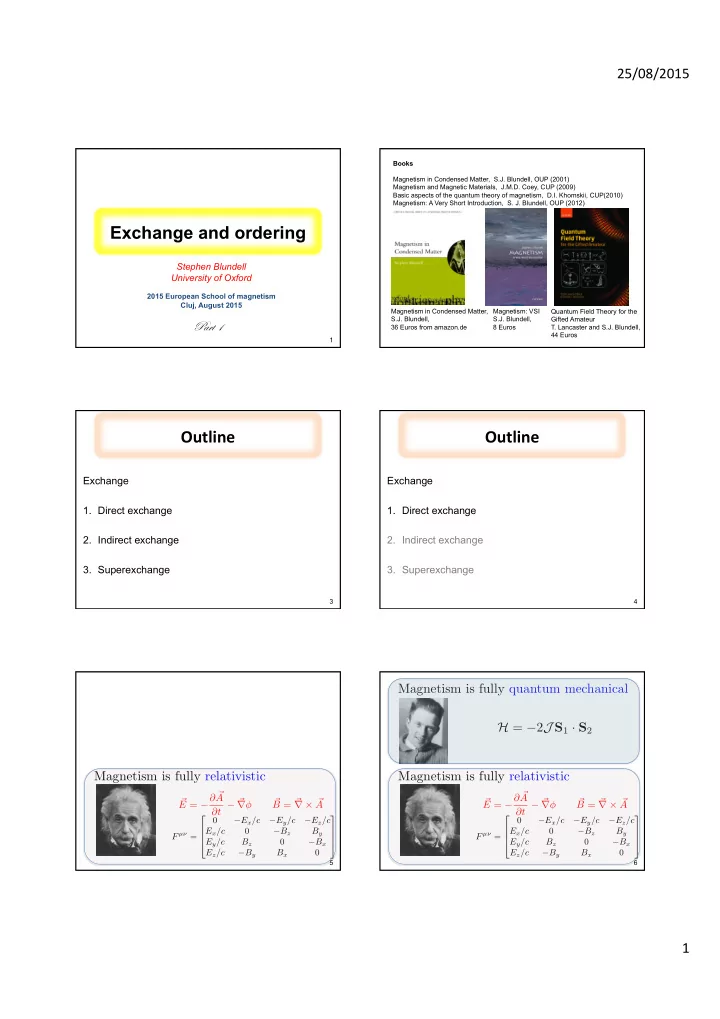
1 Books Magnetism in Condensed Matter, S.J. Blundell, OUP (2001) Magnetism and Magnetic Materials, J.M.D. Coey, CUP (2009) Basic aspects of the quantum theory of magnetism, D.I. Khomskii, CUP(2010) Magnetism: A Very Short Introduction, S. J. Blundell, OUP (2012) Magnetism in Condensed Matter, S.J. Blundell, 36 Euros from amazon.de Magnetism: VSI S.J. Blundell, 8 Euros Quantum Field Theory for the Gifted Amateur

  • T. Lancaster and S.J. Blundell,

44 Euros

Exchange

  • 1. Direct exchange
  • 2. Indirect exchange
  • 3. Superexchange

Outline ¡

3

Exchange

  • 1. Direct exchange
  • 2. Indirect exchange
  • 3. Superexchange

Outline ¡

4

Magnetism is fully relativistic

F µν =     −Ex/c −Ey/c −Ez/c Ex/c −Bz By Ey/c Bz −Bx Ez/c −By Bx    

⇤ E = ⇥ ⇤ A ⇥t ⇤ ⇤ ⇤ B = ⇤ ⇤ ⇥ ⇤ A

5

Magnetism is fully quantum mechanical Magnetism is fully relativistic H = −2J S1 · S2

F µν =     −Ex/c −Ey/c −Ez/c Ex/c −Bz By Ey/c Bz −Bx Ez/c −By Bx    

⇤ E = ⇥ ⇤ A ⇥t ⇤ ⇤ ⇤ B = ⇤ ⇤ ⇥ ⇤ A

6

slide-2
SLIDE 2

25/08/2015 ¡ 2 ¡

Magnetism is fully quantum mechanical Magnetism is fully relativistic

F µν =     −Ex/c −Ey/c −Ez/c Ex/c −Bz By Ey/c Bz −Bx Ez/c −By Bx    

⇤ E = ⇥ ⇤ A ⇥t ⇤ ⇤ ⇤ B = ⇤ ⇤ ⇥ ⇤ A

S = 1 2σ

7

Louis ¡Néel ¡ (1904-­‑2000) ¡

8

↑↓↑↓↑↓↑↓↑↓↑↓↑↓↑↓↑↓↑↓ ↑↓↑↓↑↓↑↓↑↓↑↓↑↓↑↓↑↓↑↓ ↑↓↑↓↑↓↑↓↑↓↑↓↑↓↑↓↑↓↑↓ ↓↑↓↑↓↑↓↑↓↑↓↑↓↑↓↑↓↑↓↑ ↓↑↓↑↓↑↓↑↓↑↓↑↓↑↓↑↓↑↓↑ ↑↑↑↑↑↑↑↑↑↑↑↑↑↑↑↑↑↑↑↑ ↑↑↑↑↑↑↑↑↑↑↑↑↑↑↑↑↑↑↑↑ ↑↑↑↑↑↑↑↑↑↑↑↑↑↑↑↑↑↑↑↑ ↑↑↑↑↑↑↑↑↑↑↑↑↑↑↑↑↑↑↑↑ ↑↑↑↑↑↑↑↑↑↑↑↑↑↑↑↑↑↑↑↑ antiferromagnet ferromagnet

9

Energy terms:

  • Kinetic energy eV
  • Coulomb energy eV
  • Size of atom given by balance of these two terms
  • Spin-orbit ~ meV
  • Magnetocrystalline anisotropy ~ µeV

2 2m π2 L2 = e2 4⇥0L =

10 11 12

slide-3
SLIDE 3

25/08/2015 ¡ 3 ¡

Eigenfunc<ons: ¡ ¡ ¡σ ¡= ¡(|ψA> ¡+ ¡|ψB>)/√2 ¡ ¡ ¡(Symmetric, ¡bonding) ¡ ¡ ¡ ¡ ¡ ¡ ¡ ¡ ¡ ¡ ¡ ¡ ¡ ¡ ¡ ¡ ¡ ¡ ¡ ¡ ¡σ* ¡= ¡(|ψA> ¡-­‑ ¡|ψB>)/√2 ¡ ¡ ¡(An<symmetric, ¡an<bonding) ¡ 13

Why ¡do ¡you ¡get ¡H2 ¡and ¡not ¡He2? ¡

14 15

Two-electron model Two-electron model Bethe-Slater curve

slide-4
SLIDE 4

25/08/2015 ¡ 4 ¡

Consider 2 electrons: their spins can combine to form either an antisymmetric singlet state χS (S = 0) or a symmetric triplet state χT (S = 1). The wave function, which is a product of spatial and spin terms, must be antisymmetric

  • verall. Hence:

ΨS = [ψ1(r1)ψ2(r2) + ψ1(r2)ψ2(r1)] χS ΨT = [ψ1(r1)ψ2(r2) − ψ1(r2)ψ2(r1)] χT The energies of the two possible states are ES =

  • Ψ∗

S ˆ

HΨS dr1 dr2 ET =

  • Ψ∗

T ˆ

HΨT dr1 dr2 so that the difference between the two energies is ES − ET = 4

  • ψ∗

1(r1)ψ∗ 2(r2) ˆ

Hψ1(r2)ψ2(r1) dr1 dr2. The energy is then E = 1

4(ES + 3ET ) − (ES − ET )S1 · S2. The spin-dependent

term can be written Hspin = −JS1 · S2.

19

H = −

ij JijSi · Sj

  • Interaction between pair of spins motivates the

general form of the Heisenberg model:

  • The quantity gives the exchange energy

between two spins. Be very careful on the factor

  • f two between different conventions of the

definition of J.

Jij

20 21

H = −

ij JijSi · Sj

  • Interaction between pair of spins motivates the

general form of the Heisenberg model:

  • Direct exchange: important in many metals such

as Fe, Co and Ni

  • Indirect exchange: mediated through the

conduction electrons (RKKY)

  • Superexchange: exchange interaction mediated

by oxygen. This leads to a very long exchange

  • path. Important in many magnetic oxides, e.g.

MnO, La2CuO4.

22

Exchange

  • 1. Direct exchange
  • 2. Indirect exchange
  • 3. Superexchange

Outline ¡

23

Magnetism and metals

24

slide-5
SLIDE 5

25/08/2015 ¡ 5 ¡

25 26 27 28 29

slide-6
SLIDE 6

25/08/2015 ¡ 6 ¡

31 32

1D ¡electron ¡gas ¡unstable ¡to ¡SDW ¡forma<on ¡

33

Spin-­‑density ¡wave ¡

34

TMTSF ¡salts

Stacks ¡of ¡TMTSF ¡molecules ¡⇒ ¡ ¡1D ¡chains ¡

35

TMTSF ¡salts

Very ¡rich ¡ phase ¡diagram 36

slide-7
SLIDE 7

25/08/2015 ¡ 7 ¡

37

F(x) = −x cos x + sin x x4 χ(r) = 1 (2π)3

  • d3q χqeiq·r = 2kFχp

π F(2kFr)

38

  • S. ¡S. ¡P. ¡Parkin ¡and ¡D. ¡Mauri, ¡Phys. ¡Rev. ¡B ¡44, ¡7131 ¡(1991) ¡

39

(a)

GMR = giant magnetoresistance

40

(b)

GMR = giant magnetoresistance

41 42

slide-8
SLIDE 8

25/08/2015 ¡ 8 ¡

Exchange

  • 1. Direct exchange
  • 2. Indirect exchange
  • 3. Superexchange

Outline ¡

43

H = −

ij JijSi · Sj

  • Interaction between pair of spins motivates the

general form of the Heisenberg model:

  • Direct exchange: important in many metals such

as Fe, Co and Ni

  • Indirect exchange: mediated through the

conduction electrons (RKKY)

  • Superexchange: exchange interaction mediated

by oxygen. This leads to a very long exchange

  • path. Important in many magnetic oxides, e.g.

MnO, La2CuO4.

44

Superexchange

  • Case I: AF ordering
  • Case II: F ordering
  • KE advantage for AF ordering

45

Toy model for superexchange

46

Toy model for superexchange

47

Toy model for superexchange

J ≈ 2t2 U

48

slide-9
SLIDE 9

25/08/2015 ¡ 9 ¡

Toy model for superexchange

J ≈ 2t2 U

49

  • K. A. Müller
  • J. G. Bednorz

52

In the next lecture:

  • magnetic order
  • frustration and triangles