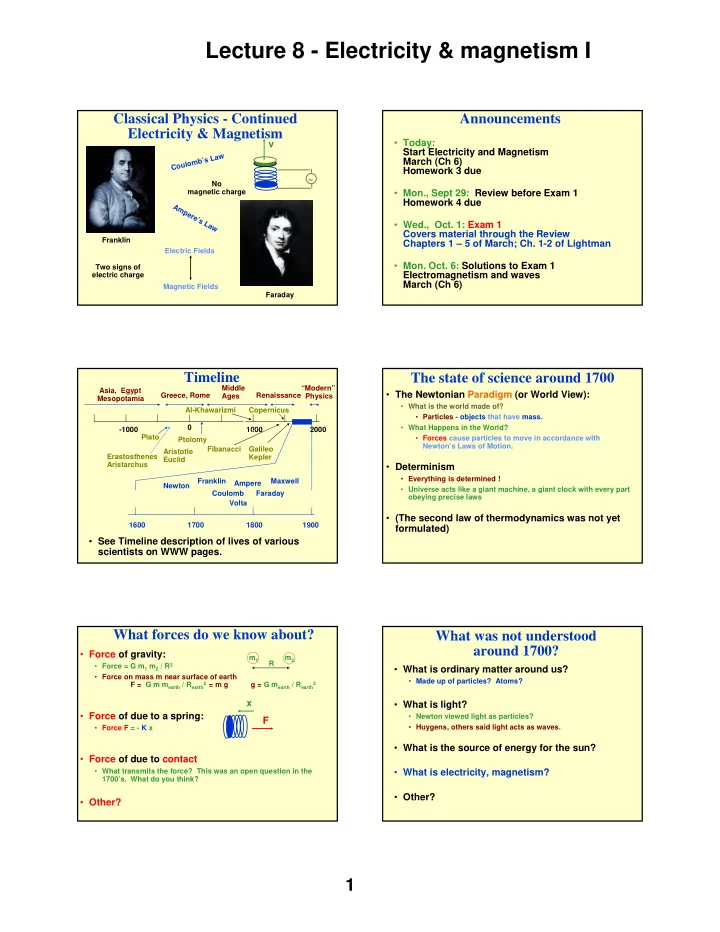

SLIDE 1
Lecture 8 - Electricity & magnetism I
1
Classical Physics - Continued Electricity & Magnetism
Faraday
~ v
Electric Fields Magnetic Fields C
- u
l
- m
b ’ s L a w Franklin Ampere’s Law Two signs of electric charge No magnetic charge
Announcements
- Today:
Start Electricity and Magnetism March (Ch 6) Homework 3 due
- Mon., Sept 29: Review before Exam 1
Homework 4 due
- Wed., Oct. 1: Exam 1
Covers material through the Review Chapters 1 – 5 of March; Ch. 1-2 of Lightman
- Mon. Oct. 6: Solutions to Exam 1
Electromagnetism and waves March (Ch 6)
Timeline
- See Timeline description of lives of various
scientists on WWW pages.
1000 2000
- 1000
Asia, Egypt Mesopotamia Aristotle Euclid Galileo Kepler Newton “Modern” Physics Greece, Rome Middle Ages Ptolomy Copernicus Renaissance Al-Khawarizmi Fibanacci Plato Erastosthenes Aristarchus 1900 1800 1700 1600 Faraday Maxwell Franklin Coulomb Volta Ampere
The state of science around 1700
- The Newtonian Paradigm (or World View):
- What is the world made of?
- Particles - objects that have mass.
- What Happens in the World?
- Forces cause particles to move in accordance with
Newton’s Laws of Motion.
- Determinism
- Everything is determined !
- Universe acts like a giant machine, a giant clock with every part
- beying precise laws
- (The second law of thermodynamics was not yet
formulated)
What forces do we know about?
- Force of gravity:
- Force = G m1 m2 / R2
- Force on mass m near surface of earth
F = G m mearth / Rearth
2 = m g g = G mearth / Rearth 2
- Force of due to a spring:
- Force F = - K x
- Force of due to contact
- What transmits the force? This was an open question in the
1700’s. What do you think?
- Other?
m1 m2 R
F x
What was not understood around 1700?
- What is ordinary matter around us?
- Made up of particles? Atoms?
- What is light?
- Newton viewed light as particles?
- Huygens, others said light acts as waves.
- What is the source of energy for the sun?
- What is electricity, magnetism?
- Other?