Magnetics Design 3.1 Important magnetic equations 3.2 Magnetic - - PDF document

magnetics design
SMART_READER_LITE
LIVE PREVIEW

Magnetics Design 3.1 Important magnetic equations 3.2 Magnetic - - PDF document

Prof. S. Ben-Yaakov , DC-DC Converters [3- 1] Magnetics Design 3.1 Important magnetic equations 3.2 Magnetic losses 3.3 Transformer 3.3.1 Ideal transformer (voltages and currents) 3.3.2 Equivalent circuit of transformer (coupling,


slide-1
SLIDE 1

1

  • Prof. S. Ben-Yaakov , DC-DC Converters

[3- 1]

Magnetics Design

3.1 Important magnetic equations 3.2 Magnetic losses 3.3 Transformer 3.3.1 Ideal transformer (voltages and currents) 3.3.2 Equivalent circuit of transformer (coupling, magnetization current) 3.3.3 Design of transformer 3.4 Inductor design

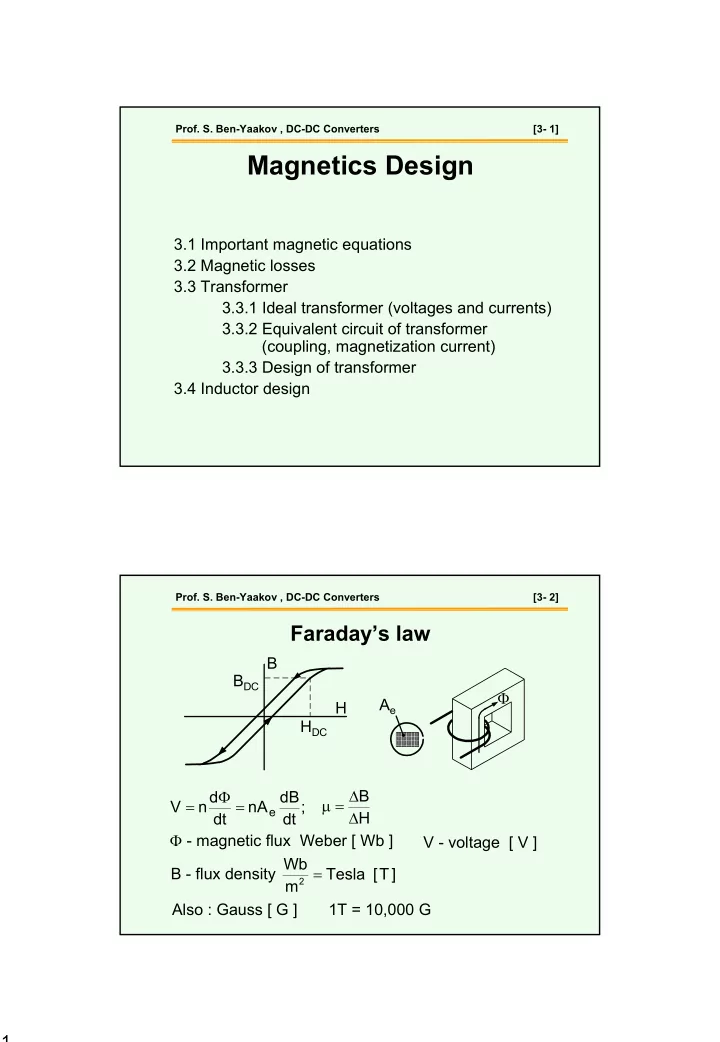
  • Prof. S. Ben-Yaakov , DC-DC Converters

[3- 2]

; dt dB nA dt d n V

e

= Φ = H B ∆ ∆ = µ Φ - magnetic flux Weber [ Wb ] B - flux density ] T [ Tesla m Wb

2 =

V - voltage [ V ] Also : Gauss [ G ] 1T = 10,000 G B H BDC HDC Φ Ae

Faraday’s law

slide-2
SLIDE 2

2

  • Prof. S. Ben-Yaakov , DC-DC Converters

[3- 3]

Ampere’s law

H - magnetic field [ A/m ]

⋅ = I n Hdl

e

H I n l ⋅ = ⋅

e

I n H l ⋅ = [ A/m ] I n

e

l

  • Prof. S. Ben-Yaakov , DC-DC Converters

[3- 4]

Magnetic losses ~∆B “Good number” = 100mW/cm3 =100KW/m3 P

3

cm mW B ∆

Magnetic losses

B H BDC HDC

slide-3
SLIDE 3

3

  • Prof. S. Ben-Yaakov , DC-DC Converters

[3- 5]

“Good number”=100mW/cm3=100 kW/m3

Magnetic Losses

  • Prof. S. Ben-Yaakov , DC-DC Converters

[3- 6]

Magnetic losses ~∆B “Good number” = 100mW/cm3 =100KW/m3 P

3

cm mW B ∆

Magnetic losses

B H BDC HDC

slide-4
SLIDE 4

4

  • Prof. S. Ben-Yaakov , DC-DC Converters

[3- 7]

Magnetic Losses

  • Prof. S. Ben-Yaakov , DC-DC Converters

[3- 8]

  • Curves for constant loss: 500mW/cm3
  • Figure of merit B*f
  • Each material has optimum operating temperature

(minimum loss)

Magnetic Losses

slide-5
SLIDE 5

5

  • Prof. S. Ben-Yaakov , DC-DC Converters

[3- 9]

Transformer currents

n1 n2 I1 I2 For ideal transformer

2 2 1 1

I n I n =

1 2 2 1

n n I I = At any given moment

2 2 1 1

I n I n = I1,I2 opposite direction. No magnetic energy stored due to useful currents I1, I2 (they cancel each other)

n1 n2 I1 I2

  • Prof. S. Ben-Yaakov , DC-DC Converters

[3- 10]

Transformer voltages

φ dt d n V

1 1 1

φ = dt d n V

2 2 2

φ =

2 1

g min Assu φ = φ dt d dt d

2 1

φ = φ

2 1 2 1

n n V V =

n1 n2 V1 V2

slide-6
SLIDE 6

6

  • Prof. S. Ben-Yaakov , DC-DC Converters

[3- 11]

Since each winding also represents an inductance, therefore for any winding

= n V

Permissible voltages: AC only on any winding

S1 V S1 S2 S2 S1 V S1 V S2 S2 S1 S2 S1 S2 t t t

A B C

Voltages

  • Prof. S. Ben-Yaakov , DC-DC Converters

[3- 12]

Equivalent circuit (preliminary)

2 m m

n L L

1 2 =

∞ → L Ideal transformer

Ideal 1:n Lm1 Llkg1 Ideal 1:n Lm2 Llkg1 Ideal 1:n Lm1 Llkg2

slide-7
SLIDE 7

7

  • Prof. S. Ben-Yaakov , DC-DC Converters

[3- 13]

Leakage inductance

I2 V2 I1 V1 n2 n1

Leakage inductance is the

uncoupled magnetic flux 1:n Lkg1 Lm1 ideal Lkg2

Relationship between Llkg, M and k (coupling coefficient).

2 1 L

L k M ⋅ = ) k 1 ( L L

1 m 1 lkg

− ≅

2 1 lkg 2 lkg

n L L ⋅ ≅

Leakage

  • Prof. S. Ben-Yaakov , DC-DC Converters

[3- 14]

1:n Llkg1 Lm1 ideal Llkg2 Vo Llkg1 Lm1 L'lkg2 V'o

2 2 lkg 2 lkg

n L L = ′

2

  • n

V V = ′

Leakage

slide-8
SLIDE 8

8

  • Prof. S. Ben-Yaakov , DC-DC Converters

[3- 15]

Magnetization Current

Vin t Vo t I2 t Im t I1 t Ideal 1:n Lm1 Llkg2 R I2 Vo I1 Im Vin

  • Prof. S. Ben-Yaakov , DC-DC Converters

[3- 16]

Transformer

  • 1. Bmax ( could be symmetrical or asymmetrical )
  • 2. Bmax < Bsat
  • 3. In most case ( high frequency ) Bmax limit by magnetic

losses. dt dB A n dt d n V

e 1 1 1

= Φ = I2 V2 I1 V1 n2 n1 H B B sat- Bsat+ B max+ ∆Β Bmax-

slide-9
SLIDE 9

9

  • Prof. S. Ben-Yaakov , DC-DC Converters

[3- 17]

Symmetrical operation

= Vdt A n 1 B

e 1 − + = max max

B B

e 1

  • n

m max

A n t V B 2 B = = ∆

{ }

e max

  • n

m 1

A B 2 t , V n = B Vm Ts Bmax- Bmax+ ton V1

s 2 T t

  • n

e 1

f 1 ~ t ~ A n

S

  • n→
  • Prof. S. Ben-Yaakov , DC-DC Converters

[3- 18]

Skin effect

depth skin − δ f 72 ) mm ( = δ Hz in f δ 1 R R

DC AC >

DC Frequency High

slide-10
SLIDE 10

10

  • Prof. S. Ben-Yaakov , DC-DC Converters

[3- 19]

Skin Effect Solutions

Litz wire Tape

  • Prof. S. Ben-Yaakov , DC-DC Converters

[3- 20]

Proximity effect

I I

Current crowding due to magnetic fields

slide-11
SLIDE 11

11

  • Prof. S. Ben-Yaakov , DC-DC Converters

[3- 21]

[ ]

k n w n w A

2 2 A 1 A w

1

⋅ + ⋅ = k - filling factor k<1 J I w

rms 1 A1 =

J - current density A/m2 J ≅ 4.5 A/mm2

1 2 1 2

I n n I = Aw - winding area Aw wA

Aw

  • Prof. S. Ben-Yaakov , DC-DC Converters

[3- 22]

2 Jk I n A

rms 1 1 w

⋅ =

rms 1 w 1

I 2 JkA n ⋅ =

{ }

e max

  • n

1 1

A B 2 t , V n =

{ }

e max

  • n

1 rms 1 w

A B 2 t , V 2 I JkA = ⋅

{ } { }Jk

B 2 I 2 t , V A A A

max rms 1

  • n

1 e w p

⋅ = =

{ }

Jk B I 2 t , V A

rms

1

  • n

1 p

⋅ ∆ ⋅ =

{ }

Jk B f I 2 D , V A

s 1

  • n

1 p

rms

⋅ ∆ ⋅ ⋅ =

Ap

slide-12
SLIDE 12

12

  • Prof. S. Ben-Yaakov , DC-DC Converters

[3- 23]

Transformer design stages

  • 1. Calculate Ap
  • 2. Look for core
  • 3. Calculate n1 by:
  • 4. Calculate n2

{ }

Jk B f I 2 D , V A

s 1

  • n

1 p

rms

⋅ ∆ ⋅ ⋅ = In symmetrical operation ∆B = Bmax

+ - Bmax

  • In asymmetrical operation

∆B = Bmax - 0

{ }

e max

  • n

m 1

A B 2 t , V n =

  • Prof. S. Ben-Yaakov , DC-DC Converters

[3- 24]

Inductor design

Need to store energy ( in transformer n1·I1= n2·I2 )

r

  • µ

µ = µ µo - air (vacuum) permeability µr - relative permeability I L B H µ

slide-13
SLIDE 13

13

  • Prof. S. Ben-Yaakov , DC-DC Converters

[3- 25]

µo = 1.26·10-6 m Henry If µ is high B will reach quickly Bsat Need to slower µ B H Ho <

2 r

µ

2 r

µ

1 r

µ

1 r

µ Bo µr of ferrites ∼ 2000 - 4000 B = µH

Permeability

  • Prof. S. Ben-Yaakov , DC-DC Converters

[3- 26]

Same Φ magnetic lines in ferromagnetic material and in air.

e g

l l <<

e e g

l l l ≅ + Discrete air gap Φ µo µr

e

l

g

l Distributed air gap

Gaps

slide-14
SLIDE 14

14

  • Prof. S. Ben-Yaakov , DC-DC Converters

[3- 27]

Current crowding due to magnetic fields RAC high around gap

Current Crowding

  • Prof. S. Ben-Yaakov , DC-DC Converters

[3- 28]

Φ = constant B ≅ constant

  • g

B H µ =

m m

B H µ =

g g e m e

H H H nI l l l + = =

  • g

B m e B e H µ + µ = l l l

e g

l l <<

e e g

l l l ≅ +

e

l

g

l

Inductance with Gap

slide-15
SLIDE 15

15

  • Prof. S. Ben-Yaakov , DC-DC Converters

[3- 29]

g e

  • a

m m e

B B B H l l µ + µ = µ =

  • g

m e e

B B H µ + µ = l l l

Dividing out le and defining

H B

e =

µ

Inductance with Gap

  • Prof. S. Ben-Yaakov , DC-DC Converters

[3- 30]

        µ + µ = µ

g e

  • m

e

1 1 1 l l         µ + µ µ = µ µ

g e

  • rm
  • re

1 1 1 l l         + µ = µ

g e rm re

1 1 1 l l         µ µ +         = µ

g e rm rm g e re

1 l l l l

rm g e g e rm re

µ +                 µ = µ l l l l

rm g e

If µ < l l         ≈ µ

g e re

l l

Gap Calculation

slide-16
SLIDE 16

16

  • Prof. S. Ben-Yaakov , DC-DC Converters

[3- 31]

dt dI L V = dt d n V Φ = dt dI n nA dt dH nA dt dB nA dt d n

e e e e

l µ = µ = = Φ dt d n dt dI L Φ = L-? dt dI A n dt dI L

e e 2

l µ =

e e 2A

n L l µ =

Inductance

  • Prof. S. Ben-Yaakov , DC-DC Converters

[3- 32]

2 2 1 2 1

n n L L       = Inductor design B H Bmax

Two windings on same core

slide-17
SLIDE 17

17

  • Prof. S. Ben-Yaakov , DC-DC Converters

[3- 33]

dt d n dt dI L Φ =

∫ ∫

      =      

max pk

B e I

dt dt dB nA dt dt dI L L Ipk = nAeBmax

max e pk

B A LI n =

max pk e

nB LI A =

rms w

I JkA n = quick design and check

Saturation Limits

  • Prof. S. Ben-Yaakov , DC-DC Converters

[3- 34]

Jk B I LI A A A

max rms pk w e p

= =

2 rms pk

LI I LI ≈ 2 LI stored Energy

2

= Air gapped core Design

  • 1. Calculate Ap
  • 2. Choose a core
  • 3. Iterate
  • 4. Calculate ( or increase gap until L is as required )

g

l

Ap

slide-18
SLIDE 18

18

  • Prof. S. Ben-Yaakov , DC-DC Converters

[3- 35]

Cores

Transformer core Inductor core

air gap

  • Prof. S. Ben-Yaakov , DC-DC Converters

[3- 36]

  • 1. E - core
  • 2. TOROID
  • 3. ARENCO
  • 4. POT

Cores

slide-19
SLIDE 19

19

  • Prof. S. Ben-Yaakov , DC-DC Converters

[3- 37]

Commercial cores

  • Prof. S. Ben-Yaakov , DC-DC Converters

[3- 38]

Distributed gap core

turn H A

y L =

) turns 1000 H sometime (

y

L for n turns:

L 2 A

n L ⋅ =

The concept of AL

Distributed air gap

slide-20
SLIDE 20

20

  • Prof. S. Ben-Yaakov , DC-DC Converters

[3- 39]

AL

  • Prof. S. Ben-Yaakov , DC-DC Converters

[3- 40]

Toroid Data

slide-21
SLIDE 21

21

  • Prof. S. Ben-Yaakov , DC-DC Converters

[3- 41]

1 Amp/m =79.5 Oe

L decreases with DC current !

Permeability change

  • Prof. S. Ben-Yaakov , DC-DC Converters

[3- 42]

These curves are measured by feeding ac signals. If the current is composed of DC + ripple, core loss is due

  • nly to ripple component !

DC bias tend to increase loss “Good number”=100mW/cm3 Misleading notations ! ∆B NOT B

Losses

slide-22
SLIDE 22

22

  • Prof. S. Ben-Yaakov , DC-DC Converters

[3- 43]

“Hot Spot” - Critical parameter

  • Temp. Rize
  • Prof. S. Ben-Yaakov , DC-DC Converters

[3- 44]

Hanna Curve

  • r

H max B e V 2 LI max HB max B 1 e V 2 LI H µ µ = µ = = = max B e A e l LI nI Hn max B e A pk LI H Hn max B e A pk LI n = = =

slide-23
SLIDE 23

23

  • Prof. S. Ben-Yaakov , DC-DC Converters

[3- 45]

Hanna Curve

  • Prof. S. Ben-Yaakov , DC-DC Converters

[3- 46]

Core Size Selection

slide-24
SLIDE 24

24

  • Prof. S. Ben-Yaakov , DC-DC Converters

[3- 47]

Basic Design of Distributed Gap Core

) nI ( f

e

l = µ

  • 1. Calculate LI2
  • 2. Look up manufacturer data
  • 3. Select Core
  • 4. Calculate
  • 5. Check Lmin
  • 6. Calculate losses. Temp rise and and
  • 7. Iterate

) ( L A L n 1000 1000 =