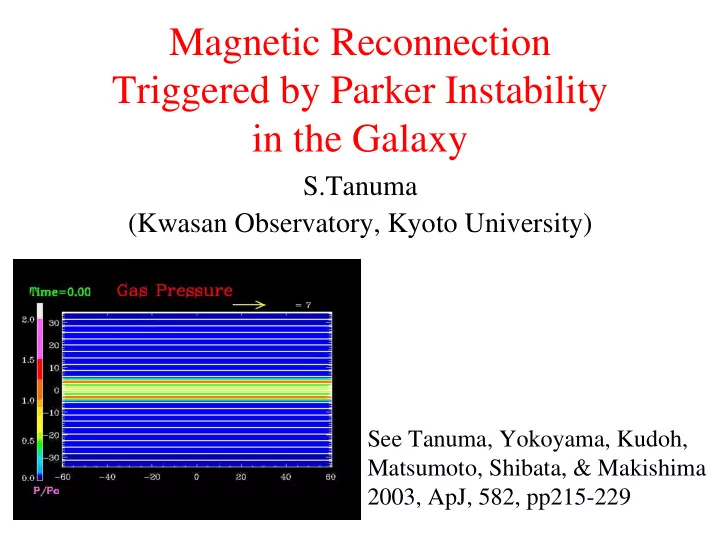
SLIDE 1
Magnetic Reconnection Triggered by Parker Instability in the Galaxy
S.Tanuma (Kwasan Observatory, Kyoto University)
See Tanuma, Yokoyama, Kudoh, Matsumoto, Shibata, & Makishima 2003, ApJ, 582, pp215-229
SLIDE 2 Parker Instability (Parker 1966)
- The Rayleigh-Taylor instability
- f magnetized gas supported by
the gravity force
- Parker instability influences the
locations and motion of gas clouds, OB associations (Sofue & Tosa 1974) and distribution of clouds (Mouschovias, Shu, & Woodward 1974; Blitz & Shu 1980).
(Fig: Parker 1992; see also Sofue 1983 for Galactic magnetic field)
Galactic disk gas halo halo
SLIDE 3 Parker Instability in the Galaxy
(Horiuchi, Matsumoto, Hanawa, & Shibata 1988)
Even mode (glid- reflection mode) Odd-mode (mirror mode)
logρ logρ
simulation (Matsumoto Horiuchi, Shibata, & Hanawa 1988)
logρ logρ
SLIDE 4 Related Studies on Parker Instability
– Parker-Jeans instability in the Galactic disk (Hanawa, F.Nakamura, & Nakano 1992; F.Nakamura, Hanawa, & Nakano 1991). – Giant molecular cloud formation by Parker instability in a skewed magnetic field (Hanawa, Matsumoto, & Shibata 1992). – Parker instability in a realistic gravitational disk (Giz & Shu 1993) and in differentially-rotating disks (Shu 1974), including the effect of cosmic rays.
– Parker instability including the effect of cosmic rays (Kuwabara, K.Nakamura, & Ko 2004).
SLIDE 5 Aim of Our Research
– Parker instability in the solar atmosphere (e.g., Shibata et al. 1989 1992; Nozawa et al. 1992), and magnetic reconnection (e.g., Yokoyama & Shibata 1996) – Parker instability in the Galaxy (e.g., Matsumoto et al. 1988, 1998)
- We would like to apply these studies to the
reconnection triggered by the Parker instability in the Galaxy; Heating of X-ray gas in the Galactic Halo.
SLIDE 6
The Galactic halo has the X-ray gas: Temperature Density Volume Luminosity Thermal energy Supernovae (“Galactic fountain”; Norman & Ikeuchi 1989) can not heat the X-ray gas enough (Birk et al. 1998). We suggest that the reconnection triggered by Parker instability heats X-ray gas in the Galactic halo.
X-ray Gas in the Galactic Halo
(Tanuma et al. 2003, ApJ, 582, 215) ( Pietz et al. 1996)
SLIDE 7
Numerical Model
Cold, dense disk and hot, rarefied halo MHD equilibrium, horizontal field, β=0.2 (B=7μG), periodic oundaries at right and left surfaces Random perturbation in the Galactic disk (<0.05Cso) Anomalous resistivity ( which sets in J/ρ>400)
SLIDE 8 Normalization Units
- Length: Gravitational scale height without
the magnetic field=
- Velocity: Sound speed at the midplane=
- Time:
- Density at the midplane :
- Gas presure at the midplane :
- Magnetic field strength at the midplane:
- Grid number: (Nx, Nz)=(403, 604)
- Grid size: dx=0.3, dz>0.075
- Simulation box: |x|<30.0, |z|<34.5
km/s 10
0 = s
C
pc 100
0 =
H
yr 10 /
7 0 =
=
s
C H τ
g/cc 10 1
25 −
× = ρ erg/cc 10 4
13 −
× =
go
P G 2 . 3 µ =
SLIDE 9 Temperature
- The reconnection is triggered by Parker instability, and
heats the gas in the Galactic halo.
Cold, dense disk Hot, rarefied halo Hot, rarefied halo gravity (Tanuma et al. 2003) B
SLIDE 10
Gas Pressure
Parker instability occurs in the Galaxy, and make many gas clouds in the Galactic disk (see also Matsumoto et al. 1988; Sofue & Tosa 1974)
SLIDE 11 Time variation of various energies
(1)Linear phase, (2)Nonlinear phase of Parker instability, (3)Magnetic reconnection
the reconnection is 3 times more than that by Parker instability in this numerical model.
Time Energy dE/dt linear nonlinear reconnection
SLIDE 12
Dependence of Current Density on Resistivity model
(a) Anomalous resistivity model Petschek-like reconnection occurs. Small diffusion region, slow shocks, and fast shocks are created. (b) Uniform resistivity model Sweet-Parker-like reconnection occurs, Long diffusion region are created.
SLIDE 13 Time Variation of Reconnection Rate.
- Magnetic reconnection rate (i.e., energy release
rate) is higher in anomalous resistivity model than that in the uniform resistivity model.
Reconnection rate is defined by ηJ.
η=0.10 (uniform) η=0.05 (uniform) anomalous resistivity
SLIDE 14 Dependence of the Resuls on Plasma β
2 / 3 −
∝ β
Typical model
Magnetic energy release rate is determined by Poynting flux toward diffusion region: Temperature is determined by energy conservation:
β / 1 1+ ∝
2 / 3
| / |
−
∝ ∂ ∂ β t E
) / 1 1 ( T T β + =
SLIDE 15
the magnetic energy release rate is
The Actual Galactic Halo
If magnetic field with the strength of 3μG releases the energy by the reconnection, it heats gas to The heated gas is confined in the time by the magnetic field (helical or random field). So, the reconnection can explain the origin of X-ray gas in the Galactic halo.
SLIDE 16 Summary
- We perform 2D MHD Simulations of the magnetic
reconnection triggered by the Parker instability in the Galaxy.
- As the results, in the Galactic halo X-ray gas is created
by the reconnection triggered by the Parker instability.
- We suggest that the actual X-ray gas can be heated by
the reconnection in the Galactic halo.
- We also suggest that the heating and particle
acceleration by the reconnection can occur in the Galactic center and Galactic disk as well as solar corona.
SLIDE 17
SLIDE 18 Cooling Time in the Galactic Halo
- They are longerer than typical time scale of Parker
instability (10^8 yr)
yr s cc erg 10 ) K 10 ( cc 10 K 10 10 yr K 10 kpc 3 cc 10 10
1 1
1 3 6 9 rad 2 / 5 6 2 3 9 − − − − −
⎟ ⎟ ⎠ ⎞ ⎜ ⎜ ⎝ ⎛ Λ ⎟ ⎠ ⎞ ⎜ ⎝ ⎛ ⎟ ⎠ ⎞ ⎜ ⎝ ⎛ = ⎟ ⎠ ⎞ ⎜ ⎝ ⎛ ⎟ ⎟ ⎠ ⎞ ⎜ ⎜ ⎝ ⎛ ⎟ ⎠ ⎞ ⎜ ⎝ ⎛ = n T T n
eff cond
τ λ τ
SLIDE 19 Slow shocks
shocks between the reconnection jet are created by Petschek- like fast reconnection in the Galactic halo
Two peaks in current density profile shows that the slow shocks are created.
SLIDE 20 Numerical Grid and Simulation Region Size
- (Nx, Nz)=(403, 604)
- dx=0.3, dz>0.075
- |x|<30.0, |z|<34.5
SLIDE 21
Current Density
Strong current sheets are created by the Parker instability.