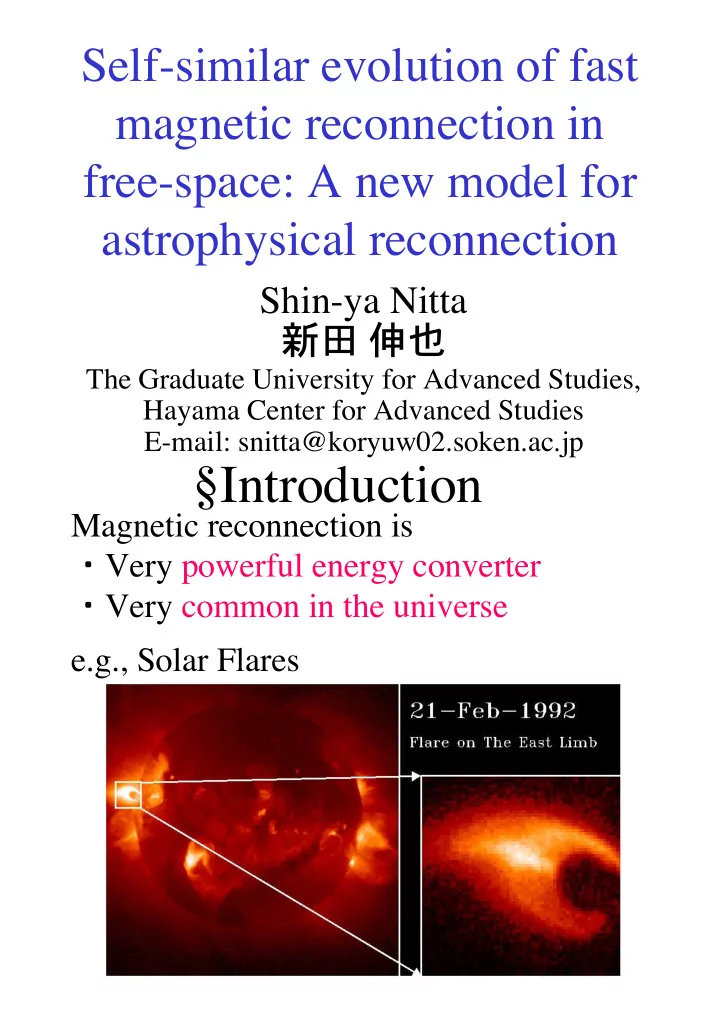
Introduction Magnetic reconnection is Very powerful energy - - PDF document
Self-similar evolution of fast magnetic reconnection in free-space: A new model for astrophysical reconnection Shin-ya Nitta The Graduate University for Advanced Studies, Hayama Center for Advanced Studies E-mail:
Astrophysical Reconnection is characterized by
huge dynamic range of expansion
e.g., Solar flares
Initial system scale
(Initial Current Sheet Thickness )
Final system scale
(Maximum scale of reconnection system )
⇩ intrinsically Time-Dependent
Should be treated as
Spontaneous Evolution in Free Space Cannot be described by previous models! §§Astrophysical Reconnection
Aim of this work
Suitable reconnection model for astrophysical application?
⇩
Self-Similar Evolution
§Evolution Process
!"#$%& !"##$%&!'($$& )*+) ,- . ./00"1/2%!*$3/2%
1) Onset (Resistive Stage) 2) Induction of Inflow 3) Similarity Stage (Petschek-like at center) Sweet-Parker-like or tearing ⇩ Formation of Fast-mode Rarefaction Wave Propagation of FRWF ⇩ Induction of Inflow Formation of Slow-Shock ⇩ Fast-mode Rarefaction Dominated (Petschek-like) Fast Reconnection
Parameters & Normalization
Parameters Normalization ⇨
§Numerical Approach
Initial Equilibrium (Harris solution) Code: 2-step Lax-Wendroff
CurrentSheet x y D:InitialCurrentSheetDepth 2D ResistiveRegion
Self-Similarly Expanding! with Fast-mode Rarefaction Wave Front
§§Simulation Result
§Analytical Approach
§§Inflow Region Zoom-out coordinate
Linear perturbation method
Equilibrium (0th)+Deviation (1st) by reconnection Grad-Shafranov Eq.
§ § Solution for Inflow Region
Fairly Consistent!
§§Reconnection Outflow
Quasi-1D structure divided by several discontinuities
Reconnection jet collides with current sheet plasma
⇩ Shock tube approximation
22 eqs. (junction conditions) for 22 unknowns ⇩ Quantities in outflow spontaneously determined!!
! "
#$%&'(!%)'*+ ,'-(.-/!%&'(!%)'*+ 0'12.*2!345*'16 7898-58!,.52!%)'*+ 0:--812! %)882
- 8;4'1!<
- 8;4'1!=
- 8;4'1!>
- 8;4'1!?
!!!%2-:*2:-8!'@!-8*'118*24'1!':2@&'(
%&'(!%)'*+
!@ !* !5
§§Reconnection Rate
- Rec. rate R ~ 0.05 for low β
(almost const. indep. of β) ⇧ Spontaneous inhalation of inflow (induced by fast-mode rarefaction)
! !"!# !"!$ !"!% !"!& !"!' !"!( !"!!!# !"!!# !"!# !"# # #! #!! #!!!
Reconnection Rate vs. beta
- Vyp*Bxp
Beta0
(Rem*≡VA0/Vdif*) converging inflow: |Vxp|↑ as Rem*↑ ⇨Vp, Bp → parallel at inflow region R ≡Vp×Bp ∝Rem*^(-1)
!"!# !"# #! #!!
Reconnection Rate vs. Mag. Reynolds Num.
- Vyp*Bxp+Vxp*Byp
Rem*
S S L S S D R ! "
§Observational Inspection
“Dimming” around reconnection point ⇧ Rarefied region by FRW Existence of inflow~10[km/s] Expanding in VA0 ~1000[km/s] Duration ~100[s]
1.185 1.040 0.715 0.930 1.000
0.00 0.20 0.40 0.60 0.80 1.00 0.00 0.20 0.40 0.60 0.80 1.00 x y Emission Measure
We can inspect Self-Similar Model by Solar-B
§Summary
Spontaneous Evolution of Fast Magnetic Reconnection in Free Space
⇩ Self-Similar Solution
(verified by numerical simulation/analytical study) A new model of Magnetic Reconnection
Self-Similar Evolution of Fast Reconnection
Properties ・Expanding with propagation of FRW ・Petschek-like structure in central region (Fast-mode rarefaction dominated) ・Reconnection rate R ~ 0.05 (for small Rem*<20, insensitive to β) ⇦ spontaneous inhalation of inflow ・ Reconnection rate R ∝Rem*^(-1) (for large Rem*≫20, insensitive to β)
References
Nitta, Tanuma, Shibata, Maezawa ApJ, 550, 1119 (2001) Nitta, Tanuma, Maezawa ApJ, 580, 538 (2002) Nitta ApJ, 610, 1117 (2004)
§§Simulation Result Evolution in Zoom-Out Coordinate
Self-Similarly Expanding! with propagation of Fast-mode Wave Front Features of reconnection system
R ≡Vp×Bp ∝Rem*^(-1) (Rem*≡ VA0/Vdif*) ⇧ converging inflow: |Vxp|↑ as Rem*↑ ⇨Vp, Bp → parallel at inflow region ⇨ R≡Vp×Bp↓
!"!# !"# #! #!!
Reconnection Rate vs. Mag. Reynolds Num.
- Vyp*Bxp+Vxp*Byp
Rem*
A new model of magnetic reconnection: Self-similar evolving model
Shin-ya Nitta
新田 伸也
The Graduate University for Advanced Studies, Hayama Center for Advanced Studies E-mail: snitta@koryuw02.soken.ac.jp