
SLIDE 1
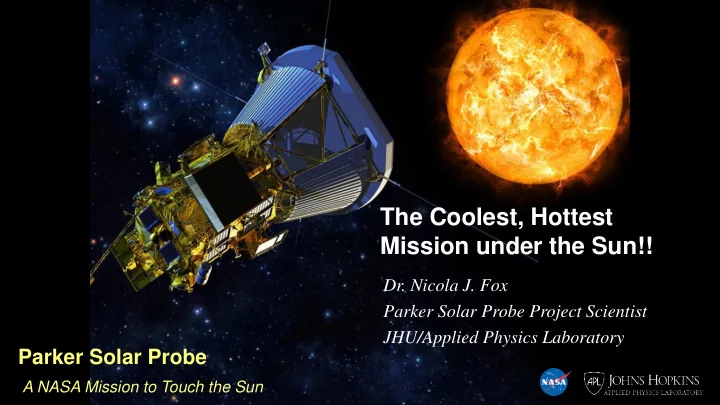
Parker Solar Probe
A NASA Mission to Touch the Sun
The Coolest, Hottest Mission under the Sun!!
- Dr. Nicola J. Fox
Parker Solar Probe Project Scientist JHU/Applied Physics Laboratory
The Coolest, Hottest Mission under the Sun!! Dr. Nicola J. Fox - - PowerPoint PPT Presentation
The Coolest, Hottest Mission under the Sun!! Dr. Nicola J. Fox Parker Solar Probe Project Scientist JHU/Applied Physics Laboratory Parker Solar Probe A NASA Mission to Touch the Sun We are PARKER SOLAR PROBE! Parker, meet Parker Parker Solar
Parker Solar Probe
A NASA Mission to Touch the Sun
The Coolest, Hottest Mission under the Sun!!
Parker Solar Probe Project Scientist JHU/Applied Physics Laboratory
December 12, 2017 Parker Solar Probe– Fall AGU 2017
We are PARKER SOLAR PROBE! Parker, meet Parker
December 12, 2017 Parker Solar Probe– Fall AGU 2017
Why haven’t we gone to the Sun yet?
It took the same technological leap from a rotary phone to an iPhone X for Parker Solar Probe to become a reality
Parker Solar Probe Mission Briefing November 16, 2017
magnetic field, understand how the solar corona and wind are heated and accelerated, and determine what mechanisms accelerate and transport energetic particles. Detailed Science Objectives
solar corona and solar wind.
magnetic fields at the sources of the solar wind.
particles.
Parker Solar Probe Mission Briefing November 16, 2017
Modeling: Providing the missing piece
shortly after each orbit for ingestion into the coronal, solar wind and global heliospheric models
the mapping between the spacecraft and the solar surface though each orbit
context when we fly through CMEs
Nour.Raouafi@jhuapl.edu
Baker et al., 2012 Manchester 2014
Journey to the Sun
Fas aste ter r Hott
er Closer
SWEAP PI Justin Kasper University of Michigan
At closest approach, the front the heat shield will be at 1,400°C (2500 oF), but the payload will be near room temperature
Anti-Ram Facing View
FIELDS PI Stuart Bale (UC, Berkeley) ISIS PI David McComas (Princeton) WISPR PI Russ Howard (Naval Research Lab)
Ram Facing View
685 kg max launch wet mass Reference Dimensions:
S/C height: 3 m TPS max diameter: 2.3 m S/C bus diameter: 1 m
C-C Thermal protection system Actively cooled solar arrays Wheels for attitude control
IS⦿IS Suite
Finishing environmental testing
Transitioning to Florida
PSP arrives at her temporary home
It has been almost 60 years since the Parker Solar Probe Concept was introduced. . . We are on our way!