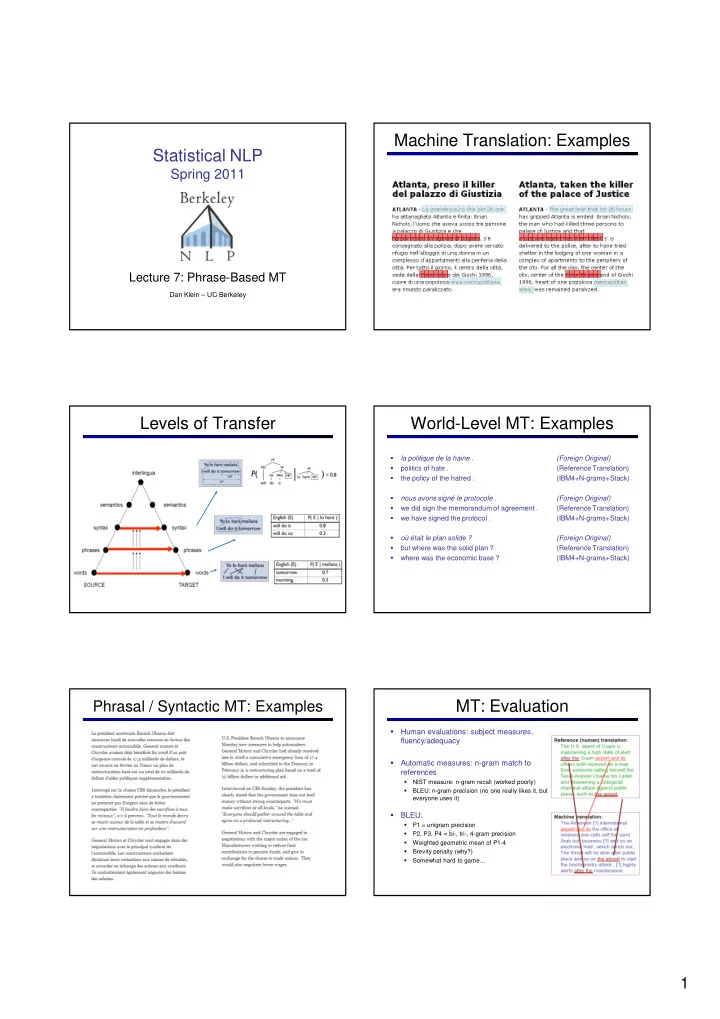
Machine Translation: Examples Statistical NLP Spring 2011 Lecture - - PDF document

machine translation examples statistical nlp
SMART_READER_LITE
LIVE PREVIEW

Machine Translation: Examples Statistical NLP Spring 2011 Lecture - - PDF document

Machine Translation: Examples Statistical NLP Spring 2011 Lecture 7: Phrase-Based MT Dan Klein UC Berkeley Levels of Transfer World-Level MT: Examples la politique de la haine . (Foreign Original) politics of hate .


slide-1
SLIDE 1

1

Statistical NLP

Spring 2011

Lecture 7: Phrase-Based MT

Dan Klein – UC Berkeley

Machine Translation: Examples Levels of Transfer World-Level MT: Examples

  • la politique de la haine .

(Foreign Original)

  • politics of hate .

(Reference Translation)

  • the policy of the hatred .

(IBM4+N-grams+Stack)

  • nous avons signé le protocole .

(Foreign Original)

  • we did sign the memorandum of agreement .

(Reference Translation)

  • we have signed the protocol .

(IBM4+N-grams+Stack)

  • ù était le plan solide ?

(Foreign Original)

  • but where was the solid plan ?

(Reference Translation)

  • where was the economic base ?

(IBM4+N-grams+Stack)

Phrasal / Syntactic MT: Examples

MT: Evaluation

  • Human evaluations: subject measures,

fluency/adequacy

  • Automatic measures: n-gram match to

references

  • NIST measure: n-gram recall (worked poorly)
  • BLEU: n-gram precision (no one really likes it, but

everyone uses it)

  • BLEU:
  • P1 = unigram precision
  • P2, P3, P4 = bi-, tri-, 4-gram precision
  • Weighted geometric mean of P1-4
  • Brevity penalty (why?)
  • Somewhat hard to game…
slide-2
SLIDE 2

2

Automatic Metrics Work (?) Corpus-Based MT

Modeling correspondences between languages

Sentence-aligned parallel corpus: Yo lo haré mañana I will do it tomorrow Hasta pronto See you soon Hasta pronto See you around Yo lo haré pronto I will do it soon I will do it around See you tomorrow Machine translation system: Model of translation

Phrase-Based Systems

Sentence-aligned corpus

cat ||| chat ||| 0.9 the cat ||| le chat ||| 0.8 dog ||| chien ||| 0.8 house ||| maison ||| 0.6 my house ||| ma maison ||| 0.9 language ||| langue ||| 0.9 …

Phrase table (translation model) Word alignments

Many slides and examples from Philipp Koehn or John DeNero

Phrase-Based Decoding

这 7人 中包括 来自 法国 和 俄罗斯 的 宇航 员 .

Decoder design is important: [Koehn et al. 03]

The Pharaoh “Model”

[Koehn et al, 2003] Segmentation Translation Distortion

slide-3
SLIDE 3

3

The Pharaoh “Model”

Where do we get these counts?

Phrase Weights Phrase-Based Decoding Monotonic Word Translation

  • Cost is LM * TM
  • It’s an HMM?
  • P(e|e-1,e-2)
  • P(f|e)
  • State includes
  • Exposed English
  • Position in foreign
  • Dynamic program loop?

[…. a slap, 5] 0.00001 […. slap to, 6] 0.00000016 […. slap by, 6] 0.00000001 for (fPosition in 1…|f|) for (eContext in allEContexts) for (eOption in translations[fPosition]) score = scores[fPosition-1][eContext] * LM(eContext+eOption) * TM(eOption, fWord[fPosition]) scores[fPosition][eContext[2]+eOption] =max score

Beam Decoding

  • For real MT models, this kind of dynamic program is a disaster (why?)
  • Standard solution is beam search: for each position, keep track of
  • nly the best k hypotheses
  • Still pretty slow… why?
  • Useful trick: cube pruning (Chiang 2005)

for (fPosition in 1…|f|) for (eContext in bestEContexts[fPosition]) for (eOption in translations[fPosition]) score = scores[fPosition-1][eContext] * LM(eContext+eOption) * TM(eOption, fWord[fPosition]) bestEContexts.maybeAdd(eContext[2]+eOption, score) Example from David Chiang

Phrase Translation

  • If monotonic, almost an HMM; technically a semi-HMM
  • If distortion… now what?

for (fPosition in 1…|f|) for (lastPosition < fPosition) for (eContext in eContexts) for (eOption in translations[fPosition]) … combine hypothesis for (lastPosition ending in eContext) with eOption

slide-4
SLIDE 4

4

Non-Monotonic Phrasal MT

Pruning: Beams + Forward Costs

Problem: easy partial analyses are cheaper

Solution 1: use beams per foreign subset Solution 2: estimate forward costs (A*-like)

The Pharaoh Decoder Hypotheis Lattices Word Alignment

Word Alignment

slide-5
SLIDE 5

5

Unsupervised Word Alignment

  • Input: a bitext: pairs of translated sentences
  • Output: alignments: pairs of

translated words

When words have unique sources, can represent as a (forward) alignment function a from French to English positions

nous acceptons votre opinion . we accept your view .

1-to-Many Alignments Many-to-Many Alignments IBM Model 1 (Brown 93)

  • Alignments: a hidden vector called an alignment specifies which

English source is responsible for each French target word. A:

IBM Models 1/2

Thank you , I shall do so gladly .

1 3 7 6 9

1 2 3 4 5 7 6 8 9

Model Parameters

Transitions: P( A2 = 3) Emissions: P( F1 = Gracias | EA1 = Thank )

Gracias , lo haré de muy buen grado .

8 8 8 8

E: F: