Statistical Machine Translation Statistical Machine Translation p - - PDF document

statistical machine translation statistical machine
SMART_READER_LITE
LIVE PREVIEW

Statistical Machine Translation Statistical Machine Translation p - - PDF document

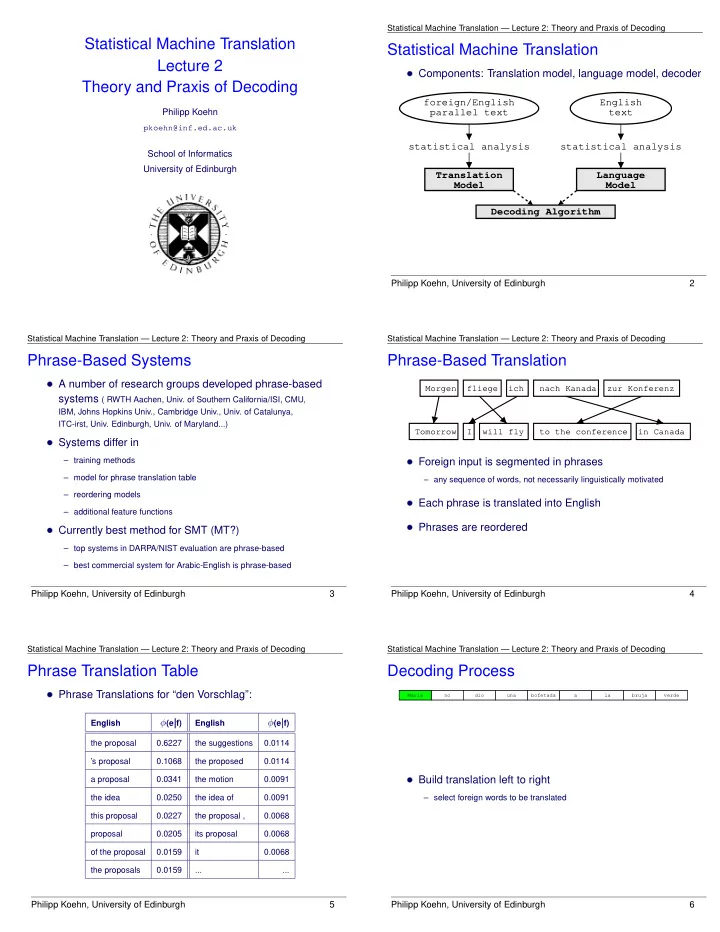
Components: Translation model, language model, decoder Statistical Machine Translation Lecture 2: Theory and Praxis of Decoding p Statistical Machine Translation Statistical Machine Translation p Lecture 2 Theory and Praxis of Decoding


slide-1
SLIDE 1

Statistical Machine Translation Lecture 2 Theory and Praxis of Decoding

Philipp Koehn

pkoehn@inf.ed.ac.uk

School of Informatics University of Edinburgh

– p.1

Statistical Machine Translation — Lecture 2: Theory and Praxis of Decoding p

Statistical Machine Translation p

Components: Translation model, language model, decoder

statistical analysis statistical analysis foreign/English parallel text English text Translation Model Language Model Decoding Algorithm

Philipp Koehn, University of Edinburgh 2

– p.2

Statistical Machine Translation — Lecture 2: Theory and Praxis of Decoding p

Phrase-Based Systems p

A number of research groups developed phrase-based

systems ( RWTH Aachen, Univ. of Southern California/ISI, CMU,

IBM, Johns Hopkins Univ., Cambridge Univ., Univ. of Catalunya, ITC-irst, Univ. Edinburgh, Univ. of Maryland...)

Systems differ in

– training methods – model for phrase translation table – reordering models – additional feature functions

Currently best method for SMT (MT?)

– top systems in DARPA/NIST evaluation are phrase-based – best commercial system for Arabic-English is phrase-based

Philipp Koehn, University of Edinburgh 3

– p.3

Statistical Machine Translation — Lecture 2: Theory and Praxis of Decoding p

Phrase-Based Translation p

Morgen fliege ich nach Kanada zur Konferenz Tomorrow I will fly to the conference in Canada

Foreign input is segmented in phrases

– any sequence of words, not necessarily linguistically motivated

Each phrase is translated into English Phrases are reordered

Philipp Koehn, University of Edinburgh 4

– p.4

Statistical Machine Translation — Lecture 2: Theory and Praxis of Decoding p

Phrase Translation Table p

Phrase Translations for “den Vorschlag”:

English

(ejf)

English

(ejf)

the proposal 0.6227 the suggestions 0.0114 ’s proposal 0.1068 the proposed 0.0114 a proposal 0.0341 the motion 0.0091 the idea 0.0250 the idea of 0.0091 this proposal 0.0227 the proposal , 0.0068 proposal 0.0205 its proposal 0.0068

  • f the proposal

0.0159 it 0.0068 the proposals 0.0159 ... ...

Philipp Koehn, University of Edinburgh 5

– p.5

Statistical Machine Translation — Lecture 2: Theory and Praxis of Decoding p

Decoding Process p

bruja Maria no verde la a dio una bofetada

Build translation left to right

– select foreign words to be translated

Philipp Koehn, University of Edinburgh 6

– p.6

slide-2
SLIDE 2

Statistical Machine Translation — Lecture 2: Theory and Praxis of Decoding p

Decoding Process p

bruja Maria no Mary verde la a dio una bofetada

Build translation left to right

– select foreign words to be translated – find English phrase translation – add English phrase to end of partial translation

Philipp Koehn, University of Edinburgh 7

– p.7

Statistical Machine Translation — Lecture 2: Theory and Praxis of Decoding p

Decoding Process p

bruja no verde la a dio una bofetada Mary Maria

Build translation left to right

– select foreign words to be translated – find English phrase translation – add English phrase to end of partial translation – mark foreign words as translated

Philipp Koehn, University of Edinburgh 8

– p.8

Statistical Machine Translation — Lecture 2: Theory and Praxis of Decoding p

Decoding Process p

bruja Maria no Mary did not verde la a dio una bofetada

One to many translation

Philipp Koehn, University of Edinburgh 9

– p.9

Statistical Machine Translation — Lecture 2: Theory and Praxis of Decoding p

Decoding Process p

bruja Maria no dio una bofetada Mary did not slap verde la a

Many to one translation

Philipp Koehn, University of Edinburgh 10

– p.10

Statistical Machine Translation — Lecture 2: Theory and Praxis of Decoding p

Decoding Process p

bruja Maria no dio una bofetada Mary did not slap the verde a la

Many to one translation

Philipp Koehn, University of Edinburgh 11

– p.11

Statistical Machine Translation — Lecture 2: Theory and Praxis of Decoding p

Decoding Process p

bruja Maria no dio una bofetada a la Mary did not slap the green verde

Reordering

Philipp Koehn, University of Edinburgh 12

– p.12

slide-3
SLIDE 3

Statistical Machine Translation — Lecture 2: Theory and Praxis of Decoding p

Decoding Process p

bruja Maria witch no verde Mary did not slap the green dio una bofetada a la

Translation finished

Philipp Koehn, University of Edinburgh 13

– p.13

Statistical Machine Translation — Lecture 2: Theory and Praxis of Decoding p

Translation Options p

bofetada una dio a la verde bruja no Maria Mary not did not give a slap to the witch green by to the to green witch the witch did not give no a slap slap the slap

Look up possible phrase translations

– many different ways to segment words into phrases – many different ways to translate each phrase

Philipp Koehn, University of Edinburgh 14

– p.14

Statistical Machine Translation — Lecture 2: Theory and Praxis of Decoding p

Hypothesis Expansion p

dio a la verde bruja no Maria Mary not did not give a slap to the witch green by to the to green witch the witch did not give no a slap slap the slap e: f: --------- p: 1 una bofetada

Start with empty hypothesis

– e: no English words – f: no foreign words covered – p: probability 1

Philipp Koehn, University of Edinburgh 15

– p.15

Statistical Machine Translation — Lecture 2: Theory and Praxis of Decoding p

Hypothesis Expansion p

dio a la verde bruja no Maria Mary not did not give a slap to the witch green by to the to green witch the witch did not give no a slap slap the slap e: Mary f: *-------- p: .534 e: f: --------- p: 1 una bofetada

Pick translation option Create hypothesis

– e: add English phrase Mary – f: first foreign word covered – p: probability 0.534

Philipp Koehn, University of Edinburgh 16

– p.16

Statistical Machine Translation — Lecture 2: Theory and Praxis of Decoding p

A Quick Word on Probabilities p

Not going into detail here, but... Translation Model

– phrase translation probability p(Mary

jMaria)

– reordering costs – phrase/word count costs – ...

Language Model

– uses trigrams: – p(Mary did not) = p(Mary

j <s >) * p(didjMary,<s >) * p(notjMary did)

Philipp Koehn, University of Edinburgh 17

– p.17

Statistical Machine Translation — Lecture 2: Theory and Praxis of Decoding p

Hypothesis Expansion p

dio a la verde bruja no Maria Mary not did not give a slap to the witch green by to the to green witch the witch did not give no a slap slap the slap e: Mary f: *-------- p: .534 e: witch f: -------*- p: .182 e: f: --------- p: 1 una bofetada

Add another hypothesis

Philipp Koehn, University of Edinburgh 18

– p.18

slide-4
SLIDE 4

Statistical Machine Translation — Lecture 2: Theory and Praxis of Decoding p

Hypothesis Expansion p

dio una bofetada a la verde bruja no Maria Mary not did not give a slap to the witch green by to the to green witch the witch did not give no a slap slap the slap e: Mary f: *-------- p: .534 e: witch f: -------*- p: .182 e: f: --------- p: 1 e: ... slap f: *-***---- p: .043

Further hypothesis expansion

Philipp Koehn, University of Edinburgh 19

– p.19

Statistical Machine Translation — Lecture 2: Theory and Praxis of Decoding p

Hypothesis Expansion p

dio una bofetada bruja verde Maria Mary not did not give a slap to the witch green by to the to green witch the witch did not give no a slap slap the slap e: Mary f: *-------- p: .534 e: witch f: -------*- p: .182 e: f: --------- p: 1 e: slap f: *-***---- p: .043 e: did not f: **------- p: .154 e: slap f: *****---- p: .015 e: the f: *******-- p: .004283 e:green witch f: ********* p: .000271 a la no

... until all foreign words covered

– find best hypothesis that covers all foreign words – backtrack to read off translation

Philipp Koehn, University of Edinburgh 20

– p.20

Statistical Machine Translation — Lecture 2: Theory and Praxis of Decoding p

Hypothesis Expansion p

Mary not did not give a slap to the witch green by to the to green witch the witch did not give no a slap slap the slap e: Mary f: *-------- p: .534 e: witch f: -------*- p: .182 e: f: --------- p: 1 e: slap f: *-***---- p: .043 e: did not f: **------- p: .154 e: slap f: *****---- p: .015 e: the f: *******-- p: .004283 e:green witch f: ********* p: .000271 no dio a la verde bruja no Maria una bofetada

Adding more hypothesis ) Explosion of search space

Philipp Koehn, University of Edinburgh 21

– p.21

Statistical Machine Translation — Lecture 2: Theory and Praxis of Decoding p

Explosion of Search Space p

Number of hypotheses is exponential with respect to

sentence length

) Decoding is NP-complete [Knight, 1999] ) Need to reduce search space

– risk free: hypothesis recombination – risky: histogram/threshold pruning

Philipp Koehn, University of Edinburgh 22

– p.22

Statistical Machine Translation — Lecture 2: Theory and Praxis of Decoding p

Hypothesis Recombination p

p=1 Mary did not give give did not p=0.534 p=0.164 p=0.092 p=0.044 p=0.092

Different paths to the same partial translation

Philipp Koehn, University of Edinburgh 23

– p.23

Statistical Machine Translation — Lecture 2: Theory and Praxis of Decoding p

Hypothesis Recombination p

p=1 Mary did not give give did not p=0.534 p=0.164 p=0.092 p=0.092

Different paths to the same partial translation ) Combine paths

– drop weaker hypothesis – keep pointer from worse path

Philipp Koehn, University of Edinburgh 24

– p.24

slide-5
SLIDE 5

Statistical Machine Translation — Lecture 2: Theory and Praxis of Decoding p

Hypothesis Recombination p

p=1 Mary did not give give did not p=0.534 p=0.164 p=0.092 Joe did not give p=0.092 p=0.017

Recombined hypotheses do not have to match completely No matter what is added, weaker path can be dropped, if:

– last two English words match (matters for language model) – foreign word coverage vectors match (effects future path)

Philipp Koehn, University of Edinburgh 25

– p.25

Statistical Machine Translation — Lecture 2: Theory and Praxis of Decoding p

Hypothesis Recombination p

p=1 Mary did not give give did not p=0.534 p=0.164 p=0.092 Joe did not give p=0.092

Recombined hypotheses do not have to match completely No matter what is added, weaker path can be dropped, if:

– last two English words match (matters for language model) – foreign word coverage vectors match (effects future path)

) Combine paths

Philipp Koehn, University of Edinburgh 26

– p.26

Statistical Machine Translation — Lecture 2: Theory and Praxis of Decoding p

Pruning p

Hypothesis recombination is not sufficient ) Heuristically discard weak hypotheses Organize Hypothesis in stacks, e.g. by

– same foreign words covered – same number of foreign words covered (Pharaoh does this) – same number of English words produced

Compare hypotheses in stacks, discard bad ones

– histogram pruning: keep top

n hypotheses in each stack (e.g., n=100)

– threshold pruning: keep hypotheses that are at most

times the cost of

best hypothesis in stack (e.g.,

= 0.001)

Philipp Koehn, University of Edinburgh 27

– p.27

Statistical Machine Translation — Lecture 2: Theory and Praxis of Decoding p

Hypothesis Stacks p

1 2 3 4 5 6

Organization of hypothesis into stacks

– here: based on number of foreign words translated – during translation all hypotheses from one stack are expanded – expanded Hypotheses are placed into stacks

Philipp Koehn, University of Edinburgh 28

– p.28

Statistical Machine Translation — Lecture 2: Theory and Praxis of Decoding p

Comparing Hypotheses p

Comparing hypotheses with same number of foreign

words covered

Maria no e: Mary did not f: **------- p: 0.154 a la e: the f: -----**-- p: 0.354 dio una bofetada bruja verde better partial translation covers easier part

  • -> lower cost
Hypothesis that covers easy part of sentence is preferred ) Need to consider future cost of uncovered parts

Philipp Koehn, University of Edinburgh 29

– p.29

Statistical Machine Translation — Lecture 2: Theory and Praxis of Decoding p

Future Cost Estimation p

a la to the

Estimate cost to translate remaining part of input Step 1: estimate future cost for each translation option

– look up translation model cost – estimate language model cost (no prior context) – ignore reordering model cost

! LM * TM = p(to) * p(thejto) * p(to theja la)

Philipp Koehn, University of Edinburgh 30

– p.30

slide-6
SLIDE 6

Statistical Machine Translation — Lecture 2: Theory and Praxis of Decoding p

Future Cost Estimation: Step 2 p

a la to the to the cost = 0.0372 cost = 0.0299 cost = 0.0354

Step 2: find cheapest cost among translation options

Philipp Koehn, University of Edinburgh 31

– p.31

Statistical Machine Translation — Lecture 2: Theory and Praxis of Decoding p

Future Cost Estimation: Step 3 p

bofetada una dio a la verde bruja no Maria bofetada una dio a la verde bruja no Maria

Step 3: find cheapest future cost path for each span

– can be done efficiently by dynamic programming – future cost for every span can be precomputed

Philipp Koehn, University of Edinburgh 32

– p.32

Statistical Machine Translation — Lecture 2: Theory and Praxis of Decoding p

Future Cost Estimation: Application p

dio una bofetada a la verde bruja no Maria Mary slap e: Mary f: *-------- p: .534 e: f: --------- p: 1 e: ... slap f: *-***---- p: .043 future cost future cost covered covered fc: .0006672 p*fc:.000029 0.1 0.006672 *

Use future cost estimates when pruning hypotheses For each uncovered contiguous span:

– look up future costs for each maximal contiguous uncovered span – factor them to actually accumulated cost for translation option for pruning

Philipp Koehn, University of Edinburgh 33

– p.33

Statistical Machine Translation — Lecture 2: Theory and Praxis of Decoding p

Pharaoh p

A beam search decoder for phrase-based models

– works with various phrase-based models – beam search algorithm – time complexity roughly linear with input length – good quality takes about 1 second per sentence

Very good performance in DARPA/NIST Evaluation Freely available for researchers

http://www.isi.edu/licensed-sw/pharaoh/

Philipp Koehn, University of Edinburgh 34

– p.34

Statistical Machine Translation — Lecture 2: Theory and Praxis of Decoding p

Running the decoder p

An example run of the decoder:

% echo ’das ist ein kleines haus’ | pharaoh -f pharaoh.ini > out Pharaoh v1.2.9, written by Philipp Koehn a beam search decoder for phrase-based statistical machine translation models (c) 2002-2003 University of Southern California (c) 2004 Massachusetts Institute of Technology (c) 2005 University of Edinburgh, Scotland loading language model from europarl.srilm loading phrase translation table from phrase-table, stored 21, pruned 0, kept 21 loaded data structures in 2 seconds reading input sentences translating 1 sentences.translated 1 sentences in 0 seconds % cat out this is a small house

Philipp Koehn, University of Edinburgh 35

– p.35

Statistical Machine Translation — Lecture 2: Theory and Praxis of Decoding p

Phrase Translation Table p

Core model component is the phrase translation table:

der ||| the ||| 0.3 das ||| the ||| 0.4 das ||| it ||| 0.1 das ||| this ||| 0.1 die ||| the ||| 0.3 ist ||| is ||| 1.0 ist ||| ’s ||| 1.0 das ist ||| it is ||| 0.2 das ist ||| this is ||| 0.8 es ist ||| it is ||| 0.8 es ist ||| this is ||| 0.2 ein ||| a ||| 1.0 ein ||| an ||| 1.0 klein ||| small ||| 0.8 klein ||| little ||| 0.8 kleines ||| small ||| 0.2 kleines ||| little ||| 0.2 haus ||| house ||| 1.0 alt ||| old ||| 0.8 altes ||| old ||| 0.2 gibt ||| gives ||| 1.0 es gibt ||| there is ||| 1.0

Philipp Koehn, University of Edinburgh 36

– p.36

slide-7
SLIDE 7

Statistical Machine Translation — Lecture 2: Theory and Praxis of Decoding p

Trace p

Running the decoder with switch “-t”

% echo ’das ist ein kleines haus’ | pharaoh -f pharaoh.ini -t [...] this is |0.014086|0|1| a |0.188447|2|2| small |0.000706353|3|3| house |1.46468e-07|4|4|

Trace for each applied phrase translation:

– output phrase (there is) – cost incurred by this phrase (0.014086) – coverage of foreign words (0-1)

Philipp Koehn, University of Edinburgh 37

– p.37

Statistical Machine Translation — Lecture 2: Theory and Praxis of Decoding p

Reordering Example p

Sometimes phrases have to be reordered:

% echo ’ein kleines haus ist das’ | pharaoh -f pharaoh.ini -t -d 0.5 [...] this |0.000632805|4|4| is |0.13853|3|3| a |0.0255035|0|0| small |0.000706353|1|1| house |1.46468e-07|2|2|

First output phrase (this) is translation of the 4th word

Philipp Koehn, University of Edinburgh 38

– p.38

Statistical Machine Translation — Lecture 2: Theory and Praxis of Decoding p

Hypothesis Accounting p

The switch “-v” allows for detailed run time information:

% echo ’das ist ein kleins haus’ | pharaoh -f pharaoh.ini -v 2 [...] HYP: 114 added, 284 discarded below threshold, 0 pruned, 58 merged. BEST: this is a small house -28.9234

Statistics over how many hypothesis were generated

– 114 hypotheses were added to hypothesis stacks – 284 hypotheses were discarded because they were too bad – 0 hypotheses were pruned, because a stack got too big – 58 hypotheses were merged due to recombination

Probability of the best translation: exp(-28.9234)

Philipp Koehn, University of Edinburgh 39

– p.39

Statistical Machine Translation — Lecture 2: Theory and Praxis of Decoding p

Translation Options p

Even more run time information is revealed with “-v 3”:

[das;2] the<1>, pC=-0.916291, c=-5.78855 it<2>, pC=-2.30259, c=-8.0761 this<3>, pC=-2.30259, c=-8.00205 [ist;4] is<4>, pC=0, c=-4.92223 ’s<5>, pC=0, c=-6.11591 [ein;7] a<8>, pC=0, c=-5.5151 an<9>, pC=0, c=-6.41298 [kleines;9] small<10>, pC=-1.60944, c=-9.72116 little<11>, pC=-1.60944, c=-10.0953 [haus;10] house<12>, pC=0, c=-9.26607 [das ist;5] it is<6>, pC=-1.60944, c=-10.207 this is<7>, pC=-0.223144, c=-10.2906

Translation model cost (pC) and future cost estimates (c)

Philipp Koehn, University of Edinburgh 40

– p.40

Statistical Machine Translation — Lecture 2: Theory and Praxis of Decoding p

Future Cost Estimation p

Pre-computation of the future cost estimates:

future costs from 0 to 0 is -5.78855 future costs from 0 to 1 is -10.207 future costs from 0 to 2 is -15.7221 future costs from 0 to 3 is -25.4433 future costs from 0 to 4 is -34.7094 future costs from 1 to 1 is -4.92223 future costs from 1 to 2 is -10.4373 future costs from 1 to 3 is -20.1585 future costs from 1 to 4 is -29.4246 future costs from 2 to 2 is -5.5151 future costs from 2 to 3 is -15.2363 future costs from 2 to 4 is -24.5023 future costs from 3 to 3 is -9.72116 future costs from 3 to 4 is -18.9872 future costs from 4 to 4 is -9.26607

Philipp Koehn, University of Edinburgh 41

– p.41

Statistical Machine Translation — Lecture 2: Theory and Praxis of Decoding p

Hypothesis Expansion p

Start of beam search: First hypothesis (das ! the)

creating hypothesis 1 from 0 ( ... </s> <s> ) base score 0 covering 0-0: das translated as: the => translation cost -0.916291 distance 0 => distortion cost 0 language model cost for ’the’ -2.03434 word penalty -0 score -2.95064 + futureCost -29.4246 = -32.3752 new best estimate for this stack merged hypothesis on stack 1, now size 1

Philipp Koehn, University of Edinburgh 42

– p.42

slide-8
SLIDE 8

Statistical Machine Translation — Lecture 2: Theory and Praxis of Decoding p

Hypothesis Expansion p

Another hypothesis (das ist ! this is)

creating hypothesis 12 from 0 ( ... </s> <s> ) base score 0 covering 0-1: das ist translated as: this is => translation cost -0.223144 distance 0 => distortion cost 0 language model cost for ’this’ -3.06276 language model cost for ’is’ -0.976669 word penalty -0 score -4.26258 + futureCost -24.5023 = -28.7649 new best estimate for this stack merged hypothesis on stack 2, now size 2

Philipp Koehn, University of Edinburgh 43

– p.43

Statistical Machine Translation — Lecture 2: Theory and Praxis of Decoding p

Hypothesis Expansion p

Hypothesis recombination

creating hypothesis 27 from 3 ( ... <s> this ) base score -5.36535 covering 1-1: ist translated as: is => translation cost 0 distance 0 => distortion cost 0 language model cost for ’is’ -0.976669 word penalty -0 score -6.34202 + futureCost -24.5023 = -30.8443 worse than existing path to 12, discarding

Philipp Koehn, University of Edinburgh 44

– p.44

Statistical Machine Translation — Lecture 2: Theory and Praxis of Decoding p

Hypothesis Expansion p

Bad hypothesis that falls out of the beam

creating hypothesis 52 from 6 ( ... <s> a ) base score -6.65992 covering 0-0: das translated as: this => translation cost -2.30259 distance -3 => distortion cost -3 language model cost for ’this’ -8.69176 word penalty -0 score -20.6543 + futureCost -23.9095 = -44.5637 estimate below threshold, discarding

Philipp Koehn, University of Edinburgh 45

– p.45

Statistical Machine Translation — Lecture 2: Theory and Praxis of Decoding p

Generating Best Translation p

Generating best translation

– find best final hypothesis (442) – trace back path to initial hypothesis

best hypothesis 442 [ 442 => 343 ] [ 343 => 106 ] [ 106 => 12 ] [ 12 => 0 ]

Philipp Koehn, University of Edinburgh 46

– p.46

Statistical Machine Translation — Lecture 2: Theory and Praxis of Decoding p

Translation Table Pruning p

Limiting translation table size speeds up search Histogram pruning: keeping only top n entries Threshold pruning: keep only entries that score times

worse than best

Philipp Koehn, University of Edinburgh 47

– p.47

Statistical Machine Translation — Lecture 2: Theory and Praxis of Decoding p

Beam Size p

Trade-off between speed and quality via beam size

% echo ’das ist ein kleines haus’ | pharaoh -f pharaoh.ini -s 10 -v 2 [...] collected 12 translation options HYP: 78 added, 122 discarded below threshold, 33 pruned, 20 merged. BEST: this is a small house -28.9234

Beam size Threshold

  • Hyp. added
  • Hyp. discarded
  • Hyp. pruned
  • Hyp. merged

1000 unlimited 634 1306 100 unlimited 557 32 199 572 100 0.00001 144 284 58 10 0.00001 78 122 33 20 1 0.00001 9 19 4

Philipp Koehn, University of Edinburgh 48

– p.48

slide-9
SLIDE 9

Statistical Machine Translation — Lecture 2: Theory and Praxis of Decoding p

Limits on Reordering p

Reordering may be limited

– Monotone Translation: No reordering at all – Only phrase movements of at most

n words Reordering limits speed up search Current reordering models are weak, so limits improve

translation quality

Philipp Koehn, University of Edinburgh 49

– p.49

Statistical Machine Translation — Lecture 2: Theory and Praxis of Decoding p

Word Lattice Generation p

p=1 Mary did not give give did not p=0.534 p=0.164 p=0.092 Joe did not give p=0.092

Search graph can be easily converted into a word lattice

– can be further mined for n-best lists

! enables reranking approaches ! enables discriminative training

Mary did not give give did not Joe did not give

Philipp Koehn, University of Edinburgh 50

– p.50

Statistical Machine Translation — Lecture 2: Theory and Praxis of Decoding p

Sample N-Best List p

N-best list from Pharaoh:

Translation ||| Reordering LM TM WordPenalty ||| Score this is a small house ||| 0 -27.0908 -1.83258 -5 ||| -28.9234 this is a little house ||| 0 -28.1791 -1.83258 -5 ||| -30.0117 it is a small house ||| 0 -27.108 -3.21888 -5 ||| -30.3268 it is a little house ||| 0 -28.1963 -3.21888 -5 ||| -31.4152 this is an small house ||| 0 -31.7294 -1.83258 -5 ||| -33.562 it is an small house ||| 0 -32.3094 -3.21888 -5 ||| -35.5283 this is an little house ||| 0 -33.7639 -1.83258 -5 ||| -35.5965 this is a house small ||| -3 -31.4851 -1.83258 -5 ||| -36.3176 this is a house little ||| -3 -31.5689 -1.83258 -5 ||| -36.4015 it is an little house ||| 0 -34.3439 -3.21888 -5 ||| -37.5628 it is a house small ||| -3 -31.5022 -3.21888 -5 ||| -37.7211 this is an house small ||| -3 -32.8999 -1.83258 -5 ||| -37.7325 it is a house little ||| -3 -31.586 -3.21888 -5 ||| -37.8049 this is an house little ||| -3 -32.9837 -1.83258 -5 ||| -37.8163 the house is a little ||| -7 -28.5107 -2.52573 -5 ||| -38.0364 the is a small house ||| 0 -35.6899 -2.52573 -5 ||| -38.2156 is it a little house ||| -4 -30.3603 -3.91202 -5 ||| -38.2723 the house is a small ||| -7 -28.7683 -2.52573 -5 ||| -38.294 it ’s a small house ||| 0 -34.8557 -3.91202 -5 ||| -38.7677 this house is a little ||| -7 -28.0443 -3.91202 -5 ||| -38.9563 it ’s a little house ||| 0 -35.1446 -3.91202 -5 ||| -39.0566 this house is a small ||| -7 -28.3018 -3.91202 -5 ||| -39.2139

Philipp Koehn, University of Edinburgh 51

– p.51

Statistical Machine Translation — Lecture 2: Theory and Praxis of Decoding p

XML Interface p

Er erzielte <NUMBER english=’17.55’>17,55</NUMBER> Punkte .

Add additional translation options

– number translation – noun phrase translation [Koehn, 2003] – name translation

Additional options

– provide multiple translations – provide probability distribution along with translations – allow bypassing of provided translations

Philipp Koehn, University of Edinburgh 52

– p.52

Statistical Machine Translation — Lecture 2: Theory and Praxis of Decoding p

Thank You! p

Questions?

Philipp Koehn, University of Edinburgh 53

– p.53