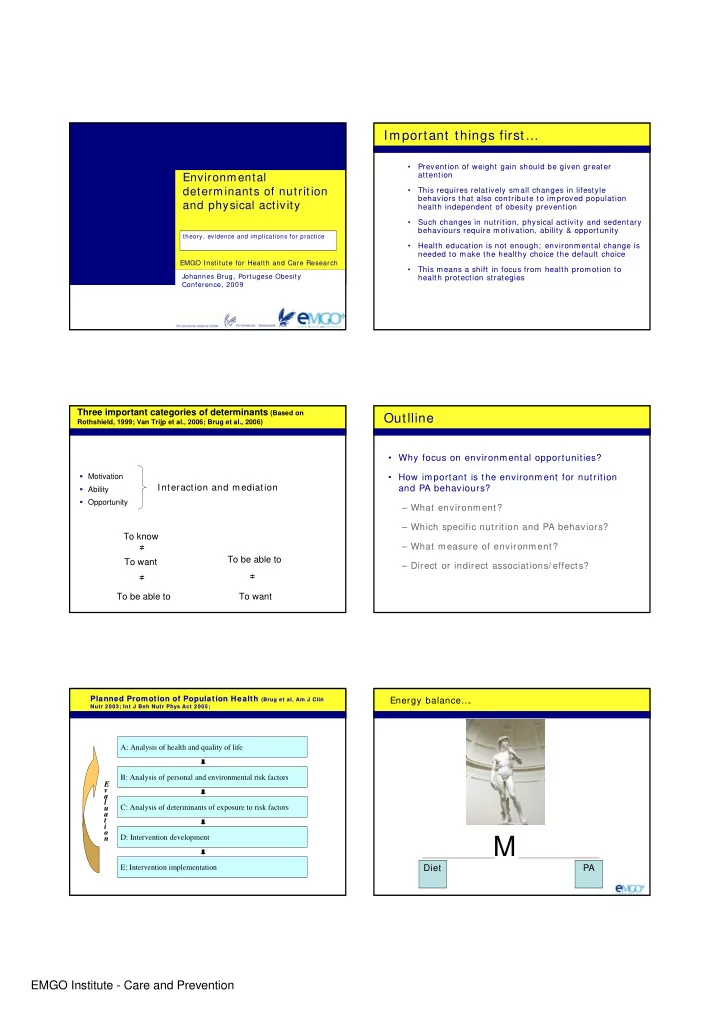
M E: Intervention implementation Diet PA EMGO Institute - Care - - PDF document

m
SMART_READER_LITE
LIVE PREVIEW

M E: Intervention implementation Diet PA EMGO Institute - Care - - PDF document

Important things first Prevention of weight gain should be given greater Environmental attention determinants of nutrition This requires relatively small changes in lifestyle behaviors that also contribute to improved population


slide-1
SLIDE 1

EMGO Institute - Care and Prevention

EMGO Institute for Health and Care Research

Lifestyle, Overweight and Diabetes

Environmental determinants of nutrition and physical activity

theory, evidence and implications for practice

Johannes Brug, Portugese Obesity Conference, 2009

Important things first…

  • Prevention of weight gain should be given greater

attention

  • This requires relatively small changes in lifestyle

behaviors that also contribute to improved population health independent of obesity prevention

  • Such changes in nutrition, physical activity and sedentary

behaviours require motivation, ability & opportunity

  • Health education is not enough; environmental change is

needed to make the healthy choice the default choice

  • This means a shift in focus from health promotion to

health protection strategies

To know ≠ ≠ To want To be able to

Motivation Ability Opportunity

Three important categories of determinants (Based on

Rothshield, 1999; Van Trijp et al., 2006; Brug et al., 2006)

Interaction and mediation To be able to ≠ To want

Outlline

  • Why focus on environmental opportunities?
  • How im portant is the environm ent for nutrition

and PA behaviours? – What environm ent? – Which specific nutrition and PA behaviors? – What measure of environment? – Direct or indirect associations/ effects?

Planned Planned Promotion of Promotion of Population Population Health Health (Brug et al. Am J

(Brug et al. Am J Clin Clin Nutr Nutr 2003; Int J 2003; Int J Beh Beh Nutr Nutr Phys Phys Act 2005; Act 2005;

A: Analysis of health and quality of life B: Analysis of personal and environmental risk factors C: Analysis of determinants of exposure to risk factors D: Intervention development E: Intervention implementation E E v v a a l l u u a a t t i i

  • n

n

M

Diet PA Energy balance… .

slide-2
SLIDE 2

EMGO Institute - Care and Prevention

M

D i e t P A Positive energy im balance… .

Planned Planned Promotion of Promotion of Population Population Health Health (Brug et al. Am J

(Brug et al. Am J Clin Clin Nutr Nutr 2003; Int J 2003; Int J Beh Beh Nutr Nutr Phys Phys Act 2005; Act 2005;

A: Analysis of health and quality of life B: Analysis of personal and environmental risk factors C: Analysis of determinants of exposure to risk factors D: Intervention development E: Intervention implementation E E v v a a l l u u a a t t i i

  • n

n

Free choice II: people act sensibly

High cognitive effort (motivation) Little cognitive effort Energy expenditure Energy intake Based on Hill, 2002

Preventive action THREAT = Perceived susceptibility X Perceived severity Evolution of a theory… (1): People change when you scare them?

Free choice II: people act sensibly

Preventive action THREAT = Perceived susceptibility X Perceived severity Change in diet THREAT = Unhealthful eating puts ME at risk for weight gain X Weight gain is very bad Beliefs X evaluations Attitudes Behaviour

  • There is m ore than risks and health…
  • Beliefs are not knowledge…
  • Affective rather than cognitive?

10 20 30 40 50 60 70 80 90 100 Important Unpleasant

Attitudes to prevent weight gain (Wammes et al. Int J Beh Nutr Phys Act, 2005.)

slide-3
SLIDE 3

EMGO Institute - Care and Prevention

Theory of planned behavior (Ajzen, 1981).

Subjective norms Intention Behaviour Perceived behavior control Attitudes

  • W e are not alone
  • W e are not alw ays in control

20-50% variance explained

  • r:
  • Precaution adoption process model
  • Social cognitive theory
  • Health belief m odel
  • Et cetera
  • Ultimate aim: prevention of
  • verweight
  • Focused on: establishing a neutral

energy balance

Mass media campaign ‘Maak je niet dik!’

  • Target group: special attention to young

adults (25‐35 years of age) with healthy BMI (18‐25)

  • Period: 2002‐2007

10 20 30 40 50 60 70 80 90 100 10 20 30 40 50 60 70 80 90 100 110 120 130

week %

campaign awareness message recall familiar with

  • ne of the

campaign activities familiar with the radio commercial familiar with the TV commercial familiar with the brochure familiar with advertisement in newspapers Campaign 1 Campaign 2 Campaign 3 Campaign 4 Campaign 5 Campaign 6

Changes in campaign awareness and message recall during the campaign weeks

Wammes et al., Public Health Nutr, 2005; Wammes et al. Obesity, 2008

10 20 30 40 50 60 70 80 90 100 10 20 30 40 50 60 70 80 90 100 110 120 130

week %

awareness: realistic about personal body weight attitude low self efficacy expectations social support motivatie Campaign 1 Campaign 2 Campaign 3 Campaign 4 Campaign 5 Campaign 6

Changes in psychosocial variables during the campaign weeks

* *

Individually-tailored health education; web-based

slide-4
SLIDE 4

EMGO Institute - Care and Prevention

But health education is not enough…

  • Too sweet and friendly…
  • Crushed by marketing

Spendings on advertising and Five a day campaign in US 2004…

(Nestle, 2006)

50 1 00 1 50 2 00 2 50 Million US$ Pepsi Coke Sprite Creme savers Sickers 5 a day

Where are we so far…

  • Motivation-based determ inant models do quite

well in practice

but not good enough

especially not among children and adolescents

Energy intake, energy expenditure and energy balance

Cognitive effort (motivation, abilities) Little cognitive effort Energy expenditure Energy intake Based on Hill, 2002

  • r environmental control

The ‘environment’

  • Ecological ‘m odel’…

– Making healthy choices easy choices – Making healthful nutrition and physical activity:

  • Easier
  • Better facilitated
  • More necessary
  • Unavoidable

Environmental opportunities

Physical environment Social-cultural environment Political environment Economical environment

slide-5
SLIDE 5

EMGO Institute - Care and Prevention

The runaway weight train (Swinburn & Egger BMJ 2007) Personal choice Health education The runaway weight train (Swinburn & Egger BMJ 2007) Obesopreventive environment Energy- balance train Health protection; environmental change

  • Series of reviews:

– Brug et al. Am J Prev Med, 2006 – Ferreira et al. Obes Rev, 2007 – Giskes et al. Prev Med, 2007 – Kremers et al. Am J Prev Med, 2007 – Van der Horst et al. Health Educ Res, 2007 – Wendel-Vos et al. Obes Rev, 2007 – Van Hooijdonk et al. In Preparation

What is the evidence? (Obesity Reviews, 2007)

The overall conclusions from the six systematic reviews - 1 (Brug & Van

Lenthe 2005; Brug et al Am J Prev Med, 2006; Brug et al. Proc Nutr Society 2008)

  • More evidence for the im portance of social environm ents than for physical

environm ents: – Social support and m odelling appears to be important for physical activity, in youth as well as in adulthood. – Parents have a crucial role in the health behaviour of their children. They should not only provide a good exam ple by eating right and being physically active themselves, but also by using parenting practices and styles that encourage and support healthy habits in their offspring.

  • Availability and accessibility of healthy and less healthy foods are important for

nutrition behaviours, in youth and adulthood; schools and worksites offer good

  • pportunities to improve availability of healthful foods.
  • From the reviews of intervention studies it appeared that increasing physical activity
  • pportunities makes a difference, and schools and w orksites offer good settings to

do that. Especially increasing the amount of hours of physical education/ physical activity in schools can m ake a difference for youth. Improving opportunities for walking can make a difference in adults.

  • Children and adolescents from m ore deprived fam ilies are likely to have unhealthier

diets and less physical activity, and lower household income is associated with less healthy diets in adults.

The overall conclusions from the six systematic reviews - 2 (Brug & Van

Lenthe 2005; Brug et al Am J Prev Med, 2006; Brug et al. Proc Nutr Society 2008)

  • Most research is of low quality with w eak research designs,

non-validated measurement instruments, lack of adjustment for confounders, non-optim al statistical m ethods

  • Solution-oriented research appears to be more fruitful

than problem-oriented research

  • Lack of evidence; because of lack of (good) studies?

Especially for macro-level environment factors

  • Lack of studies that look at environm ental and individual

level determinants of nutrition and PA behaviours

Issues

  • Physical environment vs. Social environment
  • Direct or mediated and moderated influences of

environment on behaviour; planned or autom atic?

  • Objective environment vs. Subjective/ perceived

environment

  • Specific nutrition and physical activities
  • Observational studies vs. Intervention

studies/ experimentation/ natural experiments

slide-6
SLIDE 6

EMGO Institute - Care and Prevention

Social cultural environment: modeling and imitation; conscious and unconscious imitation O’Toole and Dulin, J Pers Soc Psych, 1968 … and see Wegner’s The Illusion of Conscious Will. Cambridge MIT Press, 2002. Social-cultural environment: Correlates of bicycle use among Dutch Adolescents; Conceptual model (De Bruijn et al., Prev Med, 2005). Social-cultural environment: Correlates of bicycle use among Dutch Adolescents: Results (De Bruijn et al., Prev Med, 2005).

Stepwise logistic regression analyses with bicycle use as dependent variable (B) and distal factors (step 1), proximal factors (step 2) and intention (step 3) as independent variables

Social-cultural environment: Correlates of bicycle use among Dutch a Adjusted model (De Bruijn et al., Prev Med, 2005).

De Bruijn et al. Am J Prev Med, 2006

Individual and physical environmental correlates

  • f physical activity am ong Dutch adolesecents.

Physical environment Individual

Moderators:

  • Personality; conscientiousness (De Bruijn et al., Psych Health, 2007).
  • Gender
  • Ethnicity
  • Age
  • Habit strength (De Bruijn et al. J Nutr Educ & Behav, 2007; De Bruijn et
  • al. in preparation; Kremers et al. Appetite, 2007)

Am J Prev Med, 2007

slide-7
SLIDE 7

EMGO Institute - Care and Prevention

EnRG: Environmental Research Framework for weight- gain prevention (Kremers et al. IJBNPA 2006). Objective and subjective environments…

  • Perceptions of availability and perceptions of costs and not
  • bjectively assessed availability or costs were significantly

associated with healthy eating… . (Giskes et al., Prev Med 2007).

  • Perception of availability rather than independently observed

availability of healthy and unhealthy food items was associated with eating these foods among Dutch 12-14 year

  • lds (Van der Horst et al. in preparation).
  • Perception of availability of walking and cycling opportunities

rather than independently observed opportunities was associated with engagement in such activities among Dutch 12-14 year olds (Van der Horst et al. in preparation).

Specificity in environments and behaviors

  • Daily activities vs. Vigorous exercise (De Bruijn et
  • al. Am J Prev Med. 2006 ).
  • Walking vs. Sports participation (Kam phuis et al.

Int J Behav Nutr Phys Act. 2009 ; Kamphuis et al. Med Sci Sports Exerc. 2008 ).

Observational studies vs. Intervention studies/ experimentation/ natural experiments

De Bourdeaudhuij et al., Obesity Reviews, in press. “The results suggest that com bining educational and environmental components and a focus on both sides

  • f the energy balance issue better and

more relevant effects.”

From Health Education to Health Protection

  • Compare to

– Infectious disease control – Anti smoking efforts – Traffic safety – Food safety

slide-8
SLIDE 8

EMGO Institute - Care and Prevention

… Singapore… (Toh et al., 2002)

  • School-based program:

– Restrictions of food availability – Compulsory exercice program s – Monitoring of weight status – Special exercise programs targetted to high risk children – … and health education Some examples of recent intervention studies

  • Recent Dutch examples:

– Do-IT (Singh et al. Arch Pediatr Adolesc Med, 2007, 2009) – ‘Lekker Fit’ (Nice and Fit) (Jansen et al. in preparation) – NRG-in-balance study (Kwak et al, Obesity Reviews 2007; IJBNPA in press)

Environmental interventions: NRG-DOiT

(Singh et al., Arch Pediatr Adolesc Med. 2007, 2009)

  • school-based intervention

program

  • participants:

– 18 participating schools – 3 classes at each school – About 1100 participants included during baseline

  • mean age participants: 12.8

years (boys) and 12.7 years (girls)

  • 2,5
  • 2
  • 1,5
  • 1
  • 0,5

triceps (mm) biceps (mm) subscapular (mm) suprailiacal (mm) sum of skinfolds

girls boys

*

Differences in changes in skinfolds between intervention and control groups

France…

  • La Ville Santé/ EPODE

(Ensemble Prévenons l’Obésité des Enfants) – A ‘softer’ approach? – Bottom-up – Zwolle… – Rotterdam… – Singapore… Community FAMILY

Companies Schools Health professionals Infancy professionals Network

  • f

associations Catering Shop

  • wners

and super- markets Local producers Medias Other local players

FLVS EPODE

slide-9
SLIDE 9

EMGO Institute - Care and Prevention

EPODE and obesity prevalence…

  • Prevalence of
  • verweight in

schoolchildren

  • Results supported by
  • bserved differences in

– Nutrition knowledge – Food habits – Calorie intake

2 4 6 8 1 0 1 2 1 4 1 6 1 8 Fleurbaix and Laventie Control 19 9 2 20 0 0 20 0 4

NHF-NRG In Balance study (Kwak et al., Obesity Reviews, 2007)

  • Worksite intervention study
  • 12 worksites (6 intervention, 6 control)
  • Careful intervention mapping
  • Combining health education and environmental

changes

Changes in moderate intensity physical activities between baseline and first follow-up in min/ day (Kwak et al. In Press)

  • 5 0

5 0 10 0 15 0 20 0 25 0 30 0 35 0 40 0 Control I ntervention Active com muting Activity at w ork Leisure tim e activity Househol activities Total 1 2 m Total 2 4 m

Differences in changes in anthropometrics between intervention and control at 12 and 24 months follow-up. (Kwak et al., In Press).

  • 5
  • 4,5
  • 4
  • 3,5
  • 3
  • 2,5
  • 2
  • 1,5
  • 1
  • 0,5

Sum of skin folds ( m m) W aist C ( cm) BMI 12 months 24 months

* ; * * * * * ; * *

  • (There is nothing so practical as a good theory…

)

  • Human behavior is the function of both the person and the

environment (… and these interact and mediate… ) – Motivation, ability and opportunity

  • If you want to truly understand something, try to change it

– Be specific – Develop good measures – Experiment and use infrastructural changes as natural experiments

  • Obesity prevention requires a combination of health protection

measures and health education

Conclusions (1): thanks to Kurt Lewin, 1951; see Brug et al Am J Prev

Med, 2006

Important things last…

  • Prevention of weight gain should be given greater attention
  • This requires relatively small changes in lifestyle behaviors

that also contribute to improved population health independent of obesity prevention

  • Such changes in nutrition, physical activity and sedentary

behaviours require motivation, ability & opportunity

  • Health education is not enough; environmental change is

needed to make the healthy choice the default choice

  • This means a shift in focus from health promotion to health

protection strategies