M.Osei-Kwarteng, I. Napp, D. P. Moualeu & H. Stutzel 1 - - PowerPoint PPT Presentation

m osei kwarteng i napp d p moualeu h stutzel 1 a cruentus
SMART_READER_LITE
LIVE PREVIEW

M.Osei-Kwarteng, I. Napp, D. P. Moualeu & H. Stutzel 1 - - PowerPoint PPT Presentation

Institute of Horticultural Poduction Systems Vegetables Systems Modelling Quantifying Architectural Traits of Amaranths ( Amaranthus spp) by 3-Dimensional Digitisation M.Osei-Kwarteng, I. Napp, D. P. Moualeu & H. Stutzel 1 A.cruentus : Ex


slide-1
SLIDE 1

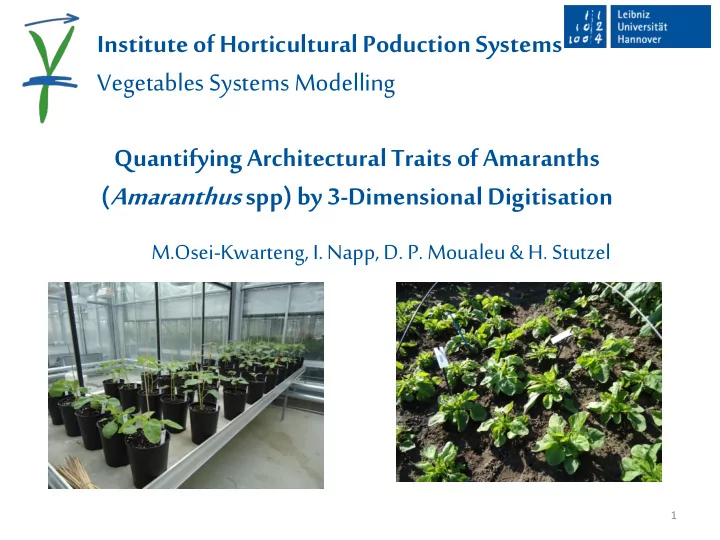
Quantifying Architectural Traits of Amaranths (Amaranthus spp) by 3-Dimensional Digitisation

M.Osei-Kwarteng, I. Napp, D. P. Moualeu & H. Stutzel

Institute of Horticultural Poduction Systems Vegetables Systems Modelling

1
slide-2
SLIDE 2

A.cruentus : Ex Zim – Vegetable

2

slide-3
SLIDE 3

A.hypochondriacus : TSM -102 (Grain )

3

slide-4
SLIDE 4

A.tricolor: Arkasuguna (Vegetable –Asian)

4

slide-5
SLIDE 5
  • A. dubius (Mombo 2)

5

slide-6
SLIDE 6

Growth processes

Environmental and factors Management practices

Productivity

Function (Physiological process) Structure/Architecture

6

slide-7
SLIDE 7

A.cruentus A.dubius A.hypochondriacus A.tricolor

7

slide-8
SLIDE 8

8

slide-9
SLIDE 9

Objective:

Quantify architectural traits in four Amaranthus spp and relate them to their dry matter yield

9

Architectural traits : leaf size (length and width) , leaf shape, leaf orientation angles ( inclination and azimuth) and internode length.

slide-10
SLIDE 10
  • Grown under non limiting nutrient and water conditions
  • Spacing: 30 cm x 30 cm isometric
  • Duration: May-June 2015 on the field
  • Location: Institute of Horticultural Production Systems, Hannover (52°2’ N)

Germany

  • Experimental design: Randomized complete block (RCBD)
  • Statistical analysis: Analysis of variance procedure (SAS,2003)

Materials and Methods

10

slide-11
SLIDE 11

Materials and Methods

Digitising: Plants were digitised acropetally in a standardized sequence

  • Leaves were digitised with 9 points
  • A node was the point of attachment of a leaf petiole on the stem
  • Internode was the interval between two nodes
  • Four plants were digitised per genotype

3-D Fastrak magnetic digitiser Electronic unit

Transmitter

Receiver/pointer

11

Digitising plants

slide-12
SLIDE 12

Preliminary results

Leaf inclination angle (degrees) 10-20 20-30 30-40 40-50 50-60 60-70 Proportion of leaves 0.0 0.1 0.2 0.3 0.4 0.5 A.tricolor. Mean : 49.2o. S.D : 16.4o A.dubius. Mean : 42.2o. S.D. : 8.2o A.hypochondriacus. Mean : 51.4o . S.D. : 10.4o A.cruentus. Mean : 43.8o. S.D. : 10.4o

12

slide-13
SLIDE 13

Preliminary results

SEM : 5.67 Acropetal leaf rank 1 2 3 4 5 6 Leaf area (cm2) 10 20 30 40 50 60 70 d cd d e d cd c e cd d d d de de b de cd cd de de cd a de de

13

slide-14
SLIDE 14

Preliminary results

SEM : 5.67 Acropetal leaf rank 1 2 3 4 5 6 Leaf area (cm2) 10 20 30 40 50 60 70 d cd d e d cd c e cd d d d de de b de cd cd de de cd a de de

14

slide-15
SLIDE 15

SEM : 0.55 Acropetal leaf rank 1 2 3 4 5 6 Petiole length (cm) 2 4 6 8 10 12 c bab c cd b ab c cd b a c d cb ab c d cb a c d b a c

15

slide-16
SLIDE 16
  • Young plants of A. tricolor have leaves equally

distributed from being fairly horizontal to vertical in

  • rientation.
  • Young plants of A tricolor and A cruentus exhibit low

leaf areas across existing leaf positions with A. tricolor displaying low petiole length.

  • The fifth acropetal leaves of A. hypochondriacus have

large leaf area and longer petioles than the other genotypes

  • Significant interaction effects exist between leaf

position and some leaf dimensions

Conclusion

16

slide-17
SLIDE 17
  • Analyse other architectural traits and construct a 3D static

model plant from digitised data

  • Relate the angular distribution and projected leaf area of

genotypes to light interception

  • Relate differences in architectural traits to dry matter yield

Outlook

17

slide-18
SLIDE 18

Thank You For Your Attention !!!!

18