Logistics Project C++: Inheritance II Part 2 (water) due Sunday, - - PDF document

logistics
SMART_READER_LITE
LIVE PREVIEW

Logistics Project C++: Inheritance II Part 2 (water) due Sunday, - - PDF document

Logistics Project C++: Inheritance II Part 2 (water) due Sunday, Oct 16 th Questions? Plan for this week Subclassing Define a more general class Performer. This is abstraction week Both Actors and


slide-1
SLIDE 1

1

C++: Inheritance II Logistics

  • Project

– Part 2 (water) due Sunday, Oct 16th

  • Questions?

Plan for this week

  • This is “abstraction week”

– Monday: Inheritance in C++ – Tuesday: Exam – Today: Inheritance in C++ (cont’d)

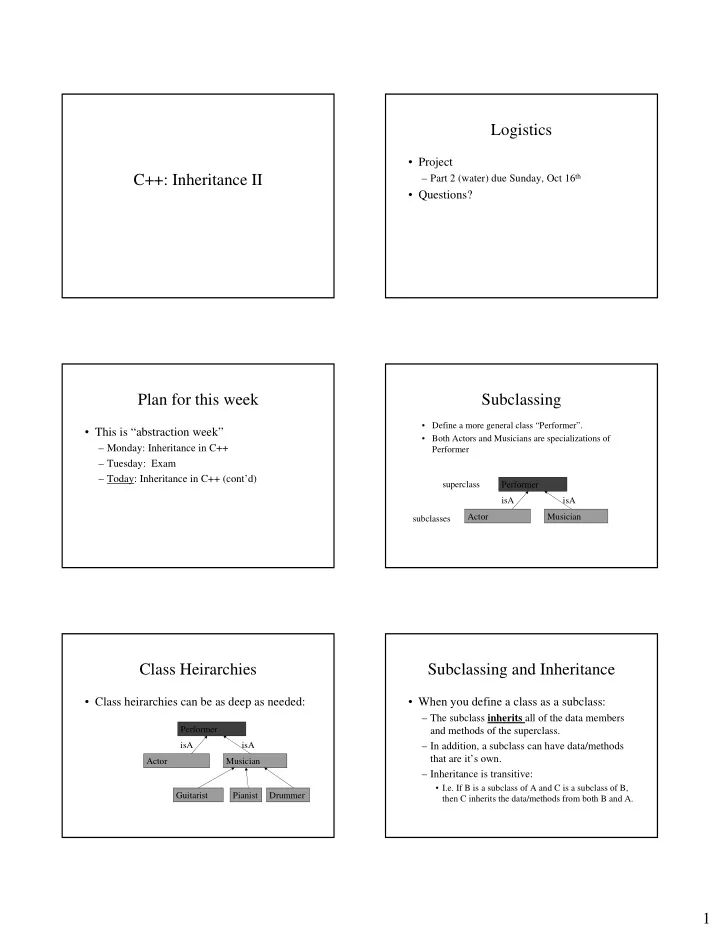
Subclassing

  • Define a more general class “Performer”.
  • Both Actors and Musicians are specializations of

Performer Performer Actor Musician isA isA superclass subclasses

Class Heirarchies

  • Class heirarchies can be as deep as needed:

Performer Actor Musician isA isA Guitarist Pianist Drummer

Subclassing and Inheritance

  • When you define a class as a subclass:

– The subclass inherits all of the data members and methods of the superclass. – In addition, a subclass can have data/methods that are it’s own. – Inheritance is transitive:

  • I.e. If B is a subclass of A and C is a subclass of B,

then C inherits the data/methods from both B and A.

slide-2
SLIDE 2

2

Inheritance

  • Behind the scenes

– The memory allocated for an object of a derived class consists of:

  • An area for the base class’s data
  • An area for the derived class’s data

Inheritance

class Performer { private: float basePay; char *name; char *talent; … public: Performer (char *name, char * talent); virtual float calculatePay(); } class Musician : public Performer { private: Instrument *axe; bool isRecorded; … public: Musician (char *name); virtual float calculatePay(); virtual void setInstrument (Intrument *I); }

Inheritance

  • What the memory for Musician looks like

basePay name talent axe isRecorded Performer data Musician data

Inheritance

  • Let’s add a Drummer

class Drummer : public Musician { private: Drum kit[]; public: Drummer (char *name); virtual void setInstrument (Instrument *I); }

Inheritance

  • What the memory for

drummer looks like

basePay name talent axe isRecorded Musician data (includes Performer data) Drummer data kit

Inheritance and Construction

  • When a member of a derived class is

constructed, the constructor of it’s base class is called first

– This fills in the memory area containing members of the base class.

slide-3
SLIDE 3

3

Inheritance and Construction

basePay name talent axe isRecorded

Musician *M = new Musician(“Ringo”);

Musician’s constructor is called Performer’s constructor is called Musician’s constructor continues

Inheritance and Construction

Drummer *D = new Drummer(“Ringo”);

Musician’s constructor is called Performer’s constructor is called Musician’s constructor continues kit basePay name talent axe isRecorded Drummer’s constructor is called Drummer’s constructor continues

Constructing Derived Class Objects

Musician::Musician (char *name) : Performer (name, “music”), axe (0), isRecorded(false),... { }

  • There is no super function in C++
  • Call to base class constructor required unless base

class has a default constructor.

  • Questions?

Slicing

  • Recall that polymorphism can only be

achieved using pointers rather than objects themselves.

  • Attempts to copy a base class object with a

derived class object will cause slicing.

– Only the base class section of the derived object will be copied.

Slicing

Musician M (“Ringo”);

basePay name talent axe isRecorded M

Performer P (M);

P basePay name talent Space allocated for P Copy constructor called

Correct Polymorphism

basePay name talent axe isRecorded heap M P

Musician *M (new Musician (“Ringo”)); Performer *P (M);

M allocated on heap Pointer copy.

slide-4
SLIDE 4

4

Slicing

  • Questions?

Multiple Inheritance

  • In C++, a class can be derived from more

than 1 base class.

  • Recall that C++ has no notion of an

interface.

Multiple Inheritance

class MusicBuyer { private: float cashOnHand; … public: MusicBuyer (float cash); … }

Multiple Inheritance

Performer Actor Musician isA isA MusicBuyer Radio Station

Multiple Inheritance

  • Objects of classes that have multiple base

classes will have a data section for each Base class.

– The constructor for each base class will need to be called in the constructor for the derived class.

Multiple Inheritance

class Musician : public Performer, public MusicBuyer { public: Musician (char *name); … } Musician::Musician (char *name) : Performer (name, “music”), MusicBuyer(100.0), ... { }

slide-5
SLIDE 5

5

Multiple Inheritance

basePay name talent axe isRecorded cashOnHand

Musician *M = new Musician(“Ringo”);

Musician’s constructor is called Performer’s constructor is called Musician’s constructor continues MusicBuyer’s constructor is called

Multiple Inheritance

  • Why some think Multiple Inheritance is evil

– Data member ambiguity – Can possibly derive from a base class twice – Extra work for compiler. – Most multiple inheritance heirarchies can be done using single inheritance

  • Java chose to disallow

– Created interfaces instead – I suggest you do the same!

Multiple Inheritance

  • Questions

Summary

  • Inheritance

– What really goes on… – Slicing

  • Multiple Inheritance
  • Questions