Features of OO Programming Topic 4 Encapsulation Inheritance - - PowerPoint PPT Presentation

features of oo programming topic 4
SMART_READER_LITE
LIVE PREVIEW

Features of OO Programming Topic 4 Encapsulation Inheritance - - PowerPoint PPT Presentation

Features of OO Programming Topic 4 Encapsulation Inheritance abstraction information hiding breaking problem up based on data types "Question: What is the object oriented way of Inheritance getting rich? code reuse specialization


slide-1
SLIDE 1

1

Topic 4 Inheritance

"Question: What is the object oriented way of getting rich?

CS 314 Inheritance

2

Features of OO Programming

Encapsulation

abstraction information hiding breaking problem up based on data types

Inheritance

code reuse specialization "New code using old code."

Encapsulation

Create a program to allow people to play the game Monopoly

Create classes for money, dice, players, the bank, the board, chance cards, community chest cards, pieces, etc.

Some classes use other classes:

the board consists of spaces a player has money a piece has a position also referred to as composition

CS 314 Inheritance

3

Inheritance

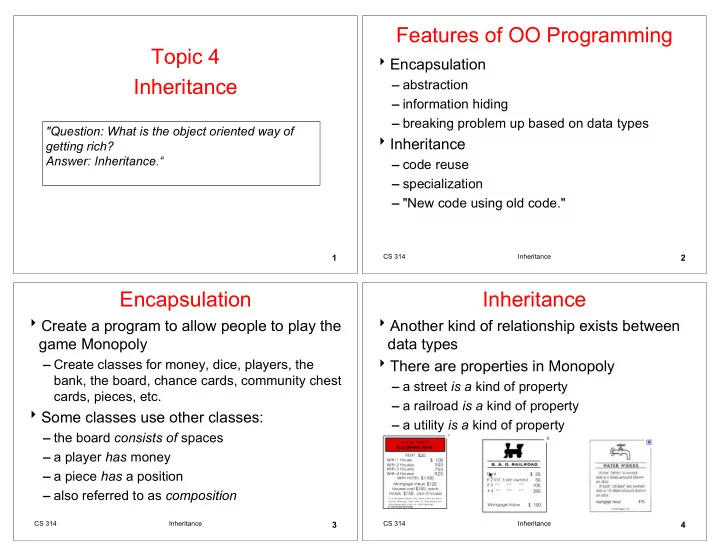
Another kind of relationship exists between data types There are properties in Monopoly

a street is a kind of property a railroad is a kind of property a utility is a kind of property

CS 314 Inheritance

4

slide-2
SLIDE 2

Inheritance

In Monopoly there is the concept of a Property All properties have some common traits

they have a name they have a position on the board they can be owned by players they have a price to buy

But some things are different for each of the three kinds of property

How to determine rent when another player lands on the Property

CS 314 Inheritance

5

What to Do?

If we have a separate class for Street, Railroad, and Utility there is going to be a lot

  • f code copied

hard to maintain an anti-pattern

Inheritance is a programming feature to allow data types to build on pre-existing data types without repeating code

CS 314 Inheritance

6

Mechanics of Inheritance

CS 314 Inheritance

7

  • 1. extends keyword
  • 2. inheritance of instance methods
  • 3. inheritance of instance variables
  • 4. object initialization and constructors
  • 5. calling a parent constructor with super()
  • 6. overriding methods
  • 7. partial overriding, super.parentMethod()
  • 8. inheritance requirement in Java
  • 9. the Object class
  • 10. inheritance hierarchies

CS 314 Inheritance

8

Inheritance in Java

Java is designed to encourage object

  • riented programming

all classes, except one, must inherit from exactly one other class

The Object class is the cosmic super class

The Object class does not inherit from any other class The Object class has several important methods: toString, equals, hashCode, clone, getClass

implications:

all classes are descendants of Object all classes and thus all objects have a toString, equals, hashCode, clone, and getClass method

toString, equals, hashCode, clone normally overridden

slide-3
SLIDE 3

CS 314 Inheritance

9

Nomenclature of Inheritance

In Java the extends keyword is used in the class header to specify which preexisting class a new class is inheriting from

public class Student extends Person Person is said to be

the parent class of Student the super class of Student the base class of Student an ancestor of Student

Student is said to be

a child class of Person a sub class of Person a derived class of Person a descendant of Person

CS 314 Inheritance

10

Clicker Question 1

What is the primary reason for using inheritance when programming?

  • A. To make a program more complicated
  • B. To copy and paste code between classes
  • C. To reuse pre-existing code
  • D. To hide implementation details of a class
  • E. To ensure pre conditions of methods are met.

CS 314 Inheritance

11

Clicker Question 2

What is output when the main method is run?

public class Foo { public static void main(String[] args) { Foo f1 = new Foo(); System.out.println(f1.toString()); } }

  • A. 0
  • B. null
  • C. Unknown until code is actually run.
  • D. No output due to a syntax error.
  • E. No output due to a runtime error.

Simple Code Example

Create a class named Shape

what class does Shape inherit from what methods can we call on Shape objects? add instance variables for a position

  • verride the toString method

Create a Circle class that extends Shape

add instance variable for radius debug and look at contents try to access instance var from Shape constructor calls use of key word super

CS 314 Inheritance

12

slide-4
SLIDE 4

CS 314 Inheritance

13

Overriding methods

any method that is not final may be

  • verridden by a descendant class

same signature as method in ancestor may not reduce visibility may use the original method if simply want to add more behavior to existing

CS 314 Inheritance

14

Constructors

Constructors handle initialization of objects When creating an object with one or more ancestors (every type except Object) a chain of constructor calls takes place The reserved word super may be used in a constructor to call a one of the parent's constructors

must be first line of constructor

if no parent constructor is explicitly called the default, 0 parameter constructor of the parent is called

if no default constructor exists a syntax error results

If a parent constructor is called another constructor in the same class may no be called

no super();this(); allowed. One or the other, not both good place for an initialization method

CS 314 Inheritance

15

The Keyword super

super is used to access something (any protected or public field or method) from the super class that has been overridden Rectangle's toString makes use of the toString in ClosedShape my calling super.toString() without the super calling toString would result in infinite recursive calls Java does not allow nested supers

super.super.toString()

results in a syntax error even though technically this refers to a valid method, Object's toString Rectangle partially overrides ClosedShapes toString

Creating a SortedIntList

slide-5
SLIDE 5

CS 314 Inheritance

17

A New Class

Assume we want to have a list of ints, but that the ints must always be maintained in ascending order

[-7, 12, 37, 212, 212, 313, 313, 500] sortedList.get(0) returns the min sortedList.get( list.size() 1 ) returns the max

CS 314 Inheritance

18

Implementing SortedIntList

Do we have to write a whole new class? Assume we have an IntList class. Clicker 3 - Which of the following methods would have to be changed?

add(int value) int get(int location) String toString() int size() int remove(int location)

CS 314 Inheritance

19

Overriding the add Method

First attempt Problem? solving with insert method

double edged sort

solving with protected

What protected really means

Clicker 4

public class IntList { private int size private int[] con }

public class SortedIntList extends IntList { public SortedIntList() { System.out.println(size); // Output? } }

  • A. 0
  • B. null
  • C. unknown until code is run
  • D. no output due to a compile error
  • E. no output due to a runtime error

20

slide-6
SLIDE 6

CS 314 Inheritance

21

Problems

What about this method? void insert(int location, int val) What about this method? void insertAll(int location, IntList otherList) SortedIntList is not a good application

  • f inheritance given the IntList we

developed

More Example Code

ClosedShape and Rectangle classes

CS 314 Inheritance

22

CS 314 Inheritance

23

Shape Classes

Declare a class called ClosedShape

assume all shapes have x and y coordinates

  • verride Object's version of toString

Possible sub classes of ClosedShape

Rectangle Circle Ellipse Square

Possible hierarchy

ClosedShape <- Rectangle <- Square

CS 314 Inheritance

24

A ClosedShape class

public class ClosedShape { private double myX; private double myY; public ClosedShape() { this(0,0); } public ClosedShape (double x, double y) { myX = x; myY = y; } public String toString() { return "x: " + getX() + " y: " + getY(); } public double getX(){ return myX; } public double getY(){ return myY; } } // Other methods not shown

slide-7
SLIDE 7

CS 314 Inheritance

25

A Rectangle Constructor

public class Rectangle extends ClosedShape { private double myWidth; private double myHeight; public Rectangle( double x, double y, double width, double height ) { super(x,y); // calls the 2 double constructor in // ClosedShape myWidth = width; myHeight = height; } // other methods not shown }

CS 314 Inheritance

26

A Rectangle Class

public class Rectangle extends ClosedShape { private double myWidth; private double myHeight; public Rectangle() { this(0, 0); } public Rectangle(double width, double height) { myWidth = width; myHeight = height; } public Rectangle(double x, double y, double width, double height) { super(x, y); myWidth = width; myHeight = height; } public String toString() { return super.toString() + " width " + myWidth + " height " + myHeight; } }

CS 314 Inheritance

27

Initialization method

public class Rectangle extends ClosedShape { private double myWidth; private double myHeight; public Rectangle() { init(0, 0); } public Rectangle(double width, double height) { init(width, height); } public Rectangle(double x, double y, double width, double height) { super(x, y); init(width, height); } private void init(double width, double height) { myWidth = width; myHeight = height; }

CS 314 Inheritance

28

Result of Inheritance

Do any of these cause a syntax error? What is the output?

Rectangle r = new Rectangle(1, 2, 3, 4); ClosedShape s = new CloseShape(2, 3); System.out.println( s.getX() ); System.out.println( s.getY() ); System.out.println( s.toString() ); System.out.println( r.getX() ); System.out.println( r.getY() ); System.out.println( r.toString() ); System.out.println( r.getWidth() );

slide-8
SLIDE 8

CS 314 Inheritance

29

The Real Picture

Fields from ClosedShape class Instance Variables declared in ClosedShape Fields from Object class Instance variables declared in Object

A Rectangle

  • bject

Available methods are all methods from Object, ClosedShape, and Rectangle

Fields from Rectangle class Instance Variables declared in Rectangle

CS 314 Inheritance

30

Access Modifiers and Inheritance

public

accessible to all classes

private

accessible only within that class. Hidden from all sub classes.

protected

accessible by classes within the same package and all descendant classes

Instance variables should be private protected methods are used to allow descendant classes to modify instance variables in ways other classes can't

CS 314 Inheritance

31

Why private Vars and not protected?

In general it is good practice to make instance variables private

hide them from your descendants if you think descendants will need to access them or modify them provide protected methods to do this

Why? Consider the following example

CS 314 Inheritance

32

Required update

public class GamePiece { private Board myBoard; private Position myPos; // whenever my position changes I must // update the board so it knows about the change protected void alterPos( Position newPos ) { Position oldPos = myPos; myPos = newPos; myBoard.update( oldPos, myPos ); }