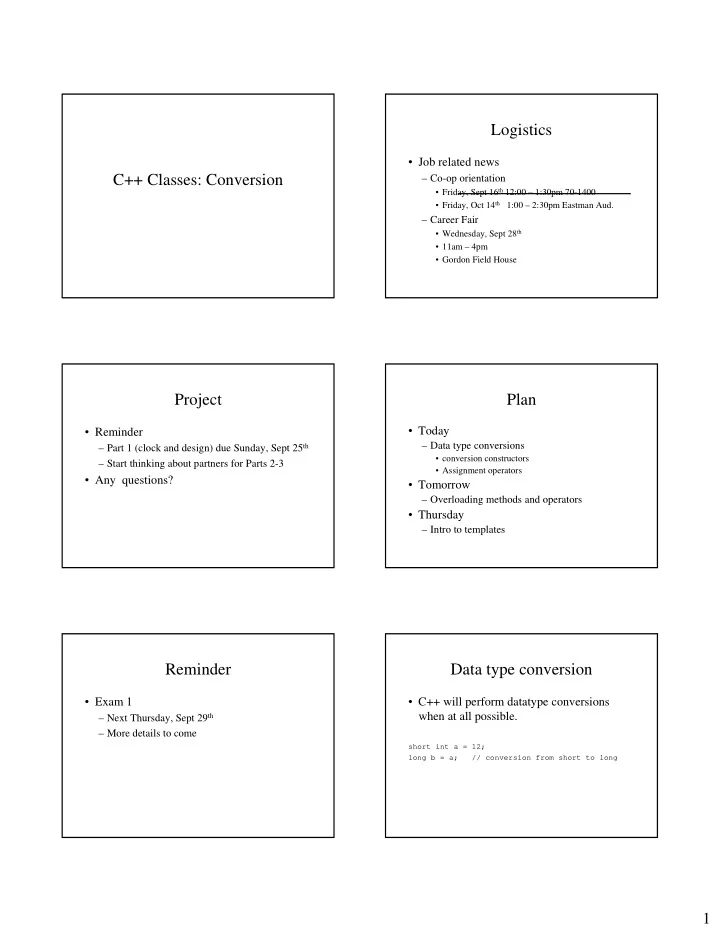
Logistics Job related news C++ Classes: Conversion Co-op - - PDF document

logistics
SMART_READER_LITE
LIVE PREVIEW

Logistics Job related news C++ Classes: Conversion Co-op - - PDF document

Logistics Job related news C++ Classes: Conversion Co-op orientation Friday, Sept 16 th 12:00 1:30pm 70-1400 Friday, Oct 14 th 1:00 2:30pm Eastman Aud. Career Fair Wednesday, Sept 28 th 11am 4pm


slide-1
SLIDE 1

1

C++ Classes: Conversion Logistics

  • Job related news

– Co-op orientation

  • Friday, Sept 16th 12:00 – 1:30pm 70-1400
  • Friday, Oct 14th 1:00 – 2:30pm Eastman Aud.

– Career Fair

  • Wednesday, Sept 28th
  • 11am – 4pm
  • Gordon Field House

Project

  • Reminder

– Part 1 (clock and design) due Sunday, Sept 25th – Start thinking about partners for Parts 2-3

  • Any questions?

Plan

  • Today

– Data type conversions

  • conversion constructors
  • Assignment operators
  • Tomorrow

– Overloading methods and operators

  • Thursday

– Intro to templates

Reminder

  • Exam 1

– Next Thursday, Sept 29th – More details to come

Data type conversion

  • C++ will perform datatype conversions

when at all possible.

short int a = 12; long b = a; // conversion from short to long

slide-2
SLIDE 2

2

Data type conversion

  • Conversion occurs:

– Assignments – Function argument passing – Return values – Initializers – Expression

  • C++ can do so with classes as well if

conversion constructors are defined.

Constructor

  • Special member function used to create an
  • bject of a class.

– Has same name as the class. – Does not return anything. – Used to initialize data members.

Box.h

#ifndef BOX_DEFINED #define BOX_DEFINED class Box { private: int height, width, depth; public: Box (int h, int w, int d); int volume (); }; #endif

Box.cpp

#include “Box.h” Box::Box (int h, int w, int d) { height=h; width=w; depth=d; } int Box::volume () { return height * width * height; }

Object initialization

  • Objects are initialized using constructors

made available by the class.

Box mybox (3,4,5); Box *boxOnHeap = new Box(3,4,5);

Conversion constructors

  • Converts an object of one type to that of

another.

  • Will get called when the need for an

automatic conversion arises.

slide-3
SLIDE 3

3

Conversion constructor

class Cube { private: int size; public: Cube (int s); int getSize(); } class Box { private: int height, width, depth; public: Box (int h, int w, int d); Box (const Cube &C); };

Conversion constructor

Box::Box (const Cube &C) : height (C.getSize()), width (C.getSize()), depth (C.getSize()) {} Cube C(6); Box convC = C; // conversion constructor called.

Member conversion functions

  • A class can also provide a means for it to be

converted to another class or intrinsic datatype.

class Date { private: int month,day, year; public: Date (int m,int d,int y);

  • perator long(); // convert this date to a long

};

Member conversion function

Date::operator long() { static int dys[] = {31,28,31,30,31,30,31,31,30,31,30,31}; long days = yr – 1900; days *= 365; days += yr/4; for (int i=0; i < mo-1; i++) days+=dys[i] days += da; return days; } Date today (9, 21, 2005); long since = today;

Member conversion function

class Box { private: int height, width, depth; public: Box(); Box (int h, int w, int d); }; class Cube { private: int size; public: Cube (int s);

  • perator Box();

}

Member conversion function

Cube::operator Box() { return Box(size, size, size); }

Cube C(6); Box convC; convC = C; // conversion function called.

slide-4
SLIDE 4

4

Ways to invoke conversion

  • Implicit

– Assignment, function args, etc.

  • Explicit

– Cast – Explicit call to conversion constructor/member conversion function

Ways to invoke conversion

class Cube { private: int size; public: Cube (int s); int getSize(); } class Box { private: int height, width, depth; public: Box(); Box (int h, int w, int d); Box (const Cube &C); };

Ways to invoke conversion

Cube C(6); Box convC; convC = C; // implicit conversion. convC = (Box)C; // explicit via cast convC = Box (C); // explicit via constructor call.

explicit

  • You can prevent the compiler from

performing implicit conversions by declaring the conversion constructor as explicit.

explicit

class Cube { private: int size; public: Cube (int s); int getSize(); } class Box { private: int height, width, depth; public: Box(); Box (int h, int w, int d); explicit Box (const Cube &C); };

explicit

Cube C(6); Box convC; convC = C; // implicit conversion will generate error. convC = (Box)C; // explicit via cast--okay convC = Box (C); // explicit via constructor call—okay.

slide-5
SLIDE 5

5

Conversions

  • Questions?

Assignment operator

  • operator=

– Called when an assignment is made – Copies all relevant data from object assigner to assignee. – Should check for self-assignment!

Assignment operator

class Complex { private: double re, im; public: Complex(); Complex & operator= (Complex &c); ... } Complex c1, c2; c2 = c1; // is the same as saying c2.operator= (c1);

Assignment operator

Complex & Complex::operator= (Complex &c) { if (c != (*this)) { re = c.re; im = c.im; } return (*this); }

Assignment operator

  • Note that the assignment operator returns a

reference to itself

– This is to allow statements like:

Complex c1, c2, c3; c3 = c2 = c1;

Assignment operator

  • If no assignment operator is defined for a

class, the default assignment operator is used.

– Member by member copy of data from one

  • bject to another.

– Can be troublesome if class have pointers as data members.

slide-6
SLIDE 6

6

Assignment operator

class Foo { private: int *array_member; int asize; ... } Foo c1, c2; c1 = c2; delete c1; delete c2;

c1 c2 Free store

Assignment operator

Foo & Foo::operator= (Foo &F) { // cleanup old array delete array_member; // allocate new array asize = F.asize; array_member = new int (F.asize); // copy for (int i=0; i<asize; i++) array_member[i] = F.array_member[i]; }

Constructor

  • Copy vs. Assignment

Date::Date (int day, int month, int year) { d = day; // constructor + assignment performed m = month; y = year; } Can also be written using subobject constructor (this way is more efficient). Date::Date (int day, int month, int year) : d (day), m (month), y (year) {} // just copy constructor is called.

Constructor

  • Copy Constructor

– If no copy constructor is defined for a class, the default copy constructor is used.

  • Member by member copy of data from one object to

another.

  • Can be troublesome if class have pointers as data

members.

– Same issues as with the default assignment

  • perator!!!!

Constructor Summary

Date d1(3, 10, 2002); // constructor called Date d2, d5; // default constructor called Date d3 (d2); // copy constructor called Date d4 = d1; // copy constructor called d5 = d2; // assignment operator called.

Questions?

Constructor

  • Important safety tips:

– Always provide a default constructor – If your constructors perform any non-trivial work (e.g. memory allocation), should define the full suite of:

  • Constructors
  • Copy constructor
  • operator=
slide-7
SLIDE 7

7

Assignment operator

Questions?

Summary

  • Conversion

– Conversion constructors – Conversion member functions

  • Assignment operators
  • Questions?