Location Privacy CompSci 590.03 Instructor: Ashwin Machanavajjhala - - PowerPoint PPT Presentation

location privacy
SMART_READER_LITE
LIVE PREVIEW

Location Privacy CompSci 590.03 Instructor: Ashwin Machanavajjhala - - PowerPoint PPT Presentation

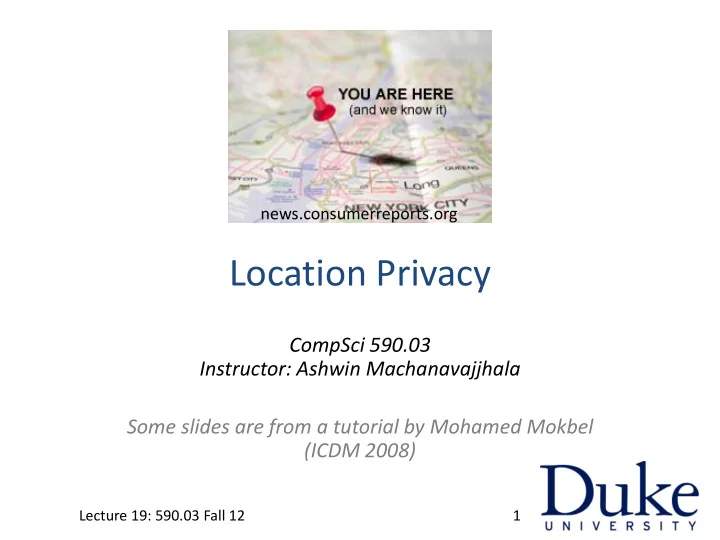
news.consumerreports.org Location Privacy CompSci 590.03 Instructor: Ashwin Machanavajjhala Some slides are from a tutorial by Mohamed Mokbel (ICDM 2008) Lecture 19: 590.03 Fall 12 1 Outline Location based services Location Privacy


slide-1
SLIDE 1

Location Privacy

CompSci 590.03 Instructor: Ashwin Machanavajjhala Some slides are from a tutorial by Mohamed Mokbel (ICDM 2008)

Lecture 19: 590.03 Fall 12 1

news.consumerreports.org
slide-2
SLIDE 2

Outline

  • Location based services
  • Location Privacy Challenges
  • Achieving Location Privacy

– Concepts – Solutions

  • Open Questions

Lecture 19: 590.03 Fall 12 2

slide-3
SLIDE 3

Location Based services

“Imagine being a victim of cardiac arrest with about ten minutes to live, and first responders more than ten minutes away. A CPR- trained passerby gets a mobile ping from the fire department that someone nearby needs help; the good Samaritan then rushes to your side, administers CPR, and keeps you alive long enough to get professional help.

Lecture 19: 590.03 Fall 12 3

Mayor of Starbucks Today, Local Hero Tomorrow: The Power and Privacy Pitfalls of Location Sharing Julie Adler, June 2011

slide-4
SLIDE 4

Location Based Services

  • Location based Traffic Reports

– How many cars on 15-501? – What is the shortest travel time?

  • Location based Search

– “showtimes near me” – Is there an ophthalmologist within 3 miles of my current location? – What is the nearest gas station?

  • Location based advertising/recommendation

– Starbucks (.5 miles away) is giving away free lattes.

Lecture 19: 590.03 Fall 12 4

Analysis of location data User initiated System Initiated

slide-5
SLIDE 5

Location Based Services

Lecture 19: 590.03 Fall 12 5

slide-6
SLIDE 6

Location Based Services

Lecture 19: 590.03 Fall 12 6

GIS / Spatial Databases Mobile Devices Internet

GPS Devices Yahoo! Maps Google Maps …

Location Based Services

slide-7
SLIDE 7

Outline

  • Location based services
  • Location Privacy Challenges
  • Achieving Location Privacy

– Concepts – Solutions

  • Open Questions

Lecture 19: 590.03 Fall 12 7

slide-8
SLIDE 8

Privacy Threats

Lecture 19: 590.03 Fall 12 8 http://www.thereporteronline.com/article/20121102/NEWS01/121109 915/man-accused-of-stalking-hatfield-woman

slide-9
SLIDE 9

Privacy Threats

Lecture 19: 590.03 Fall 12 9

slide-10
SLIDE 10

Privacy Threats

Lecture 19: 590.03 Fall 12 10

http://wifi.weblogsinc.com/2004/09/24/companies-increasingly-use- gps-enabled-cell-phones-to-track/

slide-11
SLIDE 11

Lecture 19: 590.03 Fall 12 12

GPS Act (http://www.wyden.senate.gov/download/wyden-

chaffetz-gps-amendment-text)

slide-12
SLIDE 12

Privacy-utility tradeoff

Lecture 19: 590.03 Fall 12 13

 Example: What is my nearest gas station?

Utility 100% 100% 0% Privacy 0%

slide-13
SLIDE 13

Why is Location Privacy different?

Database Privacy

  • Each individual’s record

must be kept secret.

  • Queries are not private
  • Data is usually static
  • Privacy is common across all

individuals Location Privacy

  • Individual’s current and

future locations (and other inferences) must be secret.

  • Queries (location)

themselves are private!

  • Must tolerate updates to

locations.

  • Privacy is personalized for

different individuals

Lecture 19: 590.03 Fall 12 14

slide-14
SLIDE 14

Outline

  • Location based services
  • Location Privacy Challenges
  • Achieving Location Privacy

– Concepts – Solutions

  • Open Questions

Lecture 19: 590.03 Fall 12 15

slide-15
SLIDE 15

Location Perturbation

  • The user location is

represented with a wrong value

  • The privacy is achieved from

the fact that the reported location is false

  • The accuracy and the amount
  • f privacy mainly depends on

how far the reported location form the exact location

Lecture 19: 590.03 Fall 12 16

slide-16
SLIDE 16

Spatial Cloaking

  • The user exact location is

represented as a region that includes the exact user location

  • An adversary does know that

the user is located in the cloaked region, but has no clue where the user is exactly located

  • The area of the cloaked region

achieves a trade-off between the user privacy and the service

Lecture 19: 590.03 Fall 12 17

slide-17
SLIDE 17

Spatio-temporal cloaking

  • In addition to spatial cloaking

the user information can be delayed a while to cloak the temporal dimension

  • Temporal cloaking could

tolerate asking about stationary

  • bjects (e.g., gas stations)
  • Challenging to support querying

moving objects, e.g., where is my nearest friend

Lecture 19: 590.03 Fall 12 18

X Y T

slide-18
SLIDE 18

Data Dependent Cloaking

  • If you know other individuals, you can have a single coarse region

to represent all of them.

Lecture 19: 590.03 Fall 12 19

Naïve cloaking MBR cloaking

slide-19
SLIDE 19

Space Dependent Cloaking

Lecture 19: 590.03 Fall 12 20

Adaptive grid cloaking Fixed grid cloaking

slide-20
SLIDE 20

K-anonymity

  • The cloaked region contains at least k users
  • The user is indistinguishable among other k users
  • The cloaked area largely depends on the surrounding

environment.

  • A value of k =100 may result in a very small area if a user is

located in the stadium or may result in a very large area if the user in the desert.

Lecture 19: 590.03 Fall 12 21

slide-21
SLIDE 21

Queries in Location services

  • Private Queries over Public Data

– What is my nearest gas station – The user location is private while the objects of interest are public

  • Public Queries over Private Data

– How many cars in the downtown area – The query location is public while the objects of interest is private

  • Private Queries over Private Data

– Where is my nearest friend – Both the query location and objects of interest are private

Lecture 19: 590.03 Fall 12 22

slide-22
SLIDE 22

Modes of Privacy

  • User Location Privacy

– Users want to hide their location information and their query information

  • User Query Privacy

– Users do not mind or obligated to reveal their locations, however, users want to hide their queries

  • Trajectory Privacy

– Users do not mind to reveal few locations, however, they want to avoid linking these locations together to form a trajectory

Lecture 19: 590.03 Fall 12 23

slide-23
SLIDE 23

Outline

  • Location based services
  • Location Privacy Challenges
  • Achieving Location Privacy

– Concepts – Solutions

  • Open Questions

Lecture 19: 590.03 Fall 12 24

slide-24
SLIDE 24

Solution Architectures for Location Privacy

  • Client-Server architecture

– Users communicated directly with the sever to do the anonymization

  • process. Possibly employing an offline phase with a trusted entity
  • Third trusted party architecture

– A centralized trusted entity is responsible for gathering information and providing the required privacy for each user

  • Peer-to-Peer cooperative architecture

– Users collaborate with each other without the interleaving of a centralized entity to provide customized privacy for each single user

Lecture 19: 590.03 Fall 12 25

slide-25
SLIDE 25

Client-Server

Lecture 19: 590.03 Fall 12 26

Location Based Service

Query + Perturbed Location Answer

slide-26
SLIDE 26

Client-Server

  • Clients try to cheat the server using either fake locations or fake

space

  • Simple to implement, easy to integrate with existing technologies
  • Lower quality of service
  • Examples: Landmark objects, false dummies

Lecture 19: 590.03 Fall 12 27

slide-27
SLIDE 27

Client-Server Solution 1: Landmarks

  • Instead of reporting the exact

location, report the location of a closest landmark

  • The query answer will be based
  • n the landmark
  • Voronoi diagrams can be used

to efficiently identify the closest landmark

Lecture 19: 590.03 Fall 12 28

slide-28
SLIDE 28

Client-Server Solutions 2: False Dummies

  • A user sends m locations, only one of

them is true while m-1 are false dummies

  • The server replies with a service for

each received location

  • The user is the only one who knows

the true location, and hence the true answer

  • Generating false dummies is hard:

should follow a certain pattern similar to a user pattern but with different locations

Lecture 19: 590.03 Fall 12 29

Server

A separate answer for each received location

slide-29
SLIDE 29

Trusted Third Party

Lecture 19: 590.03 Fall 12 30

Location Based Service

Query + Cloaked Spatial location

Location Anonymizer

slide-30
SLIDE 30

Trusted Third Party

  • A trusted third party receives the exact locations from clients,

blurs the locations, and sends the blurred locations to the server

  • Provide powerful privacy guarantees with high-quality services
  • Need to trusted a third party …

Lecture 19: 590.03 Fall 12 31

slide-31
SLIDE 31

Mix Zones

  • A strategy for anonymization for continuous location tracking
  • Server only sees locations and user’s pseudonyms
  • Mix zone is like a “no track zone” + “change of pseudonyms”

Lecture 19: 590.03 Fall 12 32

Mix Zone

User1234 User1235 User5768 User5678

slide-32
SLIDE 32

Quad-tree Spatial Cloaking

  • Achieve k-anonymity, i.e., a

user is indistinguishable from

  • ther k-1 users
  • Recursively divide the space

into quadrants until a quadrant has less than k users.

  • The previous quadrant, which

still meet the k-anonymity constraint, is returned

Lecture 19: 590.03 Fall 12 33

Achieve 5-anonmity for

slide-33
SLIDE 33

Nearest Neighbor k-Anonymization

  • STEP 1: Determine a set S containing u and k -

1 u’s nearest neighbors.

  • STEP 2: Randomly select v from S.
  • STEP 3: Determine a set S’ containing v and v’s

k - 1 nearest neighbors.

  • STEP 4: A cloaked spatial region is an MBR of

all users in S’ and u.

  • Need to pick a random node first. Otherwise,

adversary can reconstruct location (by picking centroid of spatial region)

Lecture 19: 590.03 Fall 12 34

S S’

slide-34
SLIDE 34

Pyramid Anonymization

  • Divide region into grids at different

resolutions

  • Each grid cell maintains the number of

users in that cell

  • To anonymize a user request, we

traverse the pyramid structure from the bottom level to the top level until a cell satisfying the user privacy profile is found.

Lecture 19: 590.03 Fall 12 35

slide-35
SLIDE 35

Outline

  • Location based services
  • Location Privacy Challenges
  • Algorithms Location Privacy

– Concepts – Solutions

  • Answering Queries over Anonymized Data
  • Open Questions

Lecture 19: 590.03 Fall 12 36

slide-36
SLIDE 36

Range Queries

  • Q1: “Find all gas stations within 5 miles from my location”

– Query is private, but results are public

  • But “my location” is a cloaked region and not a point
  • Extend the cloaked region by 5 miles in each

direction. Database returns all gas stations in the larger region. Client filters out “extra” gas stations

Lecture 19: 590.03 Fall 12 37

slide-37
SLIDE 37

Range Queries

  • Q1: “Find all gas stations within 5 miles from my location”
  • Three ways to report the answer:

Lecture 19: 590.03 Fall 12 38

0.4 0.25 0.4 0.05 0.1

  • 3. Answers per area
  • 2. Probabilistic Answers
  • 1. All possible answers
slide-38
SLIDE 38

Range Queries

  • Q2: Find all cars/people within a certain area

– Query is public, but results are private

  • Objects of interest are represented

as cloaked spatial regions in which the objects of interest can be anywhere

  • Any cloaked region that overlaps with

the query region is a candidate answer

  • Can also answer with probabilities

(A, 0.1), (B, 0.2), (C, 1.0), (D, 0.25)

Lecture 19: 590.03 Fall 12 39

A B C D

slide-39
SLIDE 39

Radius Queries

  • Q3: “How many friends are there in a 5 mile radius”

– Query is private, objects are also private

  • Use a combination of previous 2

techniques

Lecture 19: 590.03 Fall 12 40

slide-40
SLIDE 40

Nearest Neighbor Queries

  • Q1: “Find the gas stations nearest to my location”

– Query is private, but results are public

  • Step 1: Identify a set of candidate

answers

  • Step 2:

Return all candidate answers, or Determine probability of answers, or Return answers in terms of areas

Lecture 19: 590.03 Fall 12 41

v

1

v

2

v

3

v

4

slide-41
SLIDE 41

Outline

  • Location based services
  • Location Privacy Challenges
  • Algorithms Location Privacy

– Concepts – Solutions

  • Answering Queries over Anonymized Data
  • Open Questions

Lecture 19: 590.03 Fall 12 42

slide-42
SLIDE 42

Privacy Guarantees

  • Most existing algorithms provide k-anonymity type guarantees
  • However, this does not provide privacy against:

– Homogeneity attack, 100s of people may be at a race track, but one can still learn that an individual was at the race track. – Background knowledge attacks, where adversary knows something about individuals. – Minimality attacks , where adversary knows how the algorithm anonymizes the data

Lecture 19: 590.03 Fall 12 43

slide-43
SLIDE 43

Differential Privacy

  • Differential privacy tolerates aforementioned attacks
  • Can work effectively in the trusted third party model
  • Montreal Traffic, Trajectory Anonymization
  • … but,

No good solutions for the typical location based services problem. No known techniques to personalize differential privacy.

Lecture 19: 590.03 Fall 12 44

slide-44
SLIDE 44

Utility

  • Cloaking techniques can provide good utility. But, if you need to

cloak trajectories, rather than locations, utility can degrade.

  • Not much adoption of privacy technology due to this issue.

Lecture 19: 590.03 Fall 12 45

slide-45
SLIDE 45

Summary

  • Our locations is being tracked in a number of ways

– Search queries – Location based services – GPS – …

  • Defining privacy is tricky.

– Data is not static. Location keeps changing. – Must be personalized …

  • Number of solutions, but have privacy/utility problems and hence

not much adoption in real systems.

Lecture 19: 590.03 Fall 12 46

slide-46
SLIDE 46

References

  • M. Mokbel, “Privacy Preserving Location Services”, Tutorial, ICDM 2008

http://www-users.cs.umn.edu/~mokbel/tutorials/icdm08.pptx (see references in the tutorial for more pointers)

  • R. Chen, B C Fung, B. Desai, N. Sossou, “Differentially Private Transit Data Publication: A

Case Study on the Montreal Transportation System”, KDD 2012

  • V. Rastogi, S. Nath, “Differentially private aggregation of distributed time-series with

transformation and encryption”, SIGMOD ‘10

Lecture 19: 590.03 Fall 12 47