Local Response System to Prevent and Address Homelessness for - - PDF document

local response system to prevent and address homelessness
SMART_READER_LITE
LIVE PREVIEW

Local Response System to Prevent and Address Homelessness for - - PDF document

10/10/2017 Local Response System to Prevent and Address Homelessness for Survivors of Domestic Violence DV DV CO COUN UNCI CIL PRE PRESENTATIO TION OCT OCTOBER 12, 12, 2017 2017 CORI CORI MAN MANTHORN RNE, CORA SE SELIN LINA TOY TOY LE


slide-1
SLIDE 1

10/10/2017 1

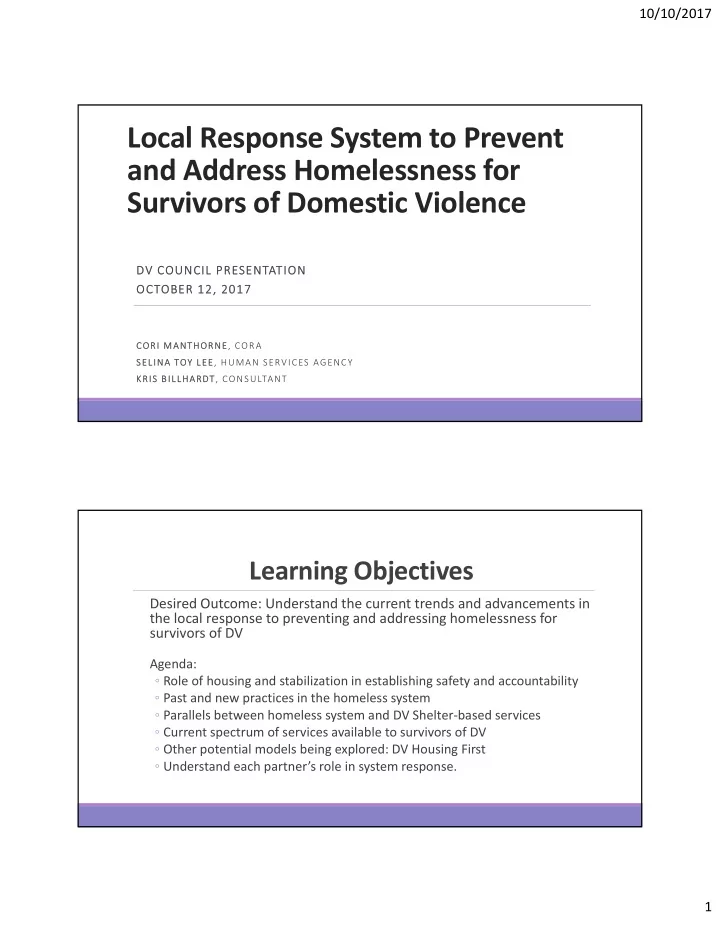
Local Response System to Prevent and Address Homelessness for Survivors of Domestic Violence

DV DV CO COUN UNCI CIL PRE PRESENTATIO TION OCT OCTOBER 12, 12, 2017 2017

CORI CORI MAN MANTHORN RNE, CORA SE SELIN LINA TOY TOY LE LEE, HUMAN SERVICES AGENCY KRIS KRIS BILL BILLHARDT, CONSULTANT

Learning Objectives

Desired Outcome: Understand the current trends and advancements in the local response to preventing and addressing homelessness for survivors of DV

Agenda:

  • Role of housing and stabilization in establishing safety and accountability
  • Past and new practices in the homeless system
  • Parallels between homeless system and DV Shelter‐based services
  • Current spectrum of services available to survivors of DV
  • Other potential models being explored: DV Housing First
  • Understand each partner’s role in system response.
slide-2
SLIDE 2

10/10/2017 2

DV and Homelessness

16% of homeless persons are victims of domestic violence. The U.S. Conference of Mayors 2013

Status Report on Hunger & Homelessness, A 25‐City Survey (2013).

Approximately 50% of all women who are homeless report that domestic violence was the immediate cause of their homelessness. “Pressing Issues Facing Families Who Are

Homeless.” The National Center on Family Homelessness. (2013).

Domestic violence creates vulnerability to homelessness for women and children with limited economic resources. Among mothers with children experiencing homelessness, more than 80% had previously experienced domestic violence. Aratani, Y.

(2009). “Homeless Children and Youth, Causes and Consequences. National Center for Children in Poverty.”

According to the San Mateo County Homeless Survey (2015) , 28% of respondents indicated they had been a victim of domestic violence – an increase from 16% in 2013.

Past Practices (pre‐2017) Homeless System Response

Homeless Service Need

Emergency Shelter Transitional Housing Housing Plan Permanent Housing

slide-3
SLIDE 3

10/10/2017 3

Past Practices (pre‐2017) Homeless System and DV System Response

Homeless Service Need

Emergency Shelter Transitional Housing Housing Plan Permanent Housing

Domestic Violence Hotline Call

Safe House/ Emergency Shelter Transitional Housing Housing Plan Permanent Housing

New Homeless System Response

Old System

Emergency Shelter Transitional Housing Housing Plan Permanent Housing

New System – Track 1

Homelessness Prevention/ Shelter Diversion Alternate Housing/ Community Resources Permanent Housing

New System – Track 2

Homelessness Prevention/ Shelter Diversion Interim Housing/ Emergency Shelter Permanent Housing

slide-4
SLIDE 4

10/10/2017 4

New Homeless System Response

Housing Service Need Homelessness Prevention/ Shelter Diversion Interim Housing/ Emergency Shelters

  • Identify options to prevent

households from entering shelter/homeless system

  • Market/Rental Housing
  • Affordable/Subsidized

Housing

  • Housing Vouchers
  • HUD alignment to

Housing First and Permanent Housing

  • Housing First approach to

lower barriers to entry

  • Provide short term

shelter for those who do not have any other

  • ptions
  • Develop housing focused

case plan while in interim housing

Permanent Housing Community Resources

Coordinated Entry

New Homeless System Response (with DV)

Housing Service Need Homelessness Prevention/ Shelter Diversion Interim Housing/ Emergency Shelters Permanent Housing Community Resources

Safety Assessment and Screening, Diversion to Safety Safe House/ Shelters

Coordinated Entry

slide-5
SLIDE 5

10/10/2017 5

CORA’s Current Residential Options

Hotels Safe Houses Transitional Housing Rental Assistance

Safety Stability

In current model, survivors can access DV specific housing options at any point based on their need. CORA also offers non‐ residential services including counseling, community advocacy, children’s activities, and legal services.

Hotline & Emergency Response: Needs/safety assessment, diversion & referral

We have been asking ourselves…

 If housing stability is a key to safety, how do we keep people housed safely? Can they be safe in their home?

  • What if the aggressor had to move and the victim/kids could stay in the

home?

  • Would they be safe in their home if there was funding to change the locks?
  • If the housing is safe, could we help them to continue to pay rent so they

don’t have to move? Could we pay the rent long enough for the assets to be divided in court?

  • Would repairing their car help them keep their job ‐ and home? Easier access

to child care?

  • Could supportive service go to them instead of them coming to us?
slide-6
SLIDE 6

10/10/2017 6

We have been asking ourselves…

If there were adequate stability options available, would it change the demand for safe house?

  • Could we reserve the safe house for those with the highest safety risks

(ex: stalking)?

  • What is the right number of shelter beds to meet this need?
  • Could we shorten stay and then move a client to permanent housing as

soon as the risk is resolved?

What is realistic in this housing market?

Housing is Foundational for DV Survivors

Housing is key to safety for survivors; it provides protection against continued abuse and is linked to a host of positive health

  • utcomes in survivors

and children.

slide-7
SLIDE 7

10/10/2017 7

What’s Happening Nationally?

Changing HUD requirements reflect increased awareness of the intersection Promising models/Current research and evaluation DV and Homeless systems learning effective practices from one another

DV Housing First

Housing is a right Housing FIRST, not Housing READY No prerequisites; assessment done to identify and help mitigate potential barriers Tailored, voluntary services provided to retain housing

slide-8
SLIDE 8

10/10/2017 8

Survivor Housing Options

Prevention (Diversion)—Survivor may choose to stay in the home or may leave temporarily if safety is a concern Bridge housing (shelter/transitional) Rapid re-housing Subsidized housing with services available Permanent supportive housing

DV Housing First (WSCADV)

slide-9
SLIDE 9

10/10/2017 9

Survivor‐Driven Mobile Advocacy

  • Working flexibly and in the community

with survivors; survivors lead the process

  • Historically what DV advocates did -

before owning buildings

  • Broadly used in culturally-specific

communities

  • Allows for highly individualized/low-barrier

services that consider culture and are trauma-informed

Flexible Financial Assistance

  • Unrestricted funds used to support

survivors to become/stay stably housed

  • May be applied to housing costs,

employment-related expenses, survivor safety, and other critical needs.

  • Amount of assistance determined in

partnership with survivor.

  • Additional assistance may be provided

based on changing needs of survivor.

slide-10
SLIDE 10

10/10/2017 10

Community Engagement

Working in and engaging with the community to build connections to support survivors’ safety, independence and housing stability.

  • Develop strong relationships with housing

authorities and landlords

  • Cultivate relationships with community

members, businesses, and service providers

  • Educate community members about

domestic violence and increase awareness

  • f survivor needs

Discussion

Questions? Comments/Concerns? Next steps?