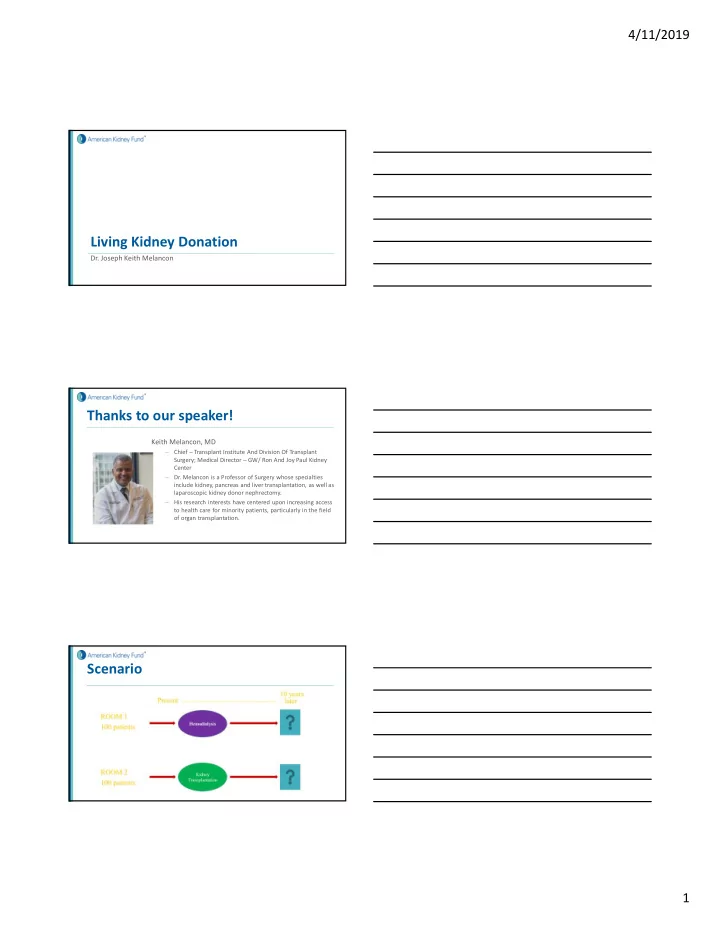
Living Kidney Donation Dr. Joseph Keith Melancon Thanks to our - - PDF document

living kidney donation
SMART_READER_LITE
LIVE PREVIEW

Living Kidney Donation Dr. Joseph Keith Melancon Thanks to our - - PDF document

4/11/2019 Living Kidney Donation Dr. Joseph Keith Melancon Thanks to our speaker! Keith Melancon, MD Chief Transplant Institute And Division Of Transplant Surgery; Medical Director GW/ Ron And Joy Paul Kidney Center Dr.


slide-1
SLIDE 1

4/11/2019 1

Living Kidney Donation

  • Dr. Joseph Keith Melancon

Thanks to our speaker!

Keith Melancon, MD

– Chief – Transplant Institute And Division Of Transplant Surgery; Medical Director – GW/ Ron And Joy Paul Kidney Center – Dr. Melancon is a Professor of Surgery whose specialties include kidney, pancreas and liver transplantation, as well as laparoscopic kidney donor nephrectomy. – His research interests have centered upon increasing access to health care for minority patients, particularly in the field

  • f organ transplantation.

Scenario

slide-2
SLIDE 2

4/11/2019 2

Did you know?

slide-3
SLIDE 3

4/11/2019 3

Renal replacement therapy

  • People with end stage renal disease

require renal replacement therapy in

  • rder to survive.
  • This can be achieved through dialysis

– hemodialysis, peritoneal dialysis,

  • r through kidney transplantation.
  • The mortality (death rate) and

morbidity (disease rate) associated with dialysis is 4-5 times higher.

Transplantation Procedure - transplant recipient

slide-4
SLIDE 4

4/11/2019 4

Why transplantation?

  • Around 100,000 patients with end stage renal

disease (ESRD) or kidney failure are on the waitlist for kidney transplantation.

  • Only around 17,000 kidney transplants are done

every year.

  • Great demand for organs with limited supply.

Types of kidney transplantation

  • Living donor kidney transplantation
  • Deceased donor kidney transplantation

The donor operation

slide-5
SLIDE 5

4/11/2019 5

Survival rates in the 2 groups

  • The 5 year and 10 year survival for deceased

donor kidney graft is 86.1% and 46.7% respectively.

  • The 5 year and 10 year survival for living donor

kidney graft is 93% and 89.2% respectively.

slide-6
SLIDE 6

4/11/2019 6

The living donor surgery

  • Donors are selected after careful consideration.
  • Routine approach for the procedure.
  • Small incisions (surgical cuts).
  • 2-3 days in the hospital after surgery.
  • Considerably less pain with the procedure.
  • 4-6 weeks for donor to return to normal activities.
  • Return to work within a few days if work isn’t physically

demanding.

Risks of being a living donor

  • Risks involving a surgery – pain, bleeding, infection.
  • Post surgical complications – pneumonia, urinary tract

infection, blood clots (DVT), wound infection, side effects

  • f drugs.
  • Longer recovery than normal for some patients.
  • Minimal risk of developing high blood pressure long

term.

  • Extremely low risk of death – 0.03% (1 in 10,000).
slide-7
SLIDE 7

4/11/2019 7

What happens after surgery?

  • Quality of life of a living donor is comparable to

an average adult with 2 kidneys.

  • Donor is in great condition health wise –

extensive testing and complete physical work up done prior to donation.

slide-8
SLIDE 8

4/11/2019 8

Insurance coverage

  • Follow up care is provided for all kidney donors.
  • Recipient’s insurance pays for the living donor’s medical

expenses related to the donation (not all issues and complications are covered by the recipient’s insurance)

  • All the pre operative check up and testing of the living donors will be

covered by the recipient’s insurance

  • Surgery and immediate post operative care is covered by the recipient's

insurance.

  • Limited coverage is provided after surgery.

What's NOT covered by recipient’s insurance?

  • Travel expenses of the kidney donor
  • Housing or hotel for donors from out of town
  • Food while traveling
  • Lost wages
  • Costs of childcare
slide-9
SLIDE 9

4/11/2019 9

Pregnancy after donation

  • Can you become pregnant after donating your

kidney?

  • What are the risks?
slide-10
SLIDE 10

4/11/2019 10

Novel strategies to increase transplantation rates

Paired kidney exchanges

Paired kidney exchange and altruistic kidney donation

slide-11
SLIDE 11

4/11/2019 11

slide-12
SLIDE 12

4/11/2019 12

What are some of the ways we have adopted to increase the awareness and access to health care in terms of kidney disease?

slide-13
SLIDE 13

4/11/2019 13 Talk to your doctor about kidney screening

Sign up to be a donor today!

slide-14
SLIDE 14

4/11/2019 14

Join us for our next webinar!

Topic: Gout in Kidney Disease

Speaker: TBD Date & Time: TBD

Go to www.KidneyFund.org/webinars to learn more and register!