Post Living Donation Disclosures Followup I have no financial - - PDF document

post living donation
SMART_READER_LITE
LIVE PREVIEW

Post Living Donation Disclosures Followup I have no financial - - PDF document

9/11/2018 Post Living Donation Disclosures Followup I have no financial relationships to disclose. Ana Marie Torres, RN, MSN, ANPBC Adult Nurse Practitioner UCSF Medical Center Liver Transplant Service Living Liver and Kidney Donors


slide-1
SLIDE 1

9/11/2018 1

Post Living Donation Follow‐up

Ana Marie Torres, RN, MSN, ANP‐BC Adult Nurse Practitioner UCSF Medical Center Liver Transplant Service

Disclosures

I have no financial relationships to disclose.

Living Kidney Donor Follow‐up

The reporting of kidney transplant center outcomes is a requirement of the Organ Procurement and Transplantation Network. U.S. transplantation programs must submit living donor follow‐up data through 2 years after donation. Donors are made aware of the need for follow‐up post donation during the time they are completing the work up and when discharged from the hospital following surgery.

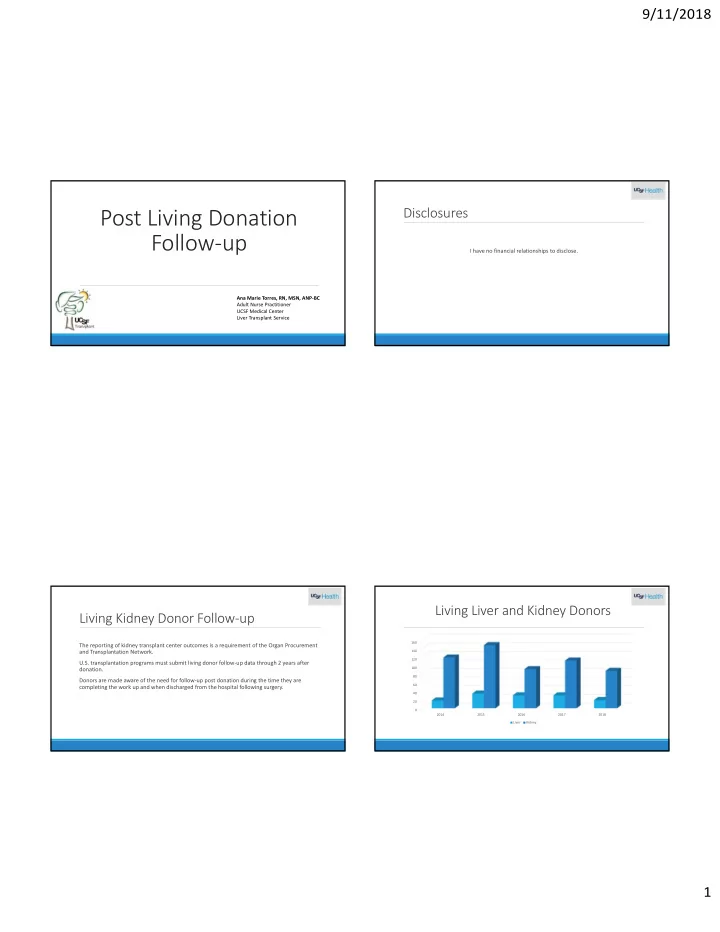
Living Liver and Kidney Donors

20 40 60 80 100 120 140 160 2014 2015 2016 2017 2018 Liver Kidney

slide-2
SLIDE 2

9/11/2018 2 Post Kidney Donor Follow‐up

At UCSF, donors are asked to follow‐up with the transplant center one week after surgery and at 6 months, one year and two years. The follow up includes: Blood work for serum creatinine Urine sample for urine protein and urine creatinine ratio Clinic visit Health History Questionnaire

Post Liver Donor Follow‐up

At UCSF, the follow up for liver donors are seen in clinic one week, two weeks and two months, six months and twelve months. The follow up includes: CBC, electrolytes and liver function tests. Abdominal ultrasound at two months A Health History Questionnaire

Living Donor Follow‐up Live Donor Follow‐up

So what are the barriers to donor follow‐up?

slide-3
SLIDE 3

9/11/2018 3 Post Living Donor Follow‐up Barriers

  • Lack of reimbursement to transplant programs for donor follow‐up care
  • Donors do not want to return to the transplant program for medical tests as time passes
  • Lack of reimbursement to donors for costs associated with follow‐up
  • Cost of additional medical testing for living donors
  • Living donors do not want to be contacted
  • Donors’ contact information becomes outdated
  • Direct and indirect costs to donors

Post Living Donor Follow Up Benefits

  • Better understanding of the long term health outcomes of living donors
  • More information can be provided to prospective living donors about risks
  • Improved national trust in the process of living donation
  • Improved health for living donors
  • Reduced medical risks associated with kidney donation
  • Reduced medical risks associated with liver donation

Post Living Donor Follow‐up

  • Research in the field of living donor and kidney donation all agree that donor follow‐up is

important.

  • Understanding the long‐term medical consequences of living donation remains deficient.
  • Follow‐up needs to be longer than 2 years to better understand the long‐term health outcomes
  • f living donors. (HTN, DM, cardiovascular disease, obesity)
  • Providing donors with health insurance as an incentive for kidney donation could make it easier

to obtain medical follow‐up from their primary care physicians.

The Future of Post Living Donor Follow‐up

  • The ASTS has been actively lobbying for a bill to be introduced in Congress that would provide

lifetime Medicare coverage for living donors.

  • In August, 2018 the U.S. Department of Labor’s Wage and Hour Division issued a new opinion

letter confirming living organ donors’ qualification for Family Medical Leave Act protections in response to a request form Congresswoman Jaime Herrera Beautler (R‐WA). The ASTS worked closely with the congresswoman’s office to ensure that living donors are protected in their jobs.

  • H.R. 1270 Living Donor Protection Act of 2017 prohibits discrimination based on an individual’s

status as a living organ donor in the offering, issuance, cancellation , coverage, price, or any

  • ther condition of a life insurance policy, disability insurance policy, or long‐term care insurance

policy.

slide-4
SLIDE 4

9/11/2018 4 Living Donor Follow‐up Summary

The disclosure of information regarding the quality of health care outcomes enforces the performance standards to improve the quality of care provided to donors. To understand the long‐term health outcomes of living donors. The information on the health of donors is needed to care for individual donors and for the education of potential donors so that they can make informed decisions about donating. Donors directly help their recipients is indisputable. Donors help society by reducing the economic and social costs of caring for patients with ESRD and ESLD.

References

Waterman, Amy D., Dew, Mary Amanda, Davis, Connie L., McCabe, Melanie, Wainwright, Jennifer L., Forland, Cynthia I., Bolton, Lee, & Cooper, Matthew. (2013). Living‐ Donor Follow‐Up Attitudes and Practices in U.S. Kidney and Liver Donor Programs. Transplantation, 95(6)883‐888. Newell, K.A., Formica, R.N., & Gill, J.S. (2016). Engaging Living Kidney Donors in a New Paradigm of Postdonation Care. American Journal

  • f Transplantation, 16, 29‐32.

Wainwright, Jennifer L., Robinson, Amanda M., Wilk, Amber R. , Klassen, David K., Cherikh, Wida S., & Stewart, Darren E.(2018). Risk of ESRD in prior living kidney donors. American Journal of Transplant, 18, 1129‐1139. Brown, Robert S., Smith, Abigail R., Dew, Mary Amanda, Gillespie, Brenda W., Hill‐Callahan, Peg, &Ladner, Daniela P. (2014) Predictors of Donor Follow‐up After Living Donor Liver Transplantation. American Association for the Study of Liver Diseases, 20, 967‐976. Murad, Sarwa Darwish, Fidler, Jeff L., Poterucha, John J., Sanchez, William, Jowsey, Sheila G., Nagorney, David, Rosen, Charles B., & Heimbch, Julie K. (2015). Longerm Clinical and Radiological Follow‐up of Living Liver Donors, 22, 934‐942.