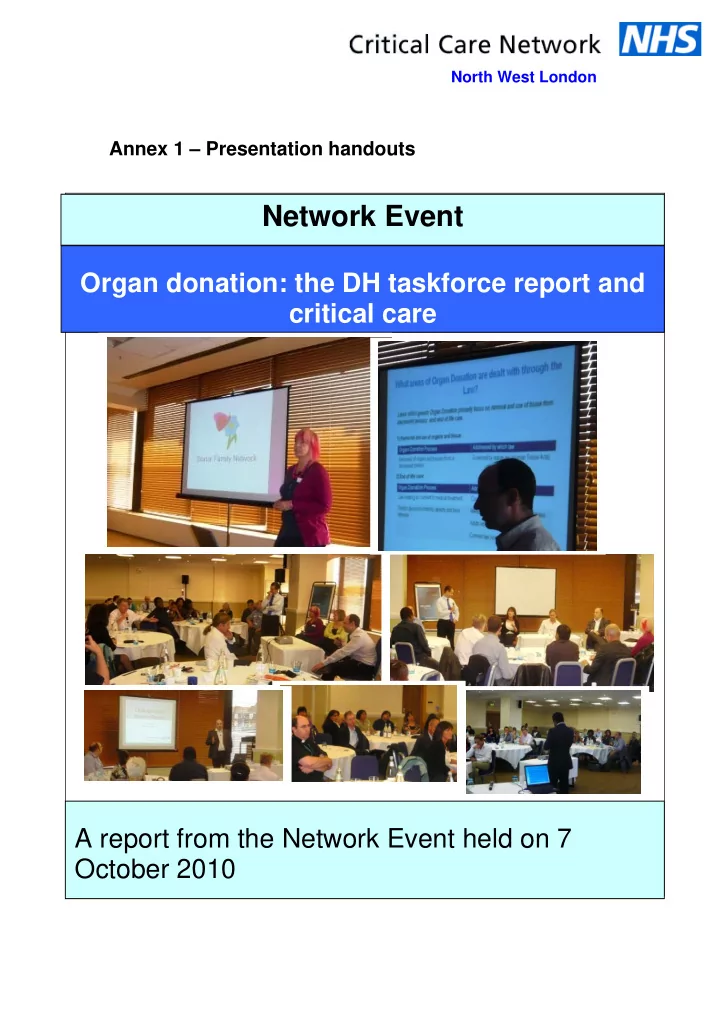
Network Event Organ donation: the DH taskforce report and critical - - PDF document

network event
SMART_READER_LITE
LIVE PREVIEW

Network Event Organ donation: the DH taskforce report and critical - - PDF document

North West London Annex 1 Presentation handouts Network Event Organ donation: the DH taskforce report and critical care A report from the Network Event held on 7 October 2010 Overview of organ donation in the UK - Dr Anthony Gordon ICU


slide-1
SLIDE 1

Annex 1 – Presentation handouts

Network Event

Organ donation: the DH taskforce report and critical care A report from the Network Event held on 7 October 2010

North West London

slide-2
SLIDE 2

Overview of organ donation in the UK - Dr Anthony Gordon ICU Senior Lecturer and clinical lead for organ donation Imperial College Healthcare NHS Trust 1

Overview of organ donation Overview of organ donation in the UK in the UK

Anthony Gordon

Senior Lecturer / Consultant Clinical Lead for Organ Donation Centre for Peri-operative & Critical Care Medicine Imperial College / Charing Cross Hospital October 2010

Organ donation taskforce 2008

slide-3
SLIDE 3

Overview of organ donation in the UK - Dr Anthony Gordon ICU Senior Lecturer and clinical lead for organ donation Imperial College Healthcare NHS Trust 2

Number Number of deceas

  • f deceased

ed dono donors & & tran transplants in U splants in UK

slide-4
SLIDE 4

Overview of organ donation in the UK - Dr Anthony Gordon ICU Senior Lecturer and clinical lead for organ donation Imperial College Healthcare NHS Trust 3

Organ donation taskforce 2008

14 recommendations accepted in full by Government believe will increase organ donation by 50% in 5 years Making donation usual, not unusual Recommendations

Recommendation 1 & 2 – UK wide service

  • A UK wide Organ Donation Organisation, the

responsibility of NHSBT

Recommendation 3 - Legal & ethics

  • Resolve of outstanding ethical, legal and

professional issues.

  • Clear frameworks of good practice
slide-5
SLIDE 5

Overview of organ donation in the UK - Dr Anthony Gordon ICU Senior Lecturer and clinical lead for organ donation Imperial College Healthcare NHS Trust 4 Recommendations

Recommendation 4 – Making donation ‘usual’

  • Donation should feature in all end of life care

pathways.

  • Appointment of clinical donation champions and

Trust donation committees Recommendations

Recommendation 5, 6 & 7 - Monitoring

  • Minimum notification criteria to DTC
  • Monitoring of Trust performance
  • BSD testing in all patients where BSD is a likely

diagnosis

Recommendation 8 – Costs of donor management

  • Reimbursement costs for the donation expenses

incurred

slide-6
SLIDE 6

Overview of organ donation in the UK - Dr Anthony Gordon ICU Senior Lecturer and clinical lead for organ donation Imperial College Healthcare NHS Trust 5

Recommendations Recommendation 9 – Donor Transplant Coordination

  • Central employment
  • Increasing DTC numbers and embedding within

Trusts.

  • Development of electronic offering systems

Recommendation 10 – Retrieval teams

  • Commissioning of dedicated organ retrieval

teams UK wide Recommendations

Recommendation 11 – Training

  • Mandatory training in the principles of donation

Recommendation 12 – Honouring donation

  • Personal & public recognition where desired

Recommendation 13 & 14 – Promoting donation

  • General public, BME population
  • Coroner
slide-7
SLIDE 7

Overview of organ donation in the UK - Dr Anthony Gordon ICU Senior Lecturer and clinical lead for organ donation Imperial College Healthcare NHS Trust 6

Inequalities of Access Ethnic Minority Groups Obstacles to donation

  • Improved outcomes
  • Diagnosis of brain stem death
  • Consent rates
  • Place of death
  • Mode of death
  • Donor management
  • Operational hurdles
slide-8
SLIDE 8

Overview of organ donation in the UK - Dr Anthony Gordon ICU Senior Lecturer and clinical lead for organ donation Imperial College Healthcare NHS Trust 7

Obstacles to donation

  • Improved outcomes
  • Diagnosis of brain stem death
  • Consent rates
  • Place of death
  • Mode of death
  • Donor management
  • Operational hurdles

Falling incidence of brainstem death

500 1000 1500 2000 2500 2003/04 2004/05 2005/06 2006/07 2007/8 2008/9 BSD possible diagnosis Patient confirmed BSD

slide-9
SLIDE 9

Overview of organ donation in the UK - Dr Anthony Gordon ICU Senior Lecturer and clinical lead for organ donation Imperial College Healthcare NHS Trust 8

Obstacles to donation

  • Improved outcomes
  • Diagnosis of brain stem death
  • Consent rates
  • Place of death
  • Mode of death
  • Donor management
  • Operational hurdles

UK Potential donor audit, 2004-8

Audited deaths of patients (n=46 801) Was the patient ever on mechanical ventilation? Yes (n=42 749) No (n=4052) Was brain stem death a likely diagnosis? Yes (n=4166) No (n=38 583) Were brain stem tests performed? Yes (n=2857) No (n=1309) Was brain stem death confirmed? Yes (n=2754) No (n=103) Were there any absolute medical contraindications to heartbeating solid organ donation? Yes (n=42 749) No (n=4052) Was the issue of heartbeating solid organ donation considered? Yes (n=2467) No (n=273) Were the next of kin approached for permission? Yes (n=2320) No (n=147) Was consent given by the next of kin? Yes (n=1379) No (n=941) Were there any absolute medical contraindications to heartbeating solid organ donation? Did donation occur? Yes (n=1244) No (n=135)

slide-10
SLIDE 10

Overview of organ donation in the UK - Dr Anthony Gordon ICU Senior Lecturer and clinical lead for organ donation Imperial College Healthcare NHS Trust 9

Possibly BSD

Was brain stem death a likely diagnosis? Yes (n=4166) No (n=38 583) Were brain stem tests performed? Yes (n=2857) No (n=1309)

  • 350 missed potential

donors in 1 year

  • 172 actual donors
  • 619 additional

transplanted patients

  • extra 2.8 donors pmp

Reasons for not BSD testing

Reasons for not testing (approx 650 / year) 30.4 28.1 14.6 11 8.4 6.1 0.7 0.7 10 20 30 40

cardiovascular instability unknow n residual neurological function family-related problems w ith testing contra-indication to donation (including age) coroner

  • thers

% total

Reasons for not testing (approx 350 / year)

slide-11
SLIDE 11

Overview of organ donation in the UK - Dr Anthony Gordon ICU Senior Lecturer and clinical lead for organ donation Imperial College Healthcare NHS Trust 10

Common response during coning Lack of capacity to consent Mental Capacity Act 2005 Mental Capacity Act 2005 Treat adult patients who lack capacity consent “reasonably believe their actions to be in the person’s best interests.”

slide-12
SLIDE 12

Overview of organ donation in the UK - Dr Anthony Gordon ICU Senior Lecturer and clinical lead for organ donation Imperial College Healthcare NHS Trust 11

What is the patient’s best interest? “A person’s best interests depend on their individual circumstances … …the courts have established that best interests are wider than simply treating a person’s medical condition and include a person’s social, emotional, cultural and religious interests.”

DOH guidance 2009

Obstacles to donation

  • Improved outcomes
  • Diagnosis of brain stem death
  • Consent rates
  • Place of death
  • Mode of death
  • Donor management
  • Operational hurdles
slide-13
SLIDE 13

Overview of organ donation in the UK - Dr Anthony Gordon ICU Senior Lecturer and clinical lead for organ donation Imperial College Healthcare NHS Trust 12

Consent rates in Europe Increasing consent rates Organ Donor Register

  • 96% would accept donation
  • 12% on ODR (45% say they would join)

Public engagement

  • Media campaign
  • Timely, sensitive approach to family
  • Ensure understand / accept BSD / donation
  • “Collaborative” approach

www.or www.organdonation.nhs.uk andonation.nhs.uk www.or www.organdonation.nhs.uk andonation.nhs.uk or call

  • r call
  • r call
  • r call 0300 123 23 23

0300 123 23 23 0300 123 23 23 0300 123 23 23

slide-14
SLIDE 14

Overview of organ donation in the UK - Dr Anthony Gordon ICU Senior Lecturer and clinical lead for organ donation Imperial College Healthcare NHS Trust 13

Obstacles to donation

  • Improved outcomes
  • Diagnosis of brain stem death
  • Consent rates
  • Place of death
  • Mode of death
  • Donor management
  • Operational hurdles

Donation from Emergency department Donation can occur from A&E

  • More challenging?

2 Specialist nurses - organ donation (DTCs)? 4-hour wait suspended

  • For that patient
  • For all patients?
slide-15
SLIDE 15

Overview of organ donation in the UK - Dr Anthony Gordon ICU Senior Lecturer and clinical lead for organ donation Imperial College Healthcare NHS Trust 14

Donation from Emergency department

  • N. Thames

Obstacles to donation

  • Improved outcomes
  • Diagnosis of brain stem death
  • Consent rates
  • Place of death
  • Mode of death
  • Donor management
  • Operational hurdles
slide-16
SLIDE 16

Overview of organ donation in the UK - Dr Anthony Gordon ICU Senior Lecturer and clinical lead for organ donation Imperial College Healthcare NHS Trust 15

Donation after cardiac death Non heart-beating donation After cardiac death organs rapidly cold perfused Organs then retrieved Controlled v Uncontrolled

  • planned vs unplanned
  • Maastricht categories III v II (IV- BSD)

Planned withdrawal of life supporting treatment DCD is not “new”

slide-17
SLIDE 17

Overview of organ donation in the UK - Dr Anthony Gordon ICU Senior Lecturer and clinical lead for organ donation Imperial College Healthcare NHS Trust 16

Donation after cardiac death Decision first made to withdraw Rx Donation only then considered

  • Family discussion / consent
  • Organs placed
  • Retrieval team present

Withdrawal of treatment as planned but timed

  • In theatre?
  • +/- family

How does DCD differ from “normal” death?

3 2

Decision to withdraw cardiorespiratory support Withdrawal Asystole Diagnosis of death Bedside vigil Last offices Decision to withdraw cardiorespiratory support Delayed withdrawal Asystole Expedient diagnosis of death Transfer to theatre Perfusion / retrieval Last offices Check Organ Donor Register Notify DTC Approach family Continue cardiorespiratory support

“Normal” Death DCD

slide-18
SLIDE 18

Overview of organ donation in the UK - Dr Anthony Gordon ICU Senior Lecturer and clinical lead for organ donation Imperial College Healthcare NHS Trust 17

Donation after cardiac death Death confirmed as usual after 5mins of asystole and apnoea 3 hour max wait (return to ICU)

  • Family must be aware donation may not be

possible (~40% stand down) Further stand-off time (~5mins) In theatre, the aorta is cannulated and organs rapidly cold perfused Organ retrieval Possible to donate

  • lungs, liver, kidney and pancreas

Last offices in theatre Death certificate given to family, offered

  • pportunity to view body

3 4

Donation after cardiac death

slide-19
SLIDE 19

Overview of organ donation in the UK - Dr Anthony Gordon ICU Senior Lecturer and clinical lead for organ donation Imperial College Healthcare NHS Trust 18

Key features of DCD

3 5

Donation has to be considered before death Donation may not happen

  • Difficult to predict time to asystole
  • 40% stand-down

Delayed withdrawal

  • Physiological instability

Altered management of death

  • Diagnosis of cardiac death and transfer to theatre

Tension between the interests of the dying patient and the recipient What is the patient’s best interest? “In many cases, actions that can facilitate NHBD most successfully will be in the person’s best interests.”

  • Blood sampling ✓
  • Alter current Rx ✓
  • Probably not new Rx that

may have risk

slide-20
SLIDE 20

Overview of organ donation in the UK - Dr Anthony Gordon ICU Senior Lecturer and clinical lead for organ donation Imperial College Healthcare NHS Trust 19

Donation after cardiac death Donation after DCD

3 8

Hea Heartbeating tbeating Non- Non- heart heartbeating eating Donors

  • nors

611 611 288 288

Ki Kidn dney ey

109 1096 477 477

Pancreas Pancreas

185 185 33 33

Hear Heart

129 129

Lu Lung ng

238 238 23 23

Liver Liver

527 527 80 80

Total organs transplanted Total organs transplanted

217 2175 613 613

Transplant Transplanted organs per ed organs per donor donor

3.6 3.6 2.1 2.1

Organs transplanted from deceased donors in UK, April 08 – March 09

slide-21
SLIDE 21

Overview of organ donation in the UK - Dr Anthony Gordon ICU Senior Lecturer and clinical lead for organ donation Imperial College Healthcare NHS Trust 20

Obstacles to donation

  • Improved outcomes
  • Diagnosis of brain stem death
  • Consent rates
  • Place of death
  • Mode of death
  • Donor management
  • Operational hurdles

Donor optimisation Switch focus from brain injury management to

  • rgan protection
  • More fluid?
  • More PEEP / Less Tidal Volume?
  • Chest physio
  • ICS guidelines

www.ics.ac.uk/intensive_care_professional/standards__safety_and_quality

  • Canadian guidelines

Shemie SD et al CMAJ 2006 vol. 174 (6) pp. S13-32

slide-22
SLIDE 22

Overview of organ donation in the UK - Dr Anthony Gordon ICU Senior Lecturer and clinical lead for organ donation Imperial College Healthcare NHS Trust 21

Donor optimisation Obstacles to donation

  • Improved outcomes
  • Diagnosis of brain stem death
  • Consent rates
  • Place of death
  • Mode of death
  • Donor management
  • Operational hurdles
slide-23
SLIDE 23

Overview of organ donation in the UK - Dr Anthony Gordon ICU Senior Lecturer and clinical lead for organ donation Imperial College Healthcare NHS Trust 22

Donor Criteria Donor Criteria Brain Stem Dead or inevitable death Absolute Contraindications are: 1) HIV +ve 2) nvCJD +ve, REFER EVERYTHING R EVERYTHING Consent (Human Tissue Act 2004) Coroner Approval If Required Success to date? 18% increase 2008-10, 4% in 2010 to date

slide-24
SLIDE 24

Overview of organ donation in the UK - Dr Anthony Gordon ICU Senior Lecturer and clinical lead for organ donation Imperial College Healthcare NHS Trust 23

Questions?

anthony.gordon@imperial.ac.uk

www.or www.organdonation.nhs.uk andonation.nhs.uk www.or www.organdonation.nhs.uk andonation.nhs.uk or call

  • r call
  • r call
  • r call 0300 123 23 23

0300 123 23 23 0300 123 23 23 0300 123 23 23

slide-25
SLIDE 25

Legal and ethical aspects of donation after cardiac death - Dr Chris Danbury Consultant ICM/anaesthetics Royal Berkshire Hospital NHS Trust and Visiting Fellow in Health Law University

  • f Reading

1

Dr Chris Danbury

“Improving organ donation within your hospital”

Law and Donation

“Best Interests is Best Practice”

‘Urgent attention is required to resolve outstanding legal, ethical and professional issues in

  • rder to ensure that all clinicians are supported and able to work within a clear and

unambiguous framework of good practice. Additionally, an independent UK-wide Donation Ethics Group should be established.’

What does the taskforce say about organs for transplants ethical, legal and professional issues?

2

Recommendation 3 of the Organ Taskforce states:

slide-26
SLIDE 26

Legal and ethical aspects of donation after cardiac death - Dr Chris Danbury Consultant ICM/anaesthetics Royal Berkshire Hospital NHS Trust and Visiting Fellow in Health Law University

  • f Reading

2

3

What are the legal authorities governing Organ and Tissue Donation?

  • Statutes
  • Statutory Instruments
  • EU Directives*
  • Human Rights Act 1998 (European Convention on Human Rights)
  • Judge-made (Common) Law

There are 5 core legal authorities which govern organ and tissue donation:

* EU Directives apply largely to tissue donation

4

What areas of Organ Donation are dealt with through the Law?

Laws which govern Organ Donation primarily focus on removal and use of tissue from deceased persons and end of life care.

Organ Donation Process Addressed by which law Removal of organs and tissues from a deceased person Governed by statute law (Human Tissue Acts) 1) Removal and use of organs and tissue: Organ Donation Process Addressed by which law Law relating to consent to medical treatment Common Law: UK generally Test for decision-making capacity and best interests Mental Capacity Act 2005: England & Wales Adults with Incapacity Act 2000: Scotland Common law: Northern Ireland 2) End of life care:

slide-27
SLIDE 27

Legal and ethical aspects of donation after cardiac death - Dr Chris Danbury Consultant ICM/anaesthetics Royal Berkshire Hospital NHS Trust and Visiting Fellow in Health Law University

  • f Reading

3

Laws governing removal and use of organs and tissue

Human Tissue Act 2004 Human Tissue (Scotland) Act 2006

5

For adults

  • If a decision of a deceased person to

consent to the activity, or a decision of his not to consent to it, was in force immediately before he had died, his consent

  • Where such a decision is not in force,

consent is required from a nominated representative or a person in a ‘qualifying relationship’ (such as next of kin)

  • No particular form for consent is specified

For minors (<18)

  • The consent of the (competent) minor
  • Where no decision was made prior to

death or the minor was not competent to deal with the issue it is the consent of a person with parental responsibility

  • If there is no person with parental

responsibility it is the consent of a ‘qualifying relative’

Who should give consent for donation?

As applied in NI, Wales and England 6

The Human Tissue Act provides guidelines on who is able to give consent:

slide-28
SLIDE 28

Legal and ethical aspects of donation after cardiac death - Dr Chris Danbury Consultant ICM/anaesthetics Royal Berkshire Hospital NHS Trust and Visiting Fellow in Health Law University

  • f Reading

4

7

If no decision was made by the deceased, how can consent be given?

As applied in NI, Wales and England

Patient Nominated Representatives Qualifying Relatives

Nominated Representatives

  • One or more persons
  • Made orally in the presence of two

witnesses or in writing either: Signed in the presence of at least one witness At his direction and in his presence and in the presence of at least one witness Made in a will

The patient has first rights to consent. Where the patient is not competent, the nominating representatives become the primary stakeholders who can provide consent for a patient

The Law Governing End-of-life Care

8

slide-29
SLIDE 29

Legal and ethical aspects of donation after cardiac death - Dr Chris Danbury Consultant ICM/anaesthetics Royal Berkshire Hospital NHS Trust and Visiting Fellow in Health Law University

  • f Reading

5

9

How have we typically justified end of life decisions and is this the right way?

Traditionally decisions to withdraw care have been made on the grounds of futility, from a physiological, probability and economic perspective Physiology

Body is no longer responding to drugs or any other form of palliative care. Continued treatment would therefore be futile

Probability

Conjecture that the patient will not survive even if treatment is

  • administered. Treatment therefore is futile

Economic

Continued care will be too costly with a small chance of success where treatment is continued. Treatment is therefore futile

The concept of futility is nebulous and therefore does not help us, as doctors, to make the most effective, legal and best decisions when it comes to withdrawal of patient care

Airedale NHS Trust v Bland [1993] A.C. 789 ‘In certain circumstances medical treatment can properly be categorised as futile, that is, if it cannot cure or palliate the disease from which the patient is suffering’ 10

Who has decision making powers in end-of-life care?

Patient competent (Y/N)? Legal authorities with decision making powers Patient has decision making powers England & Wales Scotland Northern Ireland

Welfare Attorney Guardian Intervener Clinician Court of Session High Court Clinician

The chart below shows the decision making process for end-of-life care

YES NO

Decision making powers in end-of-life care vary across countries in the UK

Lasting Power of Attorney Court Appointed by Deputy Court of Protection Clinician or Carer

slide-30
SLIDE 30

Legal and ethical aspects of donation after cardiac death - Dr Chris Danbury Consultant ICM/anaesthetics Royal Berkshire Hospital NHS Trust and Visiting Fellow in Health Law University

  • f Reading

6

11

How does the Law in England and Wales govern treatment decision-making for patients without capacity?

The Mental Capacity Act 2005 defines decision-making ‘capacity’ for adults and stipulates various rules governing their medical treatment 1.A person is assumed to possess capacity unless it is established otherwise 2.All practicable steps should be taken to facilitate decision-making capacity 3.All acts done, or decisions made, for a person lacking capacity must be done or made in the person’s best interests

As applied in Wales and England

12

What is ‘best interests’?

When a person no longer has decision-making capacity, decisions must be made in their best interests Best interests embraces the following features:

  • It is the patient’s interests only that count
  • The decision will be a function of all the circumstances of the individual case
  • Best interests includes reference to all factors affecting the person’s interests

and in particular the person’s past and present wishes

slide-31
SLIDE 31

Legal and ethical aspects of donation after cardiac death - Dr Chris Danbury Consultant ICM/anaesthetics Royal Berkshire Hospital NHS Trust and Visiting Fellow in Health Law University

  • f Reading

7

13

How are ‘best interests’ determined?

The Mental Capacity Act 2005 stipulates that in determining a person’s best interests, the decision-maker must... Consider, as far as is reasonably ascertainable…

The person’s past and present wishes and feelings (and in particular any relevant written statement made when he had capacity) The beliefs and values that would be likely to influence his decision if he had capacity The other factors that he would be likely to consider if he were able to do so

14

How is ‘best interests’ looked at today?

The judges have previously stated that a person’s best interests must account for the entire range of interests bearing on a person’s welfare

“best interests encompasses medical, emotional and all other welfare issues”

What ‘other interests’ are there?

Emotional Spiritual Psychological Altruistic Welfare

Dame Butler-Sloss in In re A (Medical Treatment: Male Sterilisation) [2000]

slide-32
SLIDE 32

Legal and ethical aspects of donation after cardiac death - Dr Chris Danbury Consultant ICM/anaesthetics Royal Berkshire Hospital NHS Trust and Visiting Fellow in Health Law University

  • f Reading

8

15

Example of the application of the broader contemporary notion of best interests

Ahsan v UHL NHS Trust [2007]

  • Patient was in a persistent vegetative state
  • Clinicians believed patient was better cared for in hospital
  • Court allowed patient to be taken home as this was more consistent with her

spiritual beliefs

16

Once best interests have been established, what are the next steps we must take as clinicians?

1. Clinicians must consider whether any of the actions taken to facilitate or optimise donation carry with them any risk of harm or distress to the patient 2. Once it is decided that a particular action or actions that will facilitate NHBD are in that person’s best interests, then they may be carried out 3. Some of the actions that are needed to initiate the process of donation fall outside the scope of the MCA and should be carried out as a matter of good practice In MCA Scope

  • Taking and analysis of blood samples
  • Maintenance of life-sustaining treatment
  • Specific and more invasive treatments and

interventions

  • Timing and location of withdrawal of

treatments. Out of MCA Scope

  • Alerting the donor transplant coordinator and

transplant team of a potential donor

  • Speaking to the relatives about donation prior to

the person’s death; and

  • Researching medical history relevant to organ

donation (Data Protection Act must be observed when collecting this information)

slide-33
SLIDE 33

Legal and ethical aspects of donation after cardiac death - Dr Chris Danbury Consultant ICM/anaesthetics Royal Berkshire Hospital NHS Trust and Visiting Fellow in Health Law University

  • f Reading

9

17

What are the specific scenarios impacted by Organ Donation Law (1/2)

Life-Prolonging Treatments Introduction of new therapies e.g.

  • Inotropic or cardio-respiratory (ventilatory) support
  • Venous cannulae

Adjustments to existing treatments e.g.

  • Increases in oxygen concentration
  • Alterations to rates of fluids or drugs or
  • Ventilation settings, etc

There are 3 key specific scenarios impacted by organ donation law:

18

What are the specific scenarios impacted by Organ Donation Law (2/2)

Blood Sampling

  • Removing blood from a patient who lacks capacity must be in their best

interests

  • Stored whole blood or serum may be tested for the purposes of

transplantation where this is in the patient’s best interests

  • The person’s desire to be an organ donor would be a relevant factor in

determining if either of the above was in the individual’s best interests

More Invasive Interventions

  • No procedure which will hasten the patient’s death may be administered in

the interests of organ donation

  • Procedures that place the individual at risk of serious harm (e.g. systematic

heparinisation; resuscitation; femoral cannulation) are unlikely ever to be in a patient’s best interests

slide-34
SLIDE 34

Legal and ethical aspects of donation after cardiac death - Dr Chris Danbury Consultant ICM/anaesthetics Royal Berkshire Hospital NHS Trust and Visiting Fellow in Health Law University

  • f Reading

10

19

Summary

  • 1. End of life decisions are an integral part of good medicine
  • 2. There needs to be a clear, patient centred, documented

reason for withholding or withdrawing treatment

  • 3. This reason may be subject to challenge

Oxford University Press, June 2010 ISBN-10: 0199562032 ISBN-13: 978-0199562039

Further Information

20

slide-35
SLIDE 35

The donor family views - Pauline Weaver Donor Family Network 1

Donor Family Network

S

mall charity run by donor families

Two aims: The support of donor families The promotion of organ and tissue donation

slide-36
SLIDE 36

The donor family views - Pauline Weaver Donor Family Network 2

We aren’ t aliens or heroes We will all react differently We are j ust ordinary, normal people

slide-37
SLIDE 37

The donor family views - Pauline Weaver Donor Family Network 3

We don’ t want to ‘ upset them further’ We don’ t want to make ‘ things worse’ They are ‘ too upset’ They’ ve ‘ suffered enough’ Everyone has the right to be asked

Make organ donation usual Remember organ donation is positive for donor families too

slide-38
SLIDE 38

The donor family views - Pauline Weaver Donor Family Network 4

slide-39
SLIDE 39

The recipient view - Mandy Venters Live Life then Give Life Charity 1

T hink about it, T alk about it Do something about it

Cr itic al Car e Networ k

Nor th West L

  • ndon

Mandy Ve nte rs 7 Oc to be r 2010

A patie nts po int o f vie w

  • As o f to day o ve r 8,000 pe o ple ac tive o n

the transplant list

  • Me dian time to kidne y transplant 1,110

days, WL RT C 1,524 days

  • WL

RT C 500 patie nts o n list in 2009

  • U

p to 2008 o nly 20% re c e ive d transplant within 2 ye ars at WL RT C

slide-40
SLIDE 40

The recipient view - Mandy Venters Live Life then Give Life Charity 2

A patie nts po int o f vie w

  • “but yo u c an do dialysis”
  • “why – did yo u do so me thing to

c ause it? ”

  • “no w yo u’ ve had yo ur transplant it's

all be tte r no w” A patie nts po int o f vie w MY ST ORY

  • Cause
  • I

mpac t

  • …. And no w
slide-41
SLIDE 41

The recipient view - Mandy Venters Live Life then Give Life Charity 3

A patie nts po int o f vie w A patie nts po int o f vie w

slide-42
SLIDE 42

The recipient view - Mandy Venters Live Life then Give Life Charity 4

And fo r the future … One last tho ug ht…

Live Life Then Give Life www.lltgl.org.uk

slide-43
SLIDE 43

Challenges in the process of donation for the general hospital - Dr Gary Wares, Consultant ICU/Anaesthetics North West London Hospitals Trust 1

Challenges in the Donation Process

Dr Gary Wares Consultant in Intensive Care

Objectives

  • Potential Pitfalls in Donation Process
  • Organisational Barriers
  • Operational Barriers
  • Individual Barriers
  • Ethnic and Racial Barriers

Solutions

  • No “one size fits all” approach
  • Difference in practice between units
  • Different patients demographics
  • Different unit case mix

Consider….

  • 65 yr gentleman. Intubated and ventilated in ED.

Massive intra-cerebral haemorrhage.

  • Combined decision from Stroke, neuro surgery and

ICU that further treatment is futile.

  • No ICU bed available and theatre full with

emergency cases!!!

Non Heart beating pathway?

slide-44
SLIDE 44

Challenges in the process of donation for the general hospital - Dr Gary Wares, Consultant ICU/Anaesthetics North West London Hospitals Trust 2

Patient Identified as potential donor

  • Failure to recognise
  • “I didn’t think he would be a candidate”
  • ‘I thought he was too old”
  • Right patient in right place
  • ICU/ED/Ward/HDU……
  • Suitable for withdrawal of therapy
  • Failure to recognise or consider brain stem death

Agreeing to Donation

  • First approach
  • When and by whom?
  • On the Organ Donor Register?
  • Potential conflict between withdrawal conversation

and request for organ donation

  • Unease amongst clinicians surrounding NHBD

Withdrawal

  • Selecting the correct patient
  • Selecting the correct withdrawal mechanism
  • Care of the dying patient
  • Lack of understanding of process
  • Ensuring senior support for process
  • When we get it wrong

Withdrawal

  • Where to withdraw
  • Dependent on local arrangements
  • Pre-defined outcomes of process
  • Appropriate senior input
  • Back up plan if fails to meet criteria

Donation Process

  • Getting the patient to theatre
  • Adequate theatre resources
  • Frequently at night and out of hours
  • Impact on local anaesthetic and theatre staffing
  • Adequate resources
  • Education

Pitfalls

  • Lack of ICU bed capacity
  • Inadequate staffing
  • Theatre busy/high emergency workload
  • Colleagues in other departments
  • Staff attitude and beliefs
  • Forgetting about it at 4am!
slide-45
SLIDE 45

Challenges in the process of donation for the general hospital - Dr Gary Wares, Consultant ICU/Anaesthetics North West London Hospitals Trust 3

Network Standard?

  • Is standardisation of donation process possible
  • Within Trusts?
  • Between Trusts?
  • Consideration of Donation Care Bundle
  • Role of the Care of the Dying Pathway
  • Multi-disciplinary activated Care Bundle
  • Consider donation options within your workplace
  • How do I maximise the chances of successful

donation within my area?

  • Where?
  • When?
  • Who?
  • How?

Your practice Questions

slide-46
SLIDE 46

How we manage the potential donor- Dr Andre Vercueil Consultant Critical Care, CLOD, King’s College Hospital www.kch.nhs.uk 1

How we manage the potential donor

Dr Andre Vercueil Consultant Critical Care CLOD King’s College Hospital

Key responsibilities

  • Objectives

– Optimising End of Life (EOL) care – Normalising concept and possibility of donation as part of that pathway – Ensuring donation is part of the core business of the hospital – Acting in accordance with patients wishes

slide-47
SLIDE 47

How we manage the potential donor- Dr Andre Vercueil Consultant Critical Care, CLOD, King’s College Hospital www.kch.nhs.uk 2

Key responsibilities of the clinical lead

– Key challenges

  • 100% referral rate
  • Optimal conversion rate

– (Conversion not a quality target?)

  • Brainstem testing in all potential cases
  • Educational and operational changes throughout Trust
  • Feed back funding and knowledge to improve EOL care

How to put organ donation on the clinical agenda

– Who to influence, and how?

  • ITU consultants and nurses

– Internal guidelines – Quality indicator during monthly M+M

  • ED consultants

– King’s unique because of MTC – SNOD attends weekly ED meetings – Regular educational sessions for ED nurses

  • The wider Trust…
slide-48
SLIDE 48

How we manage the potential donor- Dr Andre Vercueil Consultant Critical Care, CLOD, King’s College Hospital www.kch.nhs.uk 3

How to put organ donation on the clinical agenda

– Who to influence, and how?

  • The wider Trust…
  • Audit all ITU and ED deaths
  • Donation audit (SNOD)

– Independent, so compare!

  • Medical director on ODC
  • Forward reports to chief executive and the board

– Add to quality accounts of Trust

  • Hospital consultants meeting/audit day

– Early clinical engagement with “-ologists” focussing on EOL quality

Collaborative working with OD committee, SN-OD and

  • ther clinicians

– Normalise referral

  • Seek independent opinion from SN-OD

– Usual collaborative approach

  • Buy-in from theatres
  • Link with End of Life project
  • Monthly data review
  • 3 monthly committee meeting and action plan
  • Specialist teams: identify potential gains
slide-49
SLIDE 49

How we manage the potential donor- Dr Andre Vercueil Consultant Critical Care, CLOD, King’s College Hospital www.kch.nhs.uk 4

PDA

  • There were 24 deaths in our ICU in August and 19 were

under the age of 75 and therefore audited for donor potential.

  • All were identified and referred in a timely manner and all

families were approached and offered the option of donation.

  • 2 families consented. 1 DCD and 1 DBD.

SCCU/MCCU Donor potential

slide-50
SLIDE 50

How we manage the potential donor- Dr Andre Vercueil Consultant Critical Care, CLOD, King’s College Hospital www.kch.nhs.uk 5 Successful changes to clinical practice and outcomes – Outcomes?

  • Increased consideration for non-heartbeating donation
  • ITU admission for EOL care for dying patients
  • Admission of patients who are likely brainstem dead

– No conflict between EOL care and organs

  • If “No” to heartbeating, reapproach for non-heartbeating
  • Early (ethical) optimisation of donors

0.5 1 1.5 2 2.5 3 3.5 4 4.5 Oct Nov Dec Jan Febr March April May DBD Converted to DCD DBD Donors DCD Consent DCD Donors

slide-51
SLIDE 51

How we manage the potential donor- Dr Andre Vercueil Consultant Critical Care, CLOD, King’s College Hospital www.kch.nhs.uk 6

Summary of legal advice:

  • The law requires that treatment only be given if it is “in

the patient’s best interests” (England and Wales) or “to the patient’s benefit” (Scotland)

Summary of legal advice:

  • The law requires that treatment only be given if it is “in

the patient’s best interests” (England and Wales) or “to the patient’s benefit” (Scotland)

  • If an individual wished to be an organ donor, treatments

that facilitate that wish and do not cause the person harm or distress or place them at a material risk of experiencing harm or distress are in their best interests.

slide-52
SLIDE 52

How we manage the potential donor- Dr Andre Vercueil Consultant Critical Care, CLOD, King’s College Hospital www.kch.nhs.uk 7

Summary of legal advice:

  • The law requires that treatment only be given if it is “in

the patient’s best interests” (England and Wales) or “to the patient’s benefit” (Scotland)

  • If an individual wished to be an organ donor, treatments

that facilitate that wish and do not cause the person harm or distress or place them at a material risk of experiencing harm or distress are in their best interests.

  • Many, but not all, of the practical steps that cause

concern are considered to be lawful in these circumstances.

Treatment strategy at death

  • Withdrawal. Removal of inotropes; reduction in

PEEP/FiO2>1 hour before death

  • Treatment limits
  • Treatment failure. Cardiac arrest on full support (100%
  • xygen; norad> 0.4ug/kg/min /CVVH).
  • DOA: intensive care not possible
  • Palliative care only
slide-53
SLIDE 53

How we manage the potential donor- Dr Andre Vercueil Consultant Critical Care, CLOD, King’s College Hospital www.kch.nhs.uk 8

Treatment strategy at death

  • 24 deaths
  • 8 died on full/escalating support
  • 11 died with treatment limitation
  • 3 died with full withdrawal
  • 1 DOA
  • 1 palliative care only

Main reason for treatment limits or withdrawal

  • Patient requests withdrawal
  • Physiological futility (refractory shock; refractory ARDS;

irreversible hepatic failure)

  • Subjective (premorbid quality of life; age)
  • Prognostic futility based on diagnosis/clinical problem

(Hypoxic brain injury (not brain stem death), Metastatic cancer, MOF in the context of neutropenia/ HIV/ ALD; NYHA grade IV/cardiogenic shock; end stage respiratory disease eg patients on home NIV/oxygen)

slide-54
SLIDE 54

How we manage the potential donor- Dr Andre Vercueil Consultant Critical Care, CLOD, King’s College Hospital www.kch.nhs.uk 9

Primary reason for withdrawal

  • Patient request: 0
  • Subjective: 0
  • Physiological futility: 4
  • Diagnostic futility: 10

1 2 3 4 5

Number of patients 2 4 6 8 10 12 14

Col 2 Col 3 Col 4 Col 5 Col 6 Col 7 Col 8 Col 9 Aug

Reason for treatment limits or withdrawal

Physiol futility Subjecti ve Diagnostic futility Aug 10: 4 10

slide-55
SLIDE 55

How we manage the potential donor- Dr Andre Vercueil Consultant Critical Care, CLOD, King’s College Hospital www.kch.nhs.uk 10

ICU deaths

  • V049434. B K. 78. Admitted from Medway under neurosurgery. Tolias. APACHE II 28. Emergency transfer from

Medway having been found collapsed in bathroom. GCS dropped from 13 to 9 and then 3. Background ovarian cancer; angina; AF (warfarin). Beriplex. CT: blood in ventricles and patchy periventricular low density. EVD. GCS did not recover. Treatment limited. Died 3.8.10. DC: 1a Hydrocephalus; 1b Spont IVH II AF

  • V037755. M F. 75. Admitted from vascular lab. Tyrell. APACHE II <8 hours. Known AA; PVD; coeliac axis
  • stenosis. Admitted 9.8.10 for elective endovascular repair using a custom made graft. Bleeding/ischaemia/liver

injury intra-operatively. Ischaemic left arm. Fem artery repaired. Progression of MOF/bleeding/coagulopathy. Died 11.8.10. Referred to coroner. PM: 1a Haemoperitoneum; 1b mesenteric infarction; 1c AAA with thrombus; II LVH.

  • P141808. I R. 30. Admitted from OR under
  • neurosurgery. Bell. APACHE II 24. Severe TBI: temp

lobectomy/early DC. Progression of brain injury from infarction/refractory rise in ICP. Died 23.8.10. Probably BSD but too unstable to test. Potential DCD, but family declined and probably would not have been time?

  • V053425. A B. 58. Admitted from Sidcup under general surgeons. APACHE II 31. Known morbid obesity,

hypertension, epilepsy, alcohol abuse and cardiomyopathy. Presented to ED at Sidcup with 3 days of abdo pain and melaena. 22 units of blood, 8 FFP, 2 pools platelets. Transferred for embolisation of a gastric lesion. Very

  • unstable. Angio showed duodenal bleeding. Lung injury. Died on HFOV/increasing noradrenaline. Died

15.8.10. ?should have been treatment limited?

BK and IR

slide-56
SLIDE 56

How we manage the potential donor- Dr Andre Vercueil Consultant Critical Care, CLOD, King’s College Hospital www.kch.nhs.uk 11

ICU deaths

  • P143082. D G. 72. Admitted under neurosurgery from ED. APACHE II 25.

Unwitnessed fall from ladder. Found face down, unresponsive and not

  • breathing. 20 minute resuscitation. C1-C4 C spine injury. Hypoxic brain
  • injury. Treatment withdrawn. Died 31.8.10. referred to coroner. Potential

DCD and family consented. Due to age could not place the kidneys, but donated corneas, skin and bone.

  • D510651. N M. 35. admitted from ED under gen surgery. Ali Hallal.

APACHE II 34. known epileptic/GH deficient after previous brain tumour. Out-of hospital cardiac arrest. Hypoxic brain injury confirmed by CT. Critical cerebral swelling with impending tonsillar descent. BSD confirmed. Died 29.8.10. DC: 1a Hypoxic brain injury; 1b Epilepsy; 1c hydrocephalus. II Pilocytic astrocytoma. Family approached and consented. Donated heart, lungs, liver, kidneys and pancreas. All were successfully transplanted.

  • P494786. F D. 81 admitted from V&A HDU. APACHE II<8 hours. Known IHD. Also mild to mod AR/MR. Good LV.

Oliguric renal failure post CABG. Cardiac arrest 48 hours post CABG on ICU whilst awaiting CVVH. Shocked post

  • resus. Died 28.8.10 (AV). Need to review in detail. **
  • P690708. D B. 66 admitted from OR under neurosurgery. Admitted in coma

from rupture of giant left middle cerebral artery aneurysm. Arrived with fixed dilated pupils. Repeat CT showed further haemorrhage and midbrain

  • compression. Admitted to ICU dead for management of family. DOA?. DC:

1a SAH. Family were approached but daughter declined.

NM and DB

slide-57
SLIDE 57

How we manage the potential donor- Dr Andre Vercueil Consultant Critical Care, CLOD, King’s College Hospital www.kch.nhs.uk 12

Summary

  • Aug was quieter month when compared with 2009. Income down, costs up.

Severity was high though.

  • SMR now fallen to 0.62 (await ICNARC analysis-trust now agreed) with

increase in APACHE II.

  • Length of stays have come down and we are trying to isolate data from

effect of delayed discharge (yet) so difficult to report

  • Readmissions 4 (3 neurosciences)
  • Took several ‘high severity/ very poor prognostic late admissions’ who

survive short period, usually out-of-hours. Several admissions were in retrospect inappropriate (epr record)

  • 1-2 critical incidents from pre-ICU care in deaths although nothing stand
  • ut.
  • Discharge delay remains serious problem. Impact of DD reported in poster

to Brussels.

  • Continued good referral for OD ?missed one
  • Tariff income rising with some important changes in version 8 CCMDS-if

rules allowing ‘maximal charging’ are changed the delayed discharge will really cost-surely in current climate this will happen eg with introduction of

  • Tarriffs. Also what is a critical care area and can you double charge by

recoding –implications for ‘named’ consultant.

Lessons and learning points

– Two CLODS

  • Someone is always available

– Focus on EOL quality

  • Offer people the choice
  • Ensure no regrets

– 100% referral rate: normalises approaching families

  • Both for clinicians and nurses

– Ongoing analysis to discriminate between poor approach and non-conversion

slide-58
SLIDE 58

How transplant coordinators can assist in the process - Paula Aubrey Team Manager London Organ Donation Services 1

Paula Aubrey Team Manager London Organ Donation Services

Specialist Nurses – Organ Donation How can SN-ODs assist in the in the donation process ?

Paula Aubrey Team Manager London Organ Donation Services

Points for discussion

  • Background: London Donation Team Services
  • Main objectives of the Organ Donation Service
  • Essential elements for success in supporting the

process

  • The Role of the SN-OD in the Donation Process
  • Critical Care Colleagues
  • Needs of the critical care family
  • Sequence of events
  • Benefits of ‘Long Contact’ approach

Paula Aubrey Team Manager London Organ Donation Services

Main objective

‘Saving lives and improving lives’ Aim is to maximise potential for organ donation and transplantation and to ensure 100% referral of potential donors from all critical care areas Hospital wide, ICU and Emergency Departments (ED)

Paula Aubrey Team Manager London Organ Donation Services

Organ Donation Services Team- London

SCOTLAND NORTH NORTH WEST YORKSHIRE MIDLANDS SOUTH WALES EASTERN SOUTH EAST SOUTH CENTRAL SOUTH WEST NORTHERN IRELAND LONDON

Key Roles Team Background Assistant Director Anthony Clarkson Regional Manager Jane Griffiths Team Managers Julie Whitney Paula Aubrey Jeanette Foley Team SN-ODs 22 NHS Trusts

Paula Aubrey Team Manager London Organ Donation Services

Main remit

  • 24/7 responsibility for donor referrals

from Critical Care

  • Facilitate the donation process
  • National Potential Donor Audit /research
  • Educational responsibilities
  • Promote organ and tissue donation
  • Post donation support & follow-up

Paula Aubrey Team Manager London Organ Donation Services

Planning

Identification and collaboration with key personnel hospital wide

  • Chief Executive
  • Medical Directors
  • Clinical Leads
  • Donation Committees
  • Critical Care lead consultant / Nurse
  • Critical Care staff
  • Emergency Department lead consultant / lead nurse
  • Bereavement officer
  • Coroner and coroner’s officer / procurator fiscal
slide-59
SLIDE 59

How transplant coordinators can assist in the process - Paula Aubrey Team Manager London Organ Donation Services 2

Paula Aubrey Team Manager London Organ Donation Services

Presence Clear visibility of SN-OD

  • A multidisciplinary approach between SN-OD &

Critical Care & other specialities is key to success

  • A robust training programme led by the SN-OD is

fundamental to raising awareness

  • Clear policies / clinical pathways are essential to

help guide clinical staff

Paula Aubrey Team Manager London Organ Donation Services

Role of the SN-OD Sequence of events

  • Family interview
  • Blood tests, ECHO, CXR & ECG
  • Advance cardio vascular monitoring (LIDCO, Doppler

& Swan)

  • Coroner and GP contacted
  • Register with ODT
  • Offering sequence (EOS)
  • Theatres
  • Last offices
  • Post donor family follow up

Paula Aubrey Team Manager London Organ Donation Services

Role of the SN-OD in supporting the process

  • To build a trusting relationship and provide

support to potential donor families open and honest communication

  • Partnership with Critical Care Staff –requires

excellent communication

  • Give families time and answer questions -

Support family in their decision

Paula Aubrey Team Manager London Organ Donation Services

Good Communication should never be underestimated!

  • Patients and families regularly rate good

communication skills as an essential component of end of life care

  • Poor communication and breakdowns in

communication generates more complaints than any other aspect of work performed by health care professionals

Paula Aubrey Team Manager London Organ Donation Services

Recognition of needs of Critical Care Family Members

  • To have questions answered honestly
  • To know the prognosis
  • To know specific facts concerning the patient’s

progress

  • To receive information about the patient once a day
  • To see the patient frequently
  • To know why things are being done for the patient
  • To know exactly what is being done for the patient
  • To feel the hospital personnel care about the patient
  • To be assured that the best possible care is being

given to the patient

Mendonca & Warren, Crit Care Nurse Q 1998;21(1):58-67

Paula Aubrey Team Manager London Organ Donation Services

Long contact - benefits

  • A multidisciplinary approach
  • The family are supported throughout and the

subject raised only at an appropriate time

  • nce it is clear that they have understood

death

  • Bedside nurse supported throughout
slide-60
SLIDE 60

How transplant coordinators can assist in the process - Paula Aubrey Team Manager London Organ Donation Services 3

Paula Aubrey Team Manager London Organ Donation Services

  • Enables SN-OD to initiate contact with

potential donor families earlier and on a more extended basis than a traditional ‘Regional Donor Coordinator’

  • Extended contact requires:

– Early referral / minimal notification criteria – Experience SN-OD & well established Trust of MD Team – Open communication

Paula Aubrey Team Manager London Organ Donation Services

Summary

  • Organ donation is about ‘saving lives and

improving lives’

  • In order to achieve effective outcomes

establishment of good ‘team’ working is essential

  • Recognition of needs of bereaved family
  • Proven benefits of ‘Long Contact’
  • Excellent communication is essential to

ensure seamless facilitation of donor process from initial donor referral to last offices