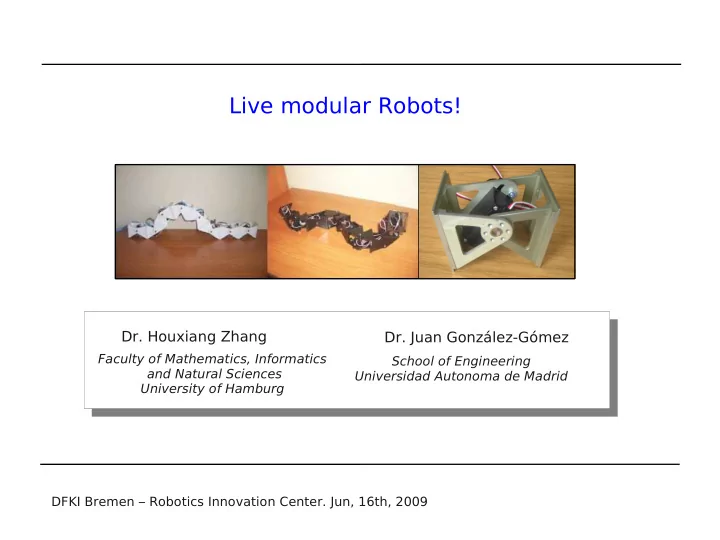
SLIDE 1 Live modular Robots!
Faculty of Mathematics, Informatics and Natural Sciences University of Hamburg School of Engineering Universidad Autonoma de Madrid
DFKI Bremen – Robotics Innovation Center. Jun, 16th, 2009
SLIDE 2 2
Outline
Live modular Robots!
- 1. Introduction
- 2. Locomotion in 1D
- 3. Locomotion in 2D
- 4. Minimal configurations
- 5. Cube-M modules
- 6. Conclusions and current work
Outline DFKI Bremen – Robotics Innovation Center. Jun, 16th, 2009
SLIDE 3
3
The Locomotion Problem
Classic approach
CMU Ambler Dante II
Bio-inspired approach
Aramies Big Dog
Modular approach
Polybot
SLIDE 4 4
Modular Robotics
- Two important aspects:
- Robot morphology
- Controller
SLIDE 5
5
Morphology
1D Topology 2D Topology 3D Topology Modular Robot classification Pitch-Pitch Yaw-yaw Pitch-yaw 1D topology sub-classification
SLIDE 6 6
Controller
Calculation of the joint's angles to realize a gait: it
- Classic approach: Mathematical modeling
- Calculation by inverse kinematics
- Disadvantages: The equations are only valid for an specific morphology
- Coordination problem:
CPG CPG CPG
- Bio-inspired controllers: CPGs
- Central Pattern Generators
- CPGs control the rhythmic activities
- Ej. The locomotion of the lamprey
SLIDE 7 7
Hypothesis: Sinusoidal oscillators
- CPGs are replaced by a Simplified model
it=A i s in 2 T iOi
- Sinusoidal oscillators:
- Advantages:
- Few resources required
CPG CPG CPG
SLIDE 8 8
Outline
Live modular Robots!
- 1. Introduction
- 2. Locomotion in 1D
- 3. Locomotion in 2D
- 4. Minimal configurations
- 5. Cube-M modules
- 6. Conclusions and current work
Outline DFKI Bremen – Robotics Innovation Center. Jun, 16th, 2009
SLIDE 9 9
Y1 Modules
- One degree of freedom
- Easy to build
- Cheap
- Open and “Free”
SLIDE 10
10
Electronics & control
SLIDE 11 11
Cube Revolutions (I)
8 modules with pitch-pitch connection
- Controller:
- 8 equal oscillators
- Parameters:
Videos A , ,T
SLIDE 12 12
Locomotion mechanism
x V=x T
- Locomotion performed by the
body wave propagation
- Step:
- Mean Speed:
- Serpenoid curve
- Step calculation:
x= l k −∫0
l k c
l sds
SLIDE 13 13
Outline
Live modular Robots!
- 1. Introduction
- 2. Locomotion in 1D
- 3. Locomotion in 2D
- 4. Minimal configurations
- 5. Cube-M modules
- 6. Conclusions and current work
Outline DFKI Bremen – Robotics Innovation Center. Jun, 16th, 2009
SLIDE 14 14
Hypercube (I)
8 modules with pitch-yaw connection
- Controller:
- 4 vertical oscillators
- 4 horizontal oscillators
- Parameters:
A h,A v ,h,v,vh ,T Demo
SLIDE 15 15
Locomotion gaits
- Searching: Genetic algorithms
- 5 categories of gaits
- Characterized by the 3D body wave
SLIDE 16 16
- 3D Body wave propagation
- Linear Step:
- Angular Step:
- Dimensions: width (w) x length (lx) x heigth (h)
Locomotion mechanism
r
SLIDE 17 17
Outline
Live modular Robots!
- 1. Introduction
- 2. Locomotion in 1D
- 3. Locomotion in 2D
- 4. Minimal configurations
- 5. Cube-M modules
- 6. Conclusions and future work
Outline DFKI Bremen – Robotics Innovation Center. Jun, 16th, 2009
SLIDE 18 18
Minimal configurations
- Configurations with the minimal number of modules that are able to move
- Searching the control space using genetic algorithms
- Straight line
- 5 gaits
SLIDE 19 19
Minicube-I
2 modules with a Pitch- pitch connection
- Controller:
- Two generators
- Parameters:
Demo
A , ,T
SLIDE 20 20
Minicube-II
3 modules with Pitch-yaw- pitch connection
- Controller:
- 3 oscillators
- Parameters:
A v,A h,v,vh,T Demo
SLIDE 21
21
Av=40, Ah=0
Forward
v=120 Av=Ah40 vh=90,v=0
Lateral shifting Turning
Av=40, Ah=0 Oh=30,v=120
Rotating
Av=10, Ah=40 vh=90,v=180
Rolling
Av=Ah60 vh=90,v=0
Locomotion gaits
SLIDE 22 22
Outline
Live modular Robots!
- 1. Introduction
- 2. Locomotion in 1D
- 3. Locomotion in 2D
- 4. Minimal configurations
- 5. Cube-M modules
- 6. Conclusions and current work
Outline DFKI Bremen – Robotics Innovation Center. Jun, 16th, 2009
SLIDE 23 23
Cube-M module(I)
- Low cost mechanical design
- Simple robust modules assembling
manually and int a quick-to-build, easy-to- handle design
- Onboard electronics and sensors
SLIDE 24
24
Cube-M module (II)
Demo
SLIDE 25 25
Software
- 1D topology simulator (Based on Open Dynamics Engine [ODE])
- Generics algorithms: PGAPack
- Mathematical models in Octave/Matlab
Demo
SLIDE 26 26
Outline
Live modular Robots!
- 1. Introduction
- 2. Locomotion in 1D
- 3. Locomotion in 2D
- 4. Minimal configurations
- 5. Cube-M modules
- 6. Conclusions and current work
Outline DFKI Bremen – Robotics Innovation Center. Jun, 16th, 2009
SLIDE 27 27
The controller based on sinusoidal oscillators is valid for the locomotion of the 1D-topology modular robots
Conclusions
- Very few resources are required for its implementation
- The locomotion gaits are very smooth and natural
- At least 5 different gaits can be achieved
it =Aisin 2 T iOi
SLIDE 28
28
Current work
Modular grasping Locomotion of 2D Topology modular robots New module design Climbing caterpillar
SLIDE 29 29
Live modular Robots!
Faculty of Mathematics, Informatics and Natural Sciences University of Hamburg School of Engineering Universidad Autonoma de Madrid
DFKI Bremen – Robotics Innovation Center. Jun, 16th, 2009