Literatur ure Literatur ure Effective teamwork = better work - - PDF document

literatur ure literatur ure
SMART_READER_LITE
LIVE PREVIEW

Literatur ure Literatur ure Effective teamwork = better work - - PDF document

How do you feel when you have to go Interprofessional to home affairs/licensing collaboration and dept/municipality? education of speech- language & occupational therapy students in a low- resourced community Maretha Bekker Renata


slide-1
SLIDE 1

1

1

How do you feel when you have to go to home affairs/licensing dept/municipality?

2

Interprofessional collaboration and education of speech- language & occupational therapy students in a low- resourced community

Maretha Bekker Renata Mosca UNIVERSITY OF PRETORIA

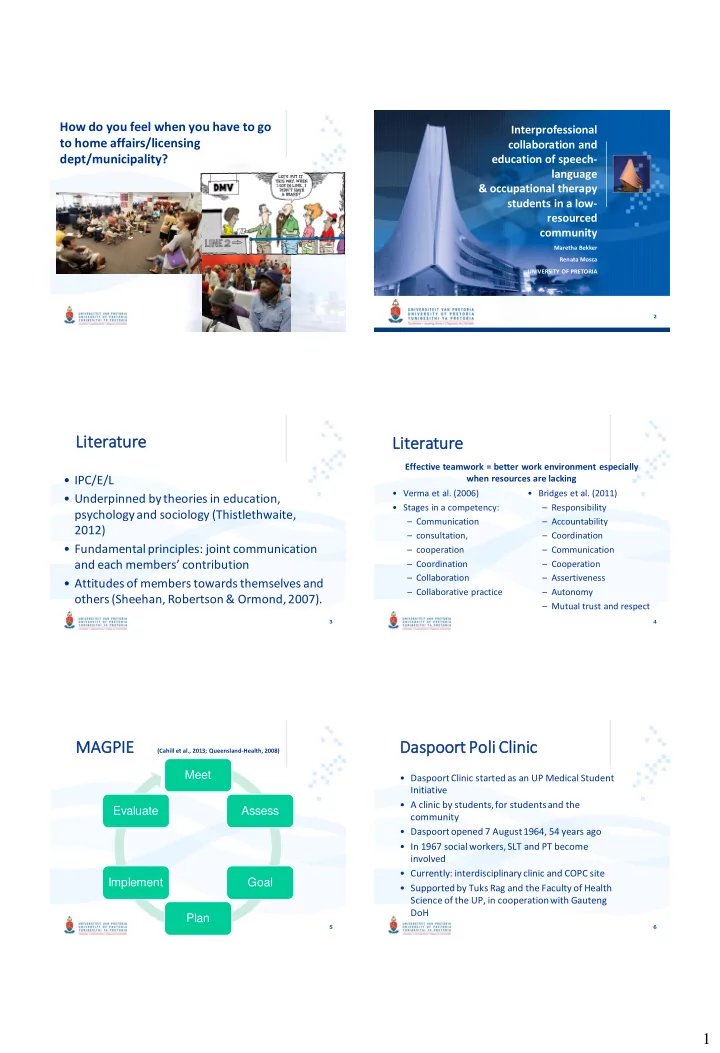
Literatur ure

  • IPC/E/L
  • Underpinned by theories in education,

psychology and sociology (Thistlethwaite, 2012)

  • Fundamental principles: joint communication

and each members’ contribution

  • Attitudes of members towards themselves and
  • thers (Sheehan, Robertson & Ormond, 2007).

3

Literatur ure

Effective teamwork = better work environment especially when resources are lacking

  • Verma et al. (2006)
  • Stages in a competency:

– Communication – consultation, – cooperation – Coordination – Collaboration – Collaborative practice

  • Bridges et al. (2011)

– Responsibility – Accountability – Coordination – Communication – Cooperation – Assertiveness – Autonomy – Mutual trust and respect

4

MAGP GPIE (Cahill et al., 2013; Queensland-Health, 2008)

5

Meet Assess Goal Plan Implement Evaluate

Da Daspo poort Poli Cl Clini nic

  • Daspoort Clinic started as an UP Medical Student

Initiative

  • A clinic by students, for students and the

community

  • Daspoort opened 7 August 1964, 54 years ago
  • In 1967 social workers, SLT and PT become

involved

  • Currently: interdisciplinary clinic and COPC site
  • Supported by Tuks Rag and the Faculty of Health

Science of the UP, in cooperation with Gauteng DoH

6

slide-2
SLIDE 2

2

Da Daspo poort

7

Family

OT SLT SW PT Dr Nurses HN CHW Dentists

Hygienists 8

Co Cont ntext for chang nge

  • As a CBR, change was needed
  • Collaboration had to be more than referral and discussion
  • ICF considerations (WHO, 2001) & TRUE smart goals
  • In a low resourced health environment, teamwork may

be essential to maintain a motivated workforce (Sheehan, Robertson & Ormond, 2007)

  • The caseload is growing
  • Complexity of the cases is increasing
  • Time constraints: both families and professionals (Nugus

et al., 2010)

  • Quality of life outcomes

9

Ca Case overview: J.L

  • Date of birth: 21 August 2012
  • Age: 5 years 1 month
  • Diagnosis: Not available
  • Mother works part time and is completing her law

degree at Unisa.

  • Father is absent.
  • Sister in Grade 1.
  • Maternal grandparents very involved with the

family.

  • Evaluated to be admitted to a school for children

with special needs.

10

Co Cons nsiderations ns before the session

  • GDD
  • General movement difficulties

– oral muscles – communication intent – speech production – feeding

  • Receptive language better than expressive
  • Cognitive function should not be judged based on level
  • f expressive language
  • Home programmes: functional and include the whole

family (sibling)

  • Low postural MT → difficulties with

– Proprioceptive feedback – Gross and fine motor coordination – Bilateral integration – Postural endurance – Balance – Praxis – Visual-motor integration (with visual difficulties)

  • Needs additional support for stability → working

controlled in the midline

  • Enjoy exploration (destructive active) but moving

towards constructive action

12

slide-3
SLIDE 3

3

13

Needs ds

  • To introduce a therapeutic feeding program:

– positioning – facilitating mouth closure – oral movements: chewing and speech production

  • Oral secretions and care
  • Possible future use of AAC
  • To improve abilities → improving occupations:

ADLs, play, pre-school/education and social participation

  • Facilitate the process of correct school placement

Activity – wa water gun un

  • SLT will provide strategies to facilitate

– Multi step directions (receptive language) – Vocabulary expansion (receptive language) – Requesting (expressive language and pragmatics) – Sequencing (cognitive/executive function) – Directional concepts (receptive and expressive language)

  • OT will provide strategies to facilitate

– Positioning by facilitating postural tone through proprioceptive feedback – Increased midline stability and bilateral integration – A firm base of support for balance and functional mobility around the home

14 15

Activity – clothing g pegs gs

  • SLT will provide strategies to facilitate
  • Multi step directions (receptive language)
  • Vocabulary expansion (receptive and expressive language)
  • Requesting and responding (Language and pragmatics)
  • Sequencing (cognitive/executive function)
  • Joint attention
  • OT will provide strategies to facilitate
  • Optimal positioning
  • Midline stability to grasp the peg
  • Crossing of the midline
  • Visual sequencing (as part of spatial relations)
  • Motor planning when positioning the peg

16

Ca Case overview: G

  • Date of birth: 6/03/2013
  • Age: 4 years 6 months
  • Diagnosis: Severe microcephaly, learning difficulties,

communication delay, hyperactivity and club foot

  • Both parents are unemployed
  • Father is blind
  • Mother is partially sighted
  • Older brother in Grade 1

17

Co Cons nsiderations ns before the session

  • Cognitive impairment → selection of activities,

importance of repetition

  • Parents’ challenges limit carry over at home
  • Mother is very positive and an asset in treatment
  • Very distractible → limits number of activities to be

used in one session

  • Present with repetitive behaviour
  • Postural stability is extremely important
  • Spectacles were prescribed for but seldom wears

them

18

slide-4
SLIDE 4

4

Needs ds

  • To experience sufficient destructive activities in
  • rder to progress to more constructive actions
  • For parents to identify new ways of how to handle

and stimulate G at home

  • For G to use exploration so that he can learn more

about his environment → communication

  • For G’s parents to decide (in collaboration with the

SLT and OT) on a school which would cater for G’s needs

19

Activity – body dy puz uzzl zle

  • SLT will provide strategies to facilitate
  • Shared attention (pragmatics)
  • Increased reciprocity (verbal and non-verbal) (language

and pragmatics)

  • Receptive and expressive language expansion
  • Word approximations (expressive language)
  • Eye contact (pragmatics)
  • OT will provide strategies to facilitate
  • Eye contact (pragmatics)
  • Correct positioning (initially on mother’s lap with increased

proprioceptive feedback)

  • Manipulation of objects in the midline
  • Constructive use of objects

20

Activity - barley

  • SLT will provide strategies to facilitate
  • Explorative play
  • Commenting (expressive language)
  • Shared attention (pragmatics)
  • Sound production (speech)
  • Vocabulary expansion (receptive and expressive

language)

  • Requesting (expressive language and pragmatics)
  • OT will provide strategies to facilitate
  • Sensory stimulation by introducing a different texture
  • Sensory discrimination
  • The use of both hands in the activity

21 22

OT students SLT student Collaboration in planning the sessions was positive Two heads are better than one, four hands are better than two! It felt like ‘we were complimenting’ one another “Hands-on” collaborative sessions helped us to better understand the needs and function level

  • f the clients

Provided the opportunity to improve interpersonal and professional skills Increased professional skills Both disciplines learned how to work towards a common goal, by discussion and problem solving. Problem solving in real time Good collaboration lead to effective service delivery Consistent expectations across therapists and environments for the parents and child

23

Be Benefits of IPC: C: stud udent perspective

24

OT perceptions SLT perceptions Good working relationship Understood joint goals SLT = strategy focus OT = activity based Functional activities Carryover to home environment

Co Cons nsiderations ns after the sessions

slide-5
SLIDE 5

5

25

The way forward: Literatur ure

  • Challenges (Ho et al., 2008; Nisbet et al., 2008)
  • Rotations differ
  • Busy schedules
  • Discrepancies in numbers between professions
  • Divergent learning and assessment styles
  • Limited resources
  • Suggestions (Reeves, 2002)
  • More focused learning objectives for students
  • Better preparation before placement

Way forward: d: Practically

  • 2-hour joint team orientation (Copley

et al., 2007; Abu-Rish et al., 2012)

  • Started earlier therapy earlier
  • Combined groups
  • Less individuals sessions
  • Individual sessions still IPC

26

BUT UT

27

Family

OT SLT SW PT Dr Nurses Dietician CHW Dentists

Hygienists

IHL & RHC

  • Shared modules
  • Collaboration
  • Community
  • Roll out
  • Do shared modules lead to

spontaneous/increased IP?: research

28 29

The way forward

  • Extend application MAGPIE

Referencing

Abu-Rish, E., Kim, S., Choe, L., Varpio, L., Malik, E., White, AA., Craddick, K., Blondon, K., Robins, L., Nagasawa, P., Thigpen, A., Chen, L., Rich, J., and Zierler, B. Current trends in interprofessional educaation of health sciences students: A literature review. Journal of Interprofessional Care, 2012, 1-8 Bridges, DR., Davidson, RA., Odegard PS., Maki, IV. and Tonkowiak, J. Interprofessional collaboration: three best opractice models of interprofessional collaboration. Medical Education Online, 16:1. Cahill, M., O’Donnell, M., Warren, A., Taylor, A. and Gowan, O. (2013). Enhancing interprofessional student practice through a case-based model. Journal of Interprofessional Care, 27. Copley, Allison, Hill, Moran, Tait and Day. (2007). Making interprofessional education real:a university clinic model. Australian Health Review, 31(3). Ho, Jarvis-Selinger, Borduas, Frank, Hall, Handfield-Jones, Hardwick, Lockyer, Sinclair, Novak Lauscher, Ferdinands, MacLeod, Robitaille and Rouleau. (2008). Making Interprofessional Education Work: The Strategic Roles of the Academy. Academic Medicine, 83(10). Nisbet, G., Hendry, GD., Rolls, G. And Field, MJ. (2008). Inter-professional learning for pre- qualification health care students: An outcomes-based evaluation. Journal of Interprofessional Care, 22(1),57-68.

30

slide-6
SLIDE 6

6

Nugus, P., Greeenfield, D., Travaglia, J., Westtbrook, J., and Braithwaite, (2010). How and where clinicians exercise power: Interprofessional relations in health care. Social Science and Medicine. Reeves, S., Freeth, D., McCrorie, P and Perry, D. (2002). ‘It teaches you what to expect in future...’: interprofessional learning on a training ward for medical, nursing, occupational therapy and physiotherapy students. Medical Education, 36, 337-344. Sheenan, D., Robertson, L., and Ormond, T. (2007) Comparison of language used and patterns of communication in interprofession and multidisciplinary teams. Journal of Interprofessional Care, 21(1). Thistlethwaite, J. (2012) Interprofessional education: a review of context, learning and the research agenda. Medical Education, 46, 58-70. Verma, S., Paterson, M., and Medves, J. (2006) Core competencies for health care professionals: What Medicine, Nursing, Occupational Therapy, and Physiotherapy Share. Journal of Allied Health, 35, 2.

31