
SLIDE 1
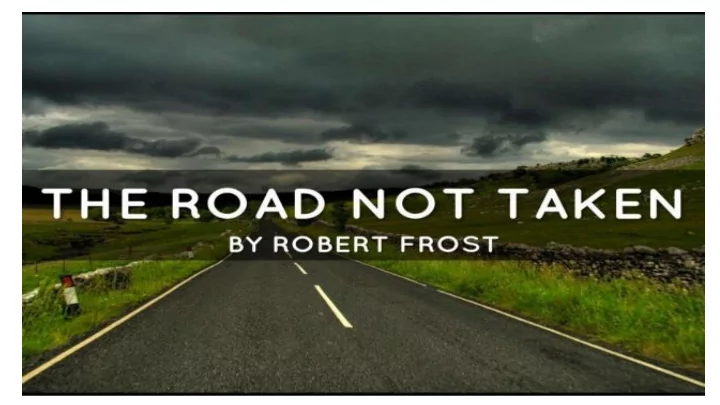
LIT ITERARY DEVICES COPY THIS! DEFINITIONS TERMINOLOGY 1) An - - PowerPoint PPT Presentation
LIT ITERARY DEVICES COPY THIS! DEFINITIONS TERMINOLOGY 1) An object or word is used to represent an abstract idea. 1) Symbolism 2) Main idea or underlying meaning. 2) Theme 3) Image evoking words that spark the senses. 3) Imagery 4)
1) Symbolism 2) Theme 3) Imagery 4) Metaphors 5) Alliteration 6) Rhyme scheme 1) An object or word is used to represent an abstract idea. 2) Main idea or underlying meaning. 3) Image evoking words that spark the senses. 4) A direct comparison without using “like” or “as”. 5) Repetition of consonants to slow down rhythm in a poem 6) Is the pattern of rhyme that comes at the end of each verse
COPY THIS!
wear,
10.Had worn them really about the same,
11.And both that morning equally lay 12.In leaves no step had trodden black. 13.Oh, I marked the first for another day! 14.Yet knowing how way leads on to way 15.I doubted if I should ever come back. 16.I shall be telling this with a sigh 17.Somewhere ages and ages hence: 18.Two roads diverged in a wood, and I, 19.I took the one less travelled by, 20.And that has made all the difference
1. Two roads diverged in a yellow wood, 2. And sorry I could not travel both 3. And be one traveller, long I stood 4. And looked down one as far as I could 5. To where it bent in the undergrowth;
On the road of life, the speaker arrives at a point where he must decide which of two equally appealing (or equally intimidating) choices is the better one. He examines one choice as best as he can, but the future prevents him from seeing where it leads. In this stanza he shows his sorrow. CHOICES LIFE / FUTURE FUTURE / UNKNOWN LIFE’S JOURNEYS MENTAL SUFFERING
10.Had worn them really about the same,
The speaker selects the road that appears at first glance to be less worn and therefore less traveled. This selection suggests that he has an independent spirit and does not wish to follow the crowd. After a moment, he concludes that both roads are about equally worn. CHOICES BEAUTIFUL ALLITERATION
Just as it is fair (Righteous path)
Leaves cover both roads equally. No one on this morning has yet taken either road, for the leaves lie
decision to take the road he had previously selected, saying that he will save the other road for another
never pass this way again and thus will never have an
11.And both that morning equally lay 12.In leaves no step had trodden black. 13.Oh, I marked the first for another day! 14.Yet knowing how way leads on to way 15.I doubted if I should ever come back. REGRET EMPATHETIC FOOLISH
In years to come, the speaker says, he will be telling
will sigh either with relief that he made the right choice or with regret that he made the wrong choice. Whether right or wrong, the choice will have had a significant impact on his life. PAST HAPPY / SAD / REFLECTIVE SUCCESS / FAILURE? 16.I shall be telling this with a sigh 17.Somewhere ages and ages hence: 18.Two roads diverged in a wood, and I- 19.I took the one less travelled by, 20.And that has made all the difference REPETITION OF LINE 1 NB! CONCLUSION HESITATION TRIUMPH