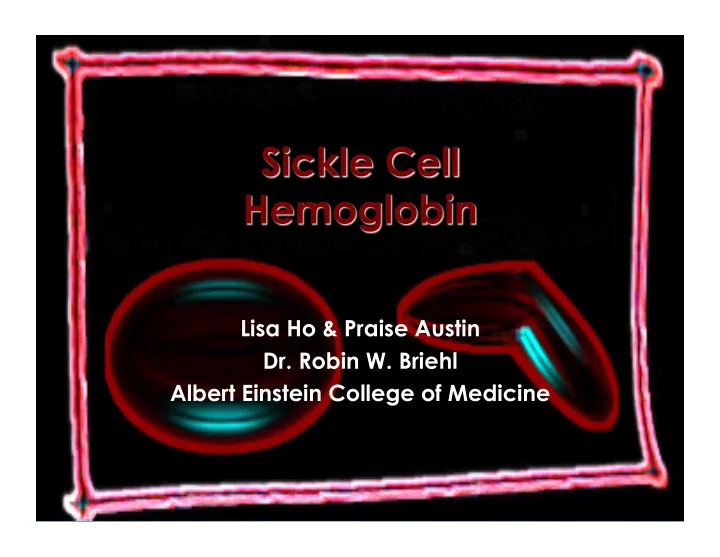
SLIDE 1 Lisa Ho & Praise Austin
Albert Einstein College of Medicine
SLIDE 2
Red Blood Cell
Round disc shape Transports oxygen
Sickle Cell Trait Sickle Cell Disease
Abnormal sickle shape Rigidity Cell Damage & Cell-Cell Adhesion Hemolysis & Anemia
SLIDE 3
Glutamic Acid Valine Deoxygenation Hydrophobic Interaction Polymerization into Stiff Fibers Distorts shape & rigidifies cells Induces Vaso-Occlusion
SLIDE 4
SLIDE 5
Video camera Zeiss light microscope DIC Optics Epi-illumination light source for
photolysis of HbCO
Potassium Phosphate buffer (pH 7.2
at 0.1 M concentration)
Blood or Hb solution sample Gel sample
SLIDE 6
Fiber Visualization using 546nm light source Differential Interference Contrast Microscopy Can visualize objects smaller than diffraction
limitation size
Splits the light into two different light beams Wollaston prism The phase image facilitates visualization of
the fibers.
SLIDE 7 VCR Image Processor Video Camera Barrier Filter Analyzer 546nm
436nm photolysis Dichroic mirror Hg arc Field Diaphragm Exciter Filter CO Hg arc Wollaston prism Slide Wollaston prism Polarizer
SLIDE 8
SLIDE 9
SLIDE 10
SLIDE 11
SLIDE 12
SLIDE 13
Help decipher how polymers grow
and dissolve
Aim:
Inhibit growth Facilitate dissolution
SLIDE 14
Increase the delay time Conduct Rheological tests on Lab
grown Gels
Clinical Studies on various therapeutic
treatments
SLIDE 15
Enbury, S. H., Hebbel, R. P., Mohandas, N. & Steinberg, M. H. (1994). Sickle cell disease: basic principles and clinical practice. New York: Raven Press Ltd.
Dickerson, R. E. & Geis, I. (1983). Hemoglobin. California: The Benjamin/ Cummings Plublishing Company, Inc.
Wang, J. C., Turner, M. S., Agarwal, G., Kwong, S., Josephs, R., Ferrone, F.
- A. & Breihl, R. W. (2002). Micromechanics of isolated sickle cell
hemoglobin fibers: bending moduli and persistence lengths. Journal of Molecular Biology, 315, 601-612.
Agarwal, G., Wang, J. C., Kwong, S., Cohen, S. M., Ferrone, F. A., Josephs, R. & Breihl, R. W. Sickle hemoglobin fibers: mechanisms of
- depolymerization. Journal of Molecular Biology, 322, 395-412.
Ferrone, F. A. (2004). Polymerization and sickle cell disease: a molecular
- view. Microcirculation, 11:2, 115-128
Breihl, R. W. (1997). Sickle cell hemoglobin. Encyclopedia of human biology, (Second Edition, Vol. 8, pp. 1-20). New York, Academic Press Inc.
Anfinsen, C. B., Edsall, J. T., Richards, F. M. & Eisenberg, D. S. (1987). Advances in protein chemistry. New York, Academic Press Inc.
SLIDE 16
- Professor Robin W. Briehl, MD
- Jiang Cheng Wang
- Suzanna Kwong
- Albert Einstein College of Medicine & Staff
- Dr. Sat Bhattacharya
- Harlem Children Society
- The audience
SLIDE 17
SLIDE 18
Any questions?