
SLIDE 1
LISA 1
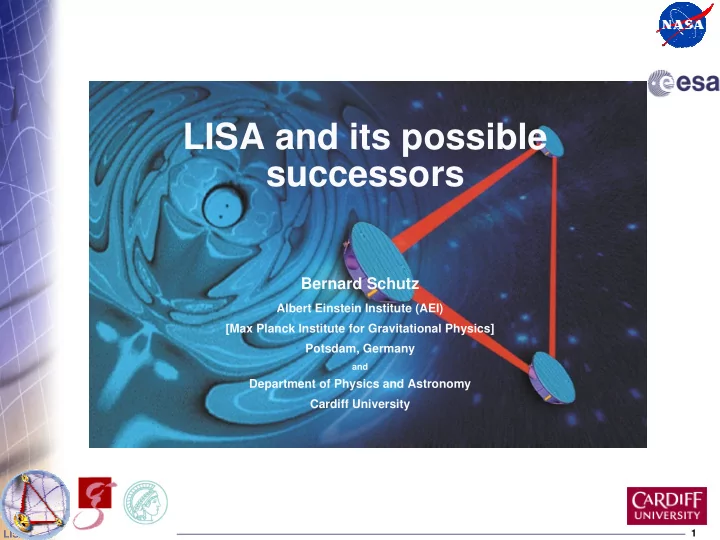
LISA and its possible successors
Bernard Schutz
Albert Einstein Institute (AEI) [Max Planck Institute for Gravitational Physics] Potsdam, Germany
and
Department of Physics and Astronomy Cardiff University
LISA and its possible successors Bernard Schutz Albert Einstein - - PowerPoint PPT Presentation
LISA and its possible successors Bernard Schutz Albert Einstein Institute (AEI) [Max Planck Institute for Gravitational Physics] Potsdam, Germany and Department of Physics and Astronomy Cardiff University 1 LISA Gravitational Wave
LISA 1
Bernard Schutz
Albert Einstein Institute (AEI) [Max Planck Institute for Gravitational Physics] Potsdam, Germany
and
Department of Physics and Astronomy Cardiff University
2
LISA and successors: Firenze 30/09/2006
2 / 1 3 rest
3
LISA and successors: Firenze 30/09/2006
Below about 1 Hz, disturbances in the Newtonian field on Earth mask
LISA will observe from 0.1 mHz to about 0.1 Hz What astronomical systems have time-scales of seconds to hours?
– Black holes of mass M have dynamics up to fmax~1 mHz (M/106M)-1 – Binary systems have orbital frequencies in this range if the stars are compact:
white dwarfs, neutron stars, or stellar black holes
– There are random backgrounds due to binaries, black holes, and any primordial
sources of GWs
– Exotic systems, such as cosmic strings, may radiate in this band.
Besides doing astronomy, LISA will do fundamental physics:
– Study black holes in great detail, testing general relativity: BH uniqueness,
Hawking area theorem, cosmic censorship
– Measure the Hubble rate as a function of time to high z: track dark energy
evolution.
Ωgw = 10-10
4
LISA and successors: Firenze 30/09/2006
Black holes are ubiquitous in galaxies, probably also in proto-
Known masses run from 106M (as in our Galaxy) to more than
LISA will hear coalescences of black holes above 104 M
– Will resolve cannibalism question: do massive black holes grow by
– Will indicate how, when and where first massive holes formed. – Inspiral orbit identifies masses, spins of components; merger phase tests
– Identification of galaxy possible if accretion turns on after merger. – Coalescing GW systems are standard sirens, signal gives luminosity
5
LISA and successors: Firenze 30/09/2006
LISA will hear stellar black holes and neutron stars falling into massive
– Objects captured into orbit by hole on first highly eccentric encounter. – Challenge to theory to predict orbits accurately, recognize signals in data. – Reward: events provide
– high precision test of strong gravity and the “no-hair” black hole uniqueness theorems – census of SMBH population and the population of the central cusp around the SMBH.
Tidal disruption of binary systems and stripping of giant stars may lead
– Objects could include white dwarfs – Orbits more circular, longer period of inspiral
Intermediate-mass black holes can also be captured (IMRI events) Signal confusion a serious potential problem
– If early universe saw SMBH growth by E/IMRI capture, there could be a strong
background.
185,000 cycles left, S/N ~ 100
41,000 cycles left, S/N ~ 20
2,300 cycles left, S/N ~ 7
6
LISA and successors: Firenze 30/09/2006
LISA will hear every binary system in the Galaxy that has a
Known binaries must be heard, and their detection will verify
First binaries strong enough to be heard in first weeks. Synergy between LISA and GAIA:
– LISA polarisation measurement determines inclination of orbital plane – LISA will give accurate distances to and masses of WD/WD binaries
7
LISA and successors: Firenze 30/09/2006
Stochastic backgrounds are probably common. Measured in
LISA can hear a background if its “noise” is above the
Universe transparent to GWs since first 10-43s!! Sources:
– Astrophysical “foregrounds” from binaries and black holes. Above LISA
– Big Bang can lead to backgrounds from inflation (Ωgw~10-15?), from
Detecting a primordial background is probably the most
Ωgw = 10−10
8
LISA and successors: Firenze 30/09/2006
LISA will have a (good) problem: source confusion
– SNR of many sources large (after ideal matched filtering), up to 104. – LISA is not a pointed instrument: signals from all over sky at once. – Source separation done in data analysis:
– “pointing” done using phase modulation, amplitude modulation, TDI – resolution in frequency depends on duration of observation, requires pointing
EMRIs present most serious challenge
– Can only be found by matched filtering, but filter family is large: >1035. – Must be handled hierarchically; already doing this for ground-based searches for
pulsars (LSC – Einstein@Home delivering 70 Tflop, allows limited area searches)
Data analysis must be done iteratively
– Identify strongest sources, remove them, identify next level, iterate, improve with
– Currently encouraging work on this problem with LISA Mock Data Challenges.
First challenge issued June 2006, results at GWDAW in December at AEI.
9
LISA and successors: Firenze 30/09/2006
10
LISA and successors: Firenze 30/09/2006
NASA-commissioned concept study Elaborate the basic LISA model to achieve
– Higher sensitivity – Higher angular resolution (for identifying foreground NS-NS binaries)
Stringent technological challenges
– Lasers: 300W – Mirrors: 3.5m diameter, sub-fm surface – Pointing, isolation, signal analysis difficult
None impossible, but all costly.
– Multiple S/C, launches add to cost
With recent inflation of LISA cost, BBO looks discouragingly
11
LISA and successors: Firenze 30/09/2006
BBO was conceived when LISA launch was 2012. Today it
European GW community may put in a more modest proposal
Goal of detecting CGWB is just as interesting as ever, but we
New technological approaches could have a major impact on