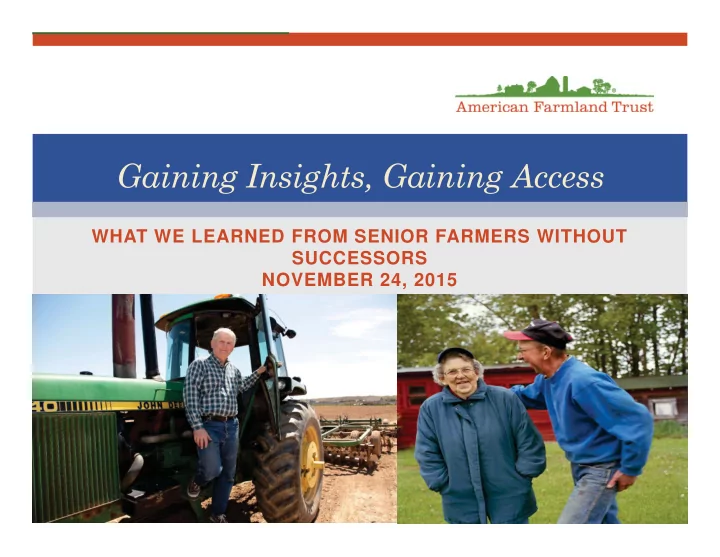
SLIDE 1 Gaining Insights, Gaining Access
WHAT WE LEARNED FROM SENIOR FARMERS WITHOUT SUCCESSORS NOVEMBER 24, 2015
SLIDE 2
Gaining Insights Research Project A seven-state (New York and New England) project done in collaboration with and a 10-member Advisory Committee that includes Cooperative Extension, Farm Credit, Farm Bureau, land trusts, young farmer orgs, and a state Department of Agriculture.
SLIDE 3 Gaining Insights Research Project Objective: To improve our understanding of senior farmers—what they are farming, and with whom; their motivations; and their concerns about their future—in order to keep land in farms and farmers
- n the land as these seniors exit farming.
Special tabulation of 2012 Census of Agriculture
data
Focus groups: Senior farmers without successors State profiles
SLIDE 4
SLIDE 5
SLIDE 6
Focus Groups: Senior Farmers without Successors
SLIDE 7
7 focus groups (one each in Connecticut, Maine,
Massachusetts, New Hampshire, New York, Rhode Island, Vermont)
67participants total Professionally facilitated conversations were
recorded and transcribed
Participants were asked to fill out questionnaires at
the end of the discussion Overview of Focus Groups
SLIDE 8
Acres owned: 2-950 Ages ranged from 46 to 85 80% had kids; of those, about half said kids were
“somewhat involved or interested” in the farm
Commodities produced included: beef, Christmas
trees, dairy, equine, flowers, forest products, fruit, hay, maple, vegetables
27% farm some amount of protected land
Participant Profile
SLIDE 9 Seniors want to see their land remain in farming.
- In a position where we could help a young farmer start out, so are
hoping to find someone who wants to lease a part of our land. We’re not ready to sell.
- Mentoring a new farmer who can take over the operation would be
ideal.
- Open to many types of operation on our protected farmland, just looking
for someone who will keep it in agriculture.
- Want our family to recognize that the important thing is for it to stay a
farm, and it doesn’t necessarily have to be in the family.
Their Vision for the Future
SLIDE 10 Seniors are interested and willing to look outside the family for a business successor.
- 54% had taken some steps to find a non-family successor
for their farm business.
- 32% had tried or are currently trying to find someone to
lease their land.
- Some said it was important that their children feel
comfortable with the successor. Others said that children who have left the farm would not have a say in the decision about a successor.
Finding a Successor
SLIDE 11 Seniors are open to innovative approaches and strategies around farm transfer and succession.
- When asked about approaches they would consider,
answers included:
“Lease to own, gradual transfer” “I really want to know what the options are, which
models have been successful”
“Purchase or lease-to-purchase” “We are open to whatever works” “Anything but sale of farm”
Approaches to Farm Transfer
SLIDE 12 Most seniors see farmland protection as a key tool in farm succession and transfer.
Of those who have not protected their land, 70% said they viewed it as an important tool in their succession strategy. Those who did not view it as an option offered these reasons:
- “Wish to retain options for next generation”
- “Value of land very high”
- “Not eligible”
- “At this point in our lives, we are not willing to commit”
- “Availability of money sources”
- Farmland Protection
SLIDE 13 Seniors see financing and future economic viability for younger farmers as an obstacle.
- Hard to find someone that would have the capital to take
- ver the operation
- Children might be interested in farming but recognize that
the operation is not making much money
- Young farmers are looking for smaller parcels where they
can be profitable with specialty crops
- Farm operation is small enough that a buyer wouldn’t get
enough out of it to recoup their investment and pay the farmer who is retiring
Economic Viability an Obstacle
SLIDE 14 Seniors without someone to take over the farm feel particularly overwhelmed about succession, and want help navigating the complex process of choosing the right succession strategy and finding a suitable successor.
Of those who have begun to look for a successor, services they had used included:
- Land linking websites
- Technical assistance from a variety of organizations,
including Extension, land trusts, other ag service providers, land access orgs
Succession Planning
SLIDE 15 Resources seniors said they would like to have to help find a successor:
- Technical assistance in identifying a suitable successor,
transferee or tenant
- A screening service that would help identify a suitable
buyer or lessee
- Financial assistance to enable [them] to hire someone to
find a suitable buyer or lessee
Succession Planning, cont.
SLIDE 16 “I want to make sure we have enough income till we
die…
We have worked hard, [and] I would like to step away
from the work…and have a chance to do a lot of the things we have on the back burner.
We built up a really great business and it has a lot of
reputation in the community and there would be a lot
- f people that would really have their feelings hurt if it
disappeared…so I would like to see the business keep going.
I would like to preserve the farm, intact if possible for
forestry and agriculture. If I could do all four of those things I would die a happy person.”
Four Things To Do Before I Die
SLIDE 17
Implications for Programing and Policies
SLIDE 18
Need for technical support to help exiting farmers
explore their succession options
Importance of purchase of agricultural
conservation easements as a farm transfer strategy
Need to showcase examples of economically
viable succession strategies
Policies to encourage succession planning need to
focus on growing demographic of 45-64 year olds
SLIDE 19
TRENDS
rend\s
Succession Planning: Working With Seniors Without Successors
SLIDE 20
Succession Planning
Transfer of the farm business, real estate or
both
No family successor vs. no identified
successor
May identify potential non-family successor:
employee, neighbor?
Beginner??
SLIDE 21 Succession Planning: Obstacles
- Financial: funding exit/retirement
- The “soft issues”
- “Not ready”; not a priority
- Finding advisors
- Perceived expense of planning
- Finding a successor
(FarmLASTS, 2011)
SLIDE 22 Planning processes & tools
- Fairly standard across situations
- Personal, family and financial assessment
- The “soft” issues
- Start with goals and values
- Communication, communication
- Trust, interpersonal dynamics
- Team of advisors
SLIDE 23 Unique to “no-successor” demographic
- Price and financing terms
- Due diligence in selecting successor
- Formality of the process
- Timing of the transfer
SLIDE 24 Bringing on the successor
- Recruit and select (assistance!)
- Line up legal and financial agreements
- Build the relationship (staged?)
- Establish benchmarks and monitor
progress
SLIDE 25
Tim Biello, AFT/New York tbiello@farmland.org Cris Coffin, AFT/New England ccoffin@farmland.org Kathy Ruhf/Land For Good kathy@landforgood.org Gary Keough/NASS gary.keough@nass.usda.gov Contact Information