Linking Technology Areas to Industrial Sectors Ulrich Schmoch, - - PDF document

linking technology areas to industrial sectors
SMART_READER_LITE
LIVE PREVIEW

Linking Technology Areas to Industrial Sectors Ulrich Schmoch, - - PDF document

Linking Technology Areas to Industrial Sectors Ulrich Schmoch, Francoise Laville, Pari Patel Fraunhofer ISI, Karlsruhe, Germany Observatoire des Sciences et des Techniques (OST), Paris, France SPRU, University of Sussex, Brighton, UK


slide-1
SLIDE 1

Fraunhofer

ISI Institute Systems and Innovation Research

Linking Technology Areas to Industrial Sectors

Ulrich Schmoch, Francoise Laville, Pari Patel Fraunhofer ISI, Karlsruhe, Germany Observatoire des Sciences et des Techniques (OST), Paris, France SPRU, University of Sussex, Brighton, UK

Platzhalter für Dateinamen

Fraunhofer

ISI Institute Systems and Innovation Research

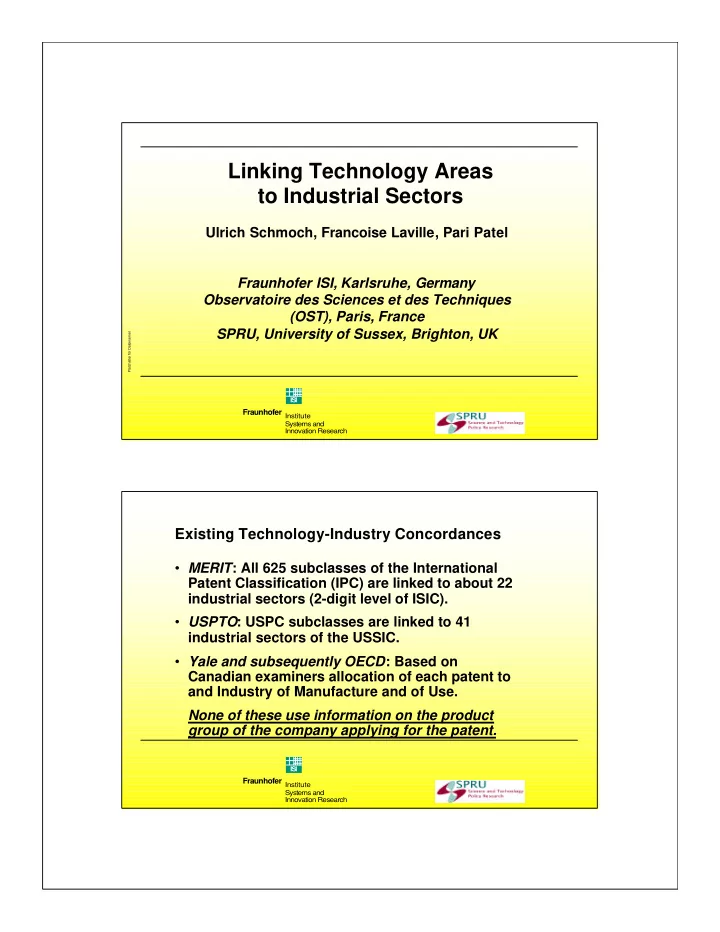
Existing Technology-Industry Concordances

  • MERIT: All 625 subclasses of the International

Patent Classification (IPC) are linked to about 22 industrial sectors (2-digit level of ISIC).

  • USPTO: USPC subclasses are linked to 41

industrial sectors of the USSIC.

  • Yale and subsequently OECD: Based on

Canadian examiners allocation of each patent to and Industry of Manufacture and of Use. None of these use information on the product group of the company applying for the patent.

slide-2
SLIDE 2

Fraunhofer

ISI Institute Systems and Innovation Research

Suggested Technology-Industry Concordance

  • Approach based on defining 44 matched Technical and

Industrial Fields.

  • First Step is to allocate 625 IPC subclasses to the 44

Fields (done by technical experts within ISI).

  • Second step analyse patents by technology for 3400

large ‘patenting’ firms classified according to 44 industrial sectors (from Dunn & Bradstreet database).

  • Final Result: a square transformation matrix from

technologies to industries.

Fraunhofer

ISI Institute Systems and Innovation Research

Decisions in Generating the Concordance Matrix

  • Only large patentees included (although we have

some information on ‘small’ patentees).

  • Only Manufacturing firms considered (although

services are an important locus of innovation).

  • Only ‘principal’ product group of a firm considered

(although some large firms are multi-product).

  • Only first IPC class considered.
slide-3
SLIDE 3

Fraunhofer

ISI Institute Systems and Innovation Research

Technology Technological field 1 2 3 4 5 6 7 1 D1 N11 N12 N13 N14 N15 N16 2 N21 D2 N22 N23 N24 N25 N26 3 N31 N32 D3 N33 N34 N35 N36 4 N41 N42 N43 D4 N44 N45 N46 5 N51 N52 N53 N54 D5 N55 N56 6 N61 N62 N63 N64 N65 D6 N66 Industrial sectors 7 N71 N72 N73 N74 N75 N76 D7 Sectors

Format of the Concordance

Fraunhofer

ISI Institute Systems and Innovation Research

% Telecommunications 52.4 Computers 21.3 Electronic components 7.5 Television 4.9 Motor Vehicles 4.0 Measuring instruments 1.7 Other transport 1.3 Lighting 1.1 Distribution of Telecommunications Technologies

An Example of the Transformation Matrix: One column.

slide-4
SLIDE 4

Fraunhofer

ISI Institute Systems and Innovation Research

Statistical Verification of concordance

  • Differences between concordance

matrices tested for

µ different countries (US / JP / UK / FR / DE) µ different points in time (early / late 1990s)

Fraunhofer

ISI Institute Systems and Innovation Research

Types of checks (1)

¬ Similarities in the distribution of a given technology across industries

  • Distributions by country somewhat similar: 67% of

all possible correlations are significant. However

  • nly 15% are greater than 0.9
  • Distributions over time highly similar: All

correlations are significant, and more than 70% greater than 0.9

slide-5
SLIDE 5

Fraunhofer

ISI Institute Systems and Innovation Research

Types of checks (2)

¬ Similarities of the distribution of technologies within a given industry

  • Distributions by country somewhat similar: 78% of

all possible correlations are significant. However

  • nly 23% are greater than 0.9
  • Distributions over time highly similar: All

correlations are significant, and more than 70% greater than 0.9

Fraunhofer

ISI Institute Systems and Innovation Research

First Use: Relationship between Technology Performance and Economic Performance

  • To what extent is higher economic performance of a

country (measured as shares of value-added or exports) within a sector associated with higher technological performance (measured as share of patenting)?

  • To what extent is sectoral specialisation in trade and

value-added within a country associated with sectoral specialisation in technology?

slide-6
SLIDE 6

Fraunhofer

ISI Institute Systems and Innovation Research

Data Used from the OECD STAN Database

  • Value-added and Exports
  • 21 Industries
  • 13 OECD countries
  • Time Period: 1993-2000

Analysis based on Simple Correlations

Fraunhofer

ISI Institute Systems and Innovation Research

Main Results

¬ Within Sector Analysis

  • In general the more ‘high-tech’ the sector the closer the

relationship between patenting and value-added. Highest correlations are in Electronics (Computers, Telecomms, Instruments), Chemicals and Pharmaceuticals.

  • Relationship between export shares & patent shares is

weaker in general. But a strong positive association in Electronics, Machinery and Transport Equipment. This doesn’t apply to Pharmaceuticals.

slide-7
SLIDE 7

Fraunhofer

ISI Institute Systems and Innovation Research

¬ Relative Specialisation

  • Finland, Italy, Sweden, Denmark, and Germany

have high correlations between technology specialisation and both trade and output (value- added) specialisation.

  • For US, UK and Spain the patterns of

specialisation in technology are very different from those in output or trade.

No straightforward explanations of these results.

Fraunhofer

ISI Institute Systems and Innovation Research

Conclusions

+ Can be used to examine importance of technologies across sectors + Can be applied easily + Can be used for international comparisons

A pioneering attempt at using information on companies patenting to link technology to industrial classes. Main problem is that the matrix works well for High-tech sectors but not for other sectors. More research needed to examine why?