Link Spokane: Integrating Transportation & Utility Infrastructure - - PowerPoint PPT Presentation

link spokane
SMART_READER_LITE
LIVE PREVIEW

Link Spokane: Integrating Transportation & Utility Infrastructure - - PowerPoint PPT Presentation

Link Spokane: Integrating Transportation & Utility Infrastructure Planning Introductions Who are you? Infrastructure interests in Spokane Hopes for best process/outcome Welcome & Background Changing circumstances Limited


slide-1
SLIDE 1

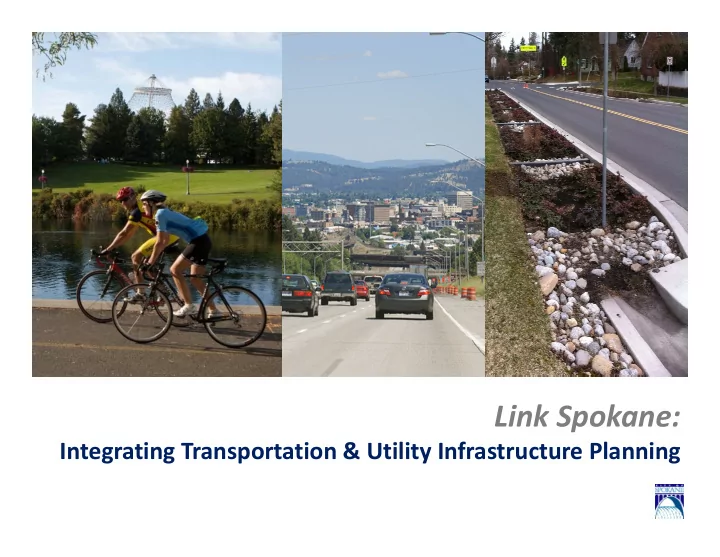
Link Spokane:

Integrating Transportation & Utility Infrastructure Planning

slide-2
SLIDE 2

Introductions

  • Who are you?
  • Infrastructure interests in Spokane
  • Hopes for best process/outcome
slide-3
SLIDE 3

Welcome & Background

  • Changing circumstances

– Limited resources and the need for integration.

  • Current Plan’s last major revision – 2001
slide-4
SLIDE 4

What is Link Spokane?

  • Preparing Spokane for the next 20 years – what

does the city value, what does it invest in?

  • Update of the Transportation Chapter of the

Spokane Comprehensive Plan including portions

  • f the Capital Facilities Chapter.
  • Address the current and future needs of all

modes of transportation (including cars, freight, transit, pedestrians and bicyclists) while meeting the needs of the city’s current and future land uses

  • Designed to be fully integrated with other City

investments in utilities and infrastructure

slide-5
SLIDE 5

What Have We Done

  • Pedestrian

Master Plan

slide-6
SLIDE 6

What Have We Done

  • Updated Project Selection Matrix
110 Project Name Project Location Person Capacity Network Connectivit y Score Neighborhoo d Accessibility Regional Accessibilit y Disadvantage d Accessibility Score Freight/ Goods movement Development & Redevelopme nt Potential Score Air Quality Water Quality Neighborho
  • d/District
Impact Score Vehicle Safety Bike Safety Ped Plan Priority Area Ped Safety Score CSO Integratio n Water Integration Maint and Facility Condition Leveraged Financing (excludes levy) Score Total Score Paving area (curb to curb, sq yd) Estimated Cost (per sq yard) Year Const Council District Five Mile Rd. Strong to Lincoln‐ intersecti
  • n
## Connects 2 modes ## 1‐2 destinations ## none none ## ## T4 50%‐75% built out ‐ 0 Neutral Neutral Neutral ## Medium bike lane improve s sw ## None None None >75% funded 0 #N/A Rowan paving Driscoll to Maple‐Ash add bike lanes, sidewalk, pathway ## Connects 1 mode ## 1‐2 destinations in project limits ## none none ## ## T4 Built out for zoning Neutral Neutral Neutral ## None bike lane improve s sw ## None None None >75% funded 0 #N/A Wellesle y Haven to Freya ## ## ## ## ## ## 0 #N/A TJ Meenach paving NW Blvd. to river add bike lanes, sidewalk, pathway ## Connects 1 mode ## none destination s near project limits 2 25%‐34% ## ## T2 50%‐75% built out ‐ Neutral Neutral Neutral ## None d lane, greenw ay, controll improve s sw ## None None None >75% funded 0 #N/A Riverside Avenue Bernard to Division 5k‐10k ADT 2 Connects 1 mode 2 4 score 1‐5 1 downtown core 5 32.91% + 5 7 T4 2 adjacent 5 7 No chang 2 Neutral 2 Not in plan 3 None 0 bike lane 3 In Ped Priority Zone 5 sw ramps or repair 2 5 Medium 3 1850‐1930 5 PCI 40‐60 3 grant eligible 1 6 32.0 8933 982,630 $ 2 Sprague Division to Hamilton
  • verpass
10k‐20k ADT + HPTN 4 None 4 score 1‐5 1 downtown core 5 32.91% + 5 7 T4 2 adjacent 5 7 No chang 2 Neutral 2 Project listed in plan 5 6 None 0 none In Ped Priority Zone 5 sw ramps or repair 2 4 Medium 3 1850‐1930 5 PCI 40‐60 3 <50% funded (any source) 4 8 35.3 24128 2,654,080 $ ? Hayford Road 48th to McFarlane 5k‐10k ADT 2 Connects 1 mode 2 4 none 1‐2 destination s near 2 0%‐6.92% 1 T3 3 None 3 No chang 2 Neutral 2 Not in plan 3 None 0 bike lane 3 none 0 none 2 None 1975‐1994 2 PCI 0‐20 5 grant eligible 1 4 16.5 ‐ $ 2 Lindeke Street ‐ 16th Sunset Blvd to 195 < 5k ADT 1 Connects 1 mode 2 3 score 1‐5 1 none 0 6.93%‐11.43% 1 1 T5 1 None 1 No chang 2 Neutral 2 Not in plan 3 None 0 signing, marking 2 none sw ramps or repair 2 2 None 1931‐1955 4 PCI 20‐40 4 limited 4 14.0 15534 1,708,740 $ 2 4th Avenue Sunset to Maple 5k‐10k ADT 2 None 2 score 1‐5 1 1‐2 destination s near 2 32.91% + 5 5 T5 1 None 1 No chang 2 New or updated facilities 5 Not in plan 5 None 0 signing, marking 2 In Ped Priority Zone 5 sw ramps or repair 2 5 High 5 1850‐1930 5 PCI 20‐40 4 grant eligible 1 8 25.0 5715 628,650 $ 2 4th Avenue Jefferson to Division < 5k ADT 1 None 1 score 1‐5 1 downtown core 5 19.37%‐26.4% 3 6 T5 1 adjacent 5 6 No chang 2 New or updated facilities 5 Not in plan 5 None 0 bike lane 3 In Ped Priority Zone 5 sw ramps or repair 2 5 Medium 3 1850‐1930 5 PCI 40‐60 3 grant eligible 1 6 28.7 ‐ $ 2

Maximize Public Benefits and Fiscal Responsibility with Integration Provide Transportation Choices Access to Daily Needs and Regional Destinations Promote Economic Opportunity Respect Natural and Neighborhood Assets Enhance Public Health and Safety

slide-7
SLIDE 7

What Have We Done

slide-8
SLIDE 8

What is Link Spokane?

  • Vision, Goals, and Priorities
  • Infrastructure Integration
  • Transportation ‐ Land Use Connection
slide-9
SLIDE 9

Transportation – Land Use Connection

slide-10
SLIDE 10

Transportation – Land Use Connection

slide-11
SLIDE 11

Transportation – Land Use Connection

slide-12
SLIDE 12

What is Link Spokane?

slide-13
SLIDE 13

Integrated Infrastructure Opportunities

  • Spokane incorporated in 1881 – Infrastructure

nearing the end of its life

– Streets, Water, Sewer, Sewer Overflow – Inadequate services hindering redevelopment

slide-14
SLIDE 14

Integrated Infrastructure

  • Predicted ‐ Fewer Transportation Capital Dollars

– Leverage Stormwater Runoff Spending – Leverage Combined Sewer Overflow Spending – Many (newer) Uses of Right‐of‐Way

slide-15
SLIDE 15

How are Street Projects Funded?

  • The City has historically relied on the General Fund to help

pay for maintenance of roads and Federal or State competitive grants for capital projects.

  • Over the last 10 years several new funding sources have been

developed:

– 2004: $117 million 10‐Year Street Bond (passed by 61.3% of City voters). Completed in 2015. – 2008: A Transportation Impact Fee Ordinance adopted by City Council requiring developers to help pay City costs to provide public services to new development. – 2010: Transportation Benefit District with $20 vehicle License Tab Fee created by City Council for residential streets. – 2014: 20‐year Arterial Street Levy (passed by 78% of City voters) (maintenance & repair funding). – 2014: Utility Lease Payments – 2015: Stormwater Green Bonds ‐ $200M

slide-16
SLIDE 16

It’s All About Integration!

  • Integrated Streets consider:

– Pavement condition – Multi‐modal transportation components—bike lanes, pedestrian improvements, mass transit – Storm water management – Public & private utility infrastructure – Economic Development

  • pportunities
  • Comes together in Comp Plan

update: Link Spokane

3-Dimensional View of Streets

slide-17
SLIDE 17

10‐Year Street Bond Program + Gap Projects + Additional Work

slide-18
SLIDE 18
  • Cleaner River faster.

– Prioritize work that has a greater impact on pollutants.

  • Implement cost‐effective &

innovative technologies.

– Add “green” technologies. – Right‐size existing projects.

  • Holistic integration with other

critical infrastructure.

– Solve multiple problems. – Better streets, new water mains, better parks…

Integrated Plan Objectives

Environmentally & Financially Responsible

slide-19
SLIDE 19

COMPREHENSIVE PLAN

  • POLICIES
  • GOALS
  • OBJECTIVES

CAPITAL FACILITIES PLAN

  • GOALS
  • OBJECTIVES
  • PROJECTS
  • BUDGET

CAPITAL IMPROVEMENT PROGRAM

  • PRIORITIZATION

CRITERIA

  • PROJECTS
  • BUDGET
  • SCHEDULE

20 YEAR PLAN UPDATED EVERY 7-10 YEARS 20-50 YEAR PLANS 5-6 YEAR PLAN UPDATED EVERY YEAR VISION

  • POLICIES
  • GOALS
  • OBJECTIV

ES

  • NEIGHBORHOOD

PLANS

  • STRATEGIC

PLANS

  • ACTION PLANS
  • SERVICE AREA

PLANNING

GROWTH MANAGEMENT ACT 20 YEAR PLAN UPDATED EVERY 8 YEARS CONSISTENCY FROM VISION TO IMPLEMENTATION CONSISTENCY FROM STATE TO LOCAL

IMPLEMENTATION

Infrastructure Planning Context

slide-20
SLIDE 20

Infrastructure Planning

GROWTH MANAGEMENT ACT CONSISTENCY FROM VISION TO IMPLEMENTATION CONSISTENCY FROM STATE TO LOCAL

COMPREHENSIVE PLAN

20-50 YEAR PLANS VISION

  • NEIGHBORHOOD

PLANS

  • STRATEGIC

PLANS

  • ACTION PLANS
  • WATER SERVICE

AREA PLANNING

20 YEAR PLAN UPDATED EVERY 5 YEARS

  • POLICIES
  • GOALS
  • OBJECTIVES

CAPITAL FACILITIES PLAN

  • GOALS
  • OBJECTIVES
  • PROJECTS
  • BUDGET

CAPITAL IMPROVEMENT PROGRAM

  • PRIORITIZATION

CRITERIA

  • PROJECTS
  • BUDGET
  • SCHEDULE

5-6 YEAR PLAN UPDATED EVERY YEAR

IMPLEMENTATION

CAN WE DELIVER INFRASTRUCTURE IN A MORE INTEGRATED MANNER?

20 YEAR PLAN UPDATED EVERY 7-10 YEARS

slide-21
SLIDE 21

Integrated Infrastructure Framework

Transportation System

Potential Projects

20-YR Plan Water System 20-YR Plan Sanitary System 20-YR Plan Stormwater System 20-YR Plan Preliminary Integrated Infrastructure Planning

City Infrastructure Budget Alignment Preliminary Selection & Prioritization Method

Long Range Capital Facility Planning

Preliminary Budget Potential Projects Preliminary Budget Potential Projects Preliminary Budget Potential Projects Preliminary Budget

Transportation System

Planned Projects

6-YR Plan Water System 6-YR Plan Sanitary System 6-YR Plan Stormwater System 6-YR Plan Integrated Infrastructure Planning

City Infrastructure Budget Selection & Prioritization Method

Capital Improvement Program (6 Year)

Capital Improvement Program

Planned Budget Planned Projects Planned Budget Planned Projects Planned Budget Planned Projects Planned Budget

System Projects Integrated Projects

Capital Facilities Plan (20 Year) Comp Plan

slide-22
SLIDE 22

What Does This All Mean?

  • Great opportunity to be SMART about how we look at
  • ur future needs within a three‐dimensional,

integrated right‐of‐way. We’ve developed a new framework for how we’re delivering projects

  • Update the Transportation Chapter to reflect this

framework and put the City in the right place to accomplish what it wants

  • Spokane’s investment strategy will need to include a

balanced multimodal transportation system.

  • The update of the Transportation Chapter will have to
  • ffer financially sound goals.
slide-23
SLIDE 23

Timeline

  • Aligning this project with overall

Comprehensive Plan update

  • Vision / Goals / Policies – Spring 2016
  • Transportation Chapter edits – Fall 2016
  • Review draft Transportation Chapter – Winter

2016

slide-24
SLIDE 24

What is YOUR Role?

  • Litmus test
  • Reassess Vision & Goals
  • Provide high‐level direction on policies /

document text

  • Form subcommittees as needed for deeper

dives

  • Other roles as project evolves
slide-25
SLIDE 25

Vision + Values

slide-26
SLIDE 26

Current Vision Statement

“Citizens of Spokane will have a variety of transportation choices that allow easy access and mobility throughout the region and that respect property and the environment”

slide-27
SLIDE 27

Current Values

  • Ensuring mobility and access within the city.
  • Maintaining the ability to access quickly the outdoors from

the city.

  • Decreasing north‐south congestion.
  • Increasing the variety and public awareness of transportation

choices.

  • Developing and maintaining good public transit.
  • Maintaining roads.
  • Developing and maintaining pedestrian‐oriented

neighborhoods.

  • Developing convenient access to the downtown area,

increasing parking, bus service, light rail, and satellite parking with shuttles, and improving the pedestrian environment.

slide-28
SLIDE 28

Discussion

slide-29
SLIDE 29

A Vision Statement…

  • Provides an overarching statement of desired
  • utcomes, and leads to well defined goals and
  • bjectives. Usually a vision statement is

concisely worded, but broad in its reach, and is intended to be compelling and inspiring.

  • Is the "hook" that captures the imagination,

the vision statement addresses several key issues

slide-30
SLIDE 30

A Vision Statement…

  • Identifies a desired achievement or condition.

More than simply the condition of the transportation system, a performance‐based transportation plan focuses on improvements from the perspective of transportation "customers", and may include a focus on improved (safer, more reliable, more cost effective, less polluting, or more enjoyable) travel conditions, as well as economic and quality of life

  • conditions. A vision statement may meld

transportation and broader community

  • utcomes, addressing issues such as land use,

housing, and economic opportunities.

slide-31
SLIDE 31

A Vision Statement…

  • Provides inspiration. A vision can help inspire

the imagination and establish momentum toward new approaches or policies. It is appropriate to set a vision that will take concerted effort among partners, and require transportation investment choices that contribute toward that vision.

slide-32
SLIDE 32

A Vision Statement…

  • Sets the stage for preparing and implementing

a performance‐based transportation plan. The benefits of a visioning process include high engagement, a big‐picture orientation, aligned actions and outcomes, and a more focused plan.

slide-33
SLIDE 33

Current Vision Statement

“Citizens of Spokane will have a variety of transportation choices that allow easy access and mobility throughout the region and that respect property and the environment”

slide-34
SLIDE 34

“Citizens of Spokane will have a variety of transportation choices that allow safer access and mobility throughout the region; that promotes healthy living; that supports land use and respects the environment; encourages economic development; and that provides affordable community development by integrating transportation and city utility infrastructure planning”

DRAFT Vision Statement

slide-35
SLIDE 35

Discussion

slide-36
SLIDE 36

Contact Information

Mike Tresidder – Project Manager mtresidder@spokanecity.org 509.625.6506 Louis Meuler ‐ Planner lmeuler@spokanecity.org 509.625.6096

slide-37
SLIDE 37

Questions / Comments?