Limits MCV4U: Calculus & Vectors Recap x 27 2 3 Determine - - PDF document

limits
SMART_READER_LITE
LIVE PREVIEW

Limits MCV4U: Calculus & Vectors Recap x 27 2 3 Determine - - PDF document

l i m i t s l i m i t s Limits MCV4U: Calculus & Vectors Recap x 27 2 3 Determine lim algebraically. x 35 x 35 x 27. Thus, x = u 3 + 27 and as x 35, u 2. 3 Let u = x 27 2 Continuity 3 u


slide-1
SLIDE 1

l i m i t s

MCV4U: Calculus & Vectors

Continuity

  • J. Garvin

Slide 1/19

l i m i t s

Limits

Recap

Determine lim

x→35

3

√x − 27 − 2 x − 35 algebraically. Let u =

3

√x − 27. Thus, x = u3 + 27 and as x → 35, u → 2. lim

x→35

3

√x − 27 − 2 x − 35 = lim

u→2

u − 2 u3 − 8 = lim

u→2

u − 2 (u − 2)(u2 + 2u + 4) = lim

u→2

1 (u2 + 2u + 4) = lim

u→2 1

lim

u→2 u2 + 2 lim u→2 u + lim u→2 4

= 1

12

  • J. Garvin — Continuity

Slide 2/19

l i m i t s

Continuity

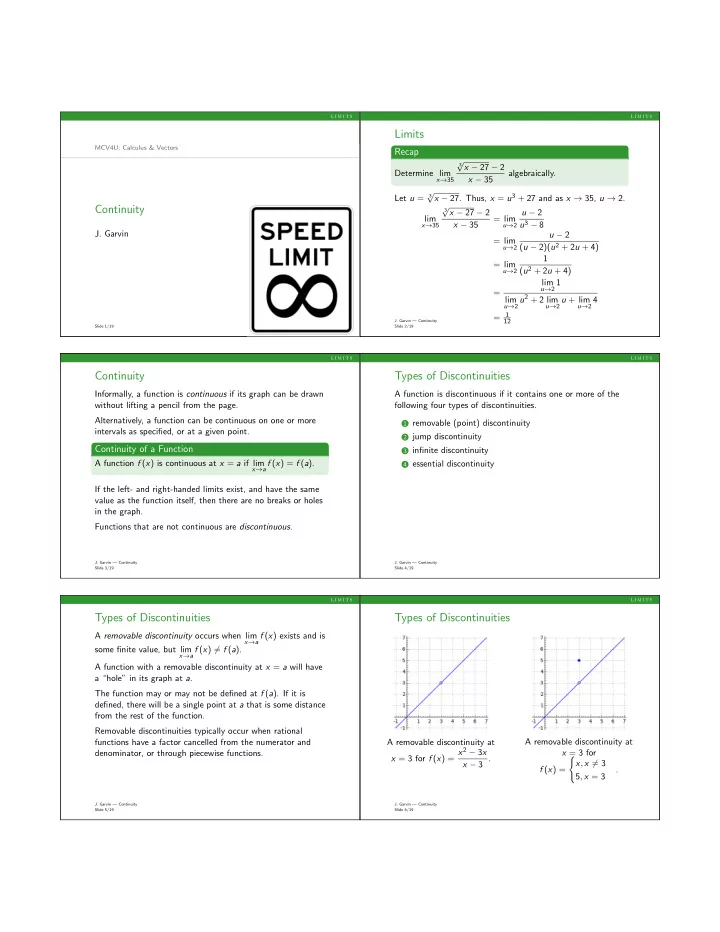
Informally, a function is continuous if its graph can be drawn without lifting a pencil from the page. Alternatively, a function can be continuous on one or more intervals as specified, or at a given point.

Continuity of a Function

A function f (x) is continuous at x = a if lim

x→a f (x) = f (a).

If the left- and right-handed limits exist, and have the same value as the function itself, then there are no breaks or holes in the graph. Functions that are not continuous are discontinuous.

  • J. Garvin — Continuity

Slide 3/19

l i m i t s

Types of Discontinuities

A function is discontinuous if it contains one or more of the following four types of discontinuities.

1 removable (point) discontinuity 2 jump discontinuity 3 infinite discontinuity 4 essential discontinuity

  • J. Garvin — Continuity

Slide 4/19

l i m i t s

Types of Discontinuities

A removable discontinuity occurs when lim

x→a f (x) exists and is

some finite value, but lim

x→a f (x) = f (a).

A function with a removable discontinuity at x = a will have a “hole” in its graph at a. The function may or may not be defined at f (a). If it is defined, there will be a single point at a that is some distance from the rest of the function. Removable discontinuities typically occur when rational functions have a factor cancelled from the numerator and denominator, or through piecewise functions.

  • J. Garvin — Continuity

Slide 5/19

l i m i t s

Types of Discontinuities

A removable discontinuity at x = 3 for f (x) = x2 − 3x x − 3 . A removable discontinuity at x = 3 for f (x) =

  • x, x = 3

5, x = 3 .

  • J. Garvin — Continuity

Slide 6/19

slide-2
SLIDE 2

l i m i t s

Types of Discontinuities

A jump discontinuity occurs when the left- and right-handed limits at x = a exist and are finite, but are not equal. A function with a jump discontinuity will see its graph “jump” up or down to a new value. Jump discontinuities seldom occur in common functions (e.g. polynomials, exponential, logarithmic), but may be described by piecewise functions or by “square-wave” functions.

  • J. Garvin — Continuity

Slide 7/19

l i m i t s

Types of Discontinuities

A jump discontinuity at x = 3 for f (x) =

  • −(x − 2)2 + 5, x ≤ 3

1, x ≥ 3 . Multiple jump discontinuities for f (x) = ⌊x⌋.

  • J. Garvin — Continuity

Slide 8/19

l i m i t s

Types of Discontinuities

An infinite discontinuity occurs when the left- and right-handed limits exist, and at least one of them is ±∞. Vertical asymptotes are examples of infinite discontinuities, and occur frequently in rational functions, logarithmic functions, and many others. Note that the left- and right-handed limits may be different. For instance, a function will have an infinite discontinuity at x = a if lim

x→a− f (x) = ∞ and lim x→a+ f (x) = −∞.

  • J. Garvin — Continuity

Slide 9/19

l i m i t s

Types of Discontinuities

An infinite discontinuity at x = 3 for f (x) = 3x − 2 x − 3 . An infinite discontinuity at x = 3 for f (x) = 1 (x − 3)2 .

  • J. Garvin — Continuity

Slide 10/19

l i m i t s

Types of Discontinuities

An essential discontinuity occurs in all other cases. A function may not be defined over some interval, or one of the left- or right-handed limits may not exist. Essential discontinuities rarely occur for the functions studied in this course; however, the square root function has an essential discontinuity at x = 0.

  • J. Garvin — Continuity

Slide 11/19

l i m i t s

Types of Discontinuities

An essential discontinuity for f (x) = −x + 5, since lim

x→3+ f (x) does not exist.

An essential discontinuity at x = 3 for f (x) =

  • x2, x ≤ 2

5, x ≥ 5 .

  • J. Garvin — Continuity

Slide 12/19

slide-3
SLIDE 3

l i m i t s

Testing For Continuity

Example

Determine whether the function f (x) =

  • x2, x ≤ 2

x + 2, x > 2 is continuous at x = 2 or not, and if f (x) is continuous. If not, describe any discontinuities. Check the value at x = 2 to see if there is a break in the graph. Since both 22 = 4 and 2 + 2 = 4, the piecewise function is continuous at x = 2. Since both x2 and x + 2 are polynomials, f (x) is continuous.

  • J. Garvin — Continuity

Slide 13/19

l i m i t s

Testing For Continuity

A graph of f (x) is below.

  • J. Garvin — Continuity

Slide 14/19

l i m i t s

Testing For Continuity

Example

Determine whether the function f (x) =

  • 5, x ≤ 3

−x + 7, x > 3 is continuous at x = 3 or not, and if f (x) is continuous. If not, describe any discontinuities. Check the value at x = 3 to see if there is a break in the graph. Since −3 + 7 = 4, but is 5 for all x ≤ 3, the piecewise function has a jump discontinuity at x = 3. Since there is a discontinuity, f (x) is discontinuous.

  • J. Garvin — Continuity

Slide 15/19

l i m i t s

Testing For Continuity

A graph of f (x) is below.

  • J. Garvin — Continuity

Slide 16/19

l i m i t s

Testing For Continuity

Example

Determine whether the function f (x) = tan x is continuous at x = π or not, and if f (x) is continuous. If not, describe any discontinuities. Recall that tan x has vertical asymptotes (infinite discontinuities) at x = (2k+1)π

2

, k ∈ Z. Therefore, f (x) = tan x is not continuous. It is, however, continuous at x = π, since lim

x→π− = lim x→π+ = tan π = 0.

  • J. Garvin — Continuity

Slide 17/19

l i m i t s

Testing For Continuity

A graph of f (x) = tan x is below.

  • J. Garvin — Continuity

Slide 18/19

slide-4
SLIDE 4

l i m i t s

Questions?

  • J. Garvin — Continuity

Slide 19/19