
SLIDE 1
LIBAL -BMS HIGH VOLTAGE™
BATTERY MANAGEMENT SYSTEM
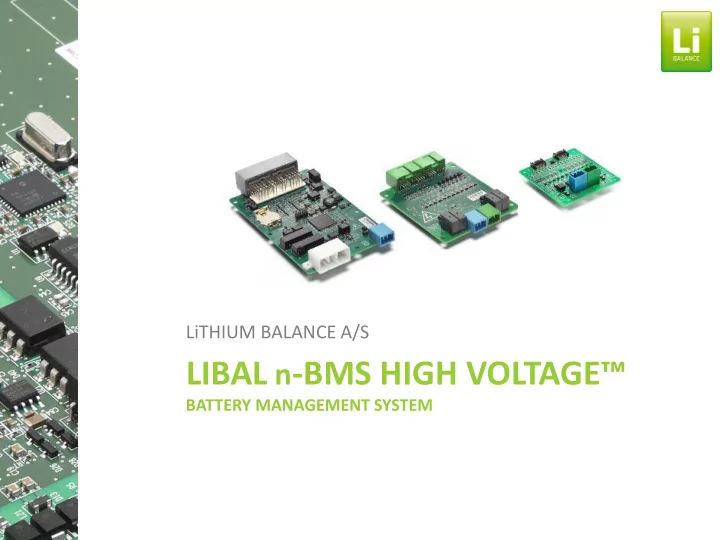
LIBAL - BMS HIGH VOLTAGE n BATTERY MANAGEMENT SYSTEM System - - PowerPoint PPT Presentation
LiTHIUM BALANCE A/S LIBAL - BMS HIGH VOLTAGE n BATTERY MANAGEMENT SYSTEM System overview BMS Creator 11 10 1. MCU 2.1 CMU 1 2.2 CMU 2 3. BATTRY PACK VCU 4. SHUNT/HAL 5. CHARGE CONTACTOR 6-34V 6. HV- MAIN CONTACTOR 9
BATTERY MANAGEMENT SYSTEM
1. MCU 2.1 CMU 1 2.2 CMU 2 3. BATTRY PACK 4. SHUNT/HAL 5. CHARGE CONTACTOR 6. HV- MAIN CONTACTOR 7. HV+ MAIN CONTACTOR 8. PRE CHARGE CONTACTOR 9. CHARGER (CAN or PWM)
HV + HV – CELL MONITORING TEMPERATURE MONITORING CAN 1 CAN 2 INPUT SIGNALS OUTPUT SIGNALS KEY SWITCH
80 % SoC 80 % SoC 80 % SoC 80 % SoC 80 % SoC 80 % SoC 80 % SoC 80 % SoC
Resistor VCU
1 2.1 3 4 5 9 6 7 8 10 11 2.2 6-34V 4
BMS Creator™
MCU – Master Control Unit CMU – Cell Monitoring Unit(s) CMU 100801 CMU 000705 CMU 100808
MCU – Master Control Unit
– Error settings – Battery model – SOC model based on OCV – Current regulation – I/O controls – CAN communication incl. full CAN open support – CAN Custom processing machine
CONNECT CONFIGURE CONTROL SERVICE
Module specifications Cells per CMU: 5 – 12 (min. 11 V) Cell voltage: 0,5 V – 4,5 V (0V – 5V with reduced accuracy) Cell voltage measurement accuracy: ±1,5mV (full temp. range) Cell voltage sampling frequency: 150 ms Temperature sensors: up to 12 or 4 per CMU Temperature measurement accuracy: ±1⁰C Communication: isoSPI PCB Dimensions: MCU: 92mm x 166mm / CMU 92x118mm (new CMU 75x80mm) Balancing current: 200mA (at 4,2 V)
System specifications Supply Voltage: 6-34 (VDC) Pack voltage: Up to 1000 (VDC) Pack current: Up to 2000 (ADC) Communication: 1 isolated CAN bus (CAN 2.0A, CAN 2.0B up to 1Mb/s) and 1 non-isolated CAN bus Pack current measurement accuracy: ±0.2% maximum, with SHUNT sensor error: ±0.5% maximum (HOBUT CLASS 0.5 ) or HALL effect sensor error: ±1% maximum (LEM DHAB S/18) and @25°C Pack temperature and current sampling rate: 150 ms SOC, SOH calculations: Coulomb counting and OCV models Temperature range: Operational -40⁰C to 85⁰C, Storage -40⁰C to 105⁰C
System tests CISPR 25: EMC susceptibility 150 kHz – 2 GHz ISO 11452: EMC susceptibility ISO 10605: ESD for road vehicles ISO 16750-2: Electrical Loads (Code A, Reversed, over voltage ect.) ISO 16750-3: Mechanical Loads (Sinusoidal and random vibration) ISO 16750-4: Climatic Loads ( Code G: -40 to 85°C) ISO 7637: Electrical disturbances from conduction and coupling