Leveraging Experts in Environmental Litigation Presenting Testimony, - - PowerPoint PPT Presentation

leveraging experts in environmental litigation
SMART_READER_LITE
LIVE PREVIEW

Leveraging Experts in Environmental Litigation Presenting Testimony, - - PowerPoint PPT Presentation

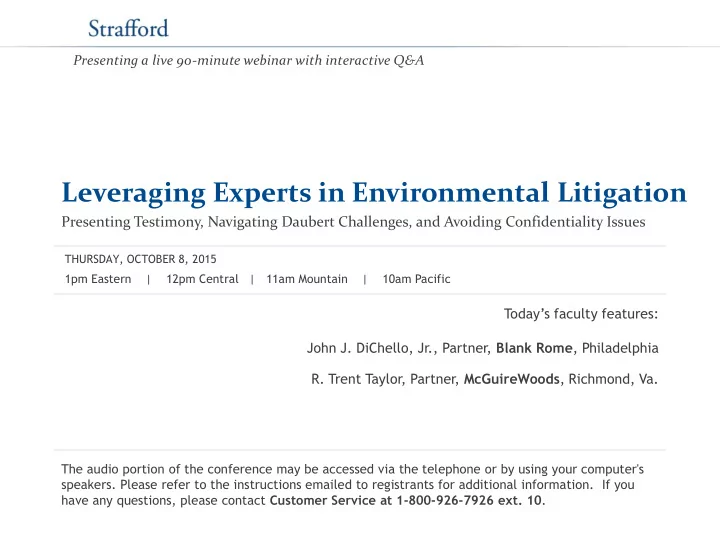
Presenting a live 90-minute webinar with interactive Q&A Leveraging Experts in Environmental Litigation Presenting Testimony, Navigating Daubert Challenges, and Avoiding Confidentiality Issues THURSDAY, OCTOBER 8, 2015 1pm Eastern |


slide-1
SLIDE 1

The audio portion of the conference may be accessed via the telephone or by using your computer's

  • speakers. Please refer to the instructions emailed to registrants for additional information. If you

have any questions, please contact Customer Service at 1-800-926-7926 ext. 10.

Presenting a live 90-minute webinar with interactive Q&A

Leveraging Experts in Environmental Litigation

Presenting Testimony, Navigating Daubert Challenges, and Avoiding Confidentiality Issues

Today’s faculty features:

1pm Eastern | 12pm Central | 11am Mountain | 10am Pacific THURSDAY, OCTOBER 8, 2015

John J. DiChello, Jr., Partner, Blank Rome, Philadelphia

  • R. Trent Taylor, Partner, McGuireWoods, Richmond, Va.
slide-2
SLIDE 2

Tips for Optimal Quality

Sound Quality If you are listening via your computer speakers, please note that the quality

  • f your sound will vary depending on the speed and quality of your internet

connection. If the sound quality is not satisfactory, you may listen via the phone: dial 1-866-961-8499 and enter your PIN when prompted. Otherwise, please send us a chat or e-mail sound@straffordpub.com immediately so we can address the problem. If you dialed in and have any difficulties during the call, press *0 for assistance. Viewing Quality To maximize your screen, press the F11 key on your keyboard. To exit full screen, press the F11 key again.

FOR LIVE EVENT ONLY

slide-3
SLIDE 3

Continuing Education Credits

In order for us to process your continuing education credit, you must confirm your participation in this webinar by completing and submitting the Attendance Affirmation/Evaluation after the webinar. A link to the Attendance Affirmation/Evaluation will be in the thank you email that you will receive immediately following the program. For additional information about continuing education, call us at 1-800-926-7926

  • ext. 35.

FOR LIVE EVENT ONLY

slide-4
SLIDE 4

Program Materials

If you have not printed the conference materials for this program, please complete the following steps:

  • Click on the ^ symbol next to “Conference Materials” in the middle of the left-

hand column on your screen.

  • Click on the tab labeled “Handouts” that appears, and there you will see a

PDF of the slides for today's program.

  • Double click on the PDF and a separate page will open.
  • Print the slides by clicking on the printer icon.

FOR LIVE EVENT ONLY

slide-5
SLIDE 5

Use of Experts in Environmental Litigation

Presented By: Trent Taylor McGuireWoods LLP John DiChello Blank Rome LLP

Slides Prepared by:

slide-6
SLIDE 6

Expert Witnesses

  • A witness may be qualified as an expert by:

– Knowledge – Skill – Experience – Training – Education (Fed. R. Evid. 702)

  • Testimony must be helpful to jury
  • May testify to the ultimate issues in the case
  • An opinion is not required
  • May base opinion on hearsay that such an expert would reasonably

rely on, but disclosure of hearsay to the jury is limited by value vs. prejudice test (Fed. R. Evid. 703)

6

slide-7
SLIDE 7

Hypothetical Case

Our client is a precision metal parts manufacturer. Its plant is located in an industrial area among similar businesses. In the 1950’s through the 1970’s our client used tetrachloroethylene (PCE) in its industrial degreasing operations. The common practice was to dispose of PCE by dumping spent solvent on unpaved ground behind the building. PCE, trichloroethylene, and vinyl chloride have been found in the well water of a home near the area. Members of the household have ingested the contaminated water, and one individual has been diagnosed with kidney cancer. In addition, as a result of the presence of chlorinated solvents in the ground water, they believe that the value of their home has drastically decreased. A neighboring manufacturer has begun cleaning up ground water containing these contaminants beneath its property.

7

slide-8
SLIDE 8

Hypothetical Case (cont.)

Two suits have been filed against our client. The first suit is by the neighboring

  • manufacturer. The industrial plaintiff is suing for costs associated with the cleanup.

Plaintiffs in the second suit are members of the household located near the industrial area. The individual plaintiffs allege that a member of the household was diagnosed with kidney cancer as a result of ingesting well water. The remaining members of the household are suing for medical monitoring and for the diminution in the value of their property.

8

slide-9
SLIDE 9

Possible Expert Witnesses

9

slide-10
SLIDE 10

Possible Expert Witnesses

  • Both Cases

– Hydrogeologist- Obtain groundwater and soil data to determine the origin of the solvents – Groundwater Modeler- Create model of ground water flow system – Expert in Groundwater Chemistry- Determine the effect soil and water have on the breakdown of solvents – State of the Art Expert (household and manufacturer’s tort claims)- Explain that the chemicals were handled with the prevailing scientific knowledge and industry and regulatory standards

10

slide-11
SLIDE 11

Possible Expert Witnesses

  • Household Case

– Epidemiologist- General causation – Toxicologist- General causation – Medical Doctor- Specific causation – Medical Monitoring

  • Whether the plaintiff is at an increased risk of a serious latent disease
  • Whether early detection is beneficial
  • Whether appropriate monitoring methods exist
  • Possible downsides of monitoring

– Property Appraiser

  • Manufacturer’s Case

– Environmental Engineer- Reasonable cost of cleanup

11

slide-12
SLIDE 12

Selection of Experts

12

slide-13
SLIDE 13

Consulting vs. Testifying

  • No discovery from non-testifying experts

(FRCP 26(b)(4)(d))

  • Experts’ draft reports are protected (FRCP

26(b)(4)(B)

  • Communications between attorney and

witness are protected (FRCP 26(b)(4)(C))

  • Benefits of having a separate consulting

expert

13

slide-14
SLIDE 14

Selection Criteria

  • Knowledge
  • Communication skills
  • Qualifications
  • Experience as a witness
  • Prior relationship to case vs. independent
  • Past identification with particular viewpoint

– Possibly overlook weaknesses of our theories

  • Credibility

– Demeanor – Stature

14

slide-15
SLIDE 15

Selection-Interview

  • Witness Selection Procedure

– Recommendations – Confidentiality/Retention Agreement

  • All information, mental impressions, conclusions, opinions,

and theories that you gain or develop during the course of your Expert Services will be maintained in strict confidence

  • All written materials will be prepared initially in draft and

will be marked “Draft” in addition to containing the language:

– “Privileged and Confidential” – “Attorney Work Product” and – “Prepared at the Request of Counsel”

15

slide-16
SLIDE 16

Selection-Interview

  • Witness Selection Procedure (Cont. )

– Briefing Packet – Conduct interviews on the same day

  • Experts you already know

16

slide-17
SLIDE 17

Case Preparation

17

slide-18
SLIDE 18

Case Preparation

  • Shaping our case
  • Analyzing opponent's case
  • Assisting in preparing for depositions

– Fact Witness – Opposing Expert

  • Attend deposition

18

slide-19
SLIDE 19

Expert Testimony

19

slide-20
SLIDE 20

Expert Testimony

  • Submit report (with graphics)
  • Deposition defense
  • Preparation for direct testimony

– Rehearsal (with graphics)

  • Demeanor
  • Graphics
  • Cross Examination

– Mock Cross Examination – On cross maintain same demeanor as on direct

20

slide-21
SLIDE 21

www.mcguirewoods.com

Leveraging Experts in Environmental Litigation: Presenting Testimony, Navigating Daubert Challenges, and Avoiding Confidentiality Issues

  • R. Trent Taylor – McGuireWoods LLP
slide-22
SLIDE 22

McGuireWoods | 22

CONFIDENTIAL

Recent Trends/Issues Related to Experts in Environmental Litigation

slide-23
SLIDE 23

McGuireWoods | 23

CONFIDENTIAL

slide-24
SLIDE 24

McGuireWoods | 24

CONFIDENTIAL

Federal Rule of Evidence 702

  • RULE 702. TESTIMONY BY EXPERT WITNESSES
  • A witness who is qualified as an expert by knowledge, skill, experience,

training, or education may testify in the form of an opinion or otherwise if:

  • (a) The expert’s scientific, technical, or other specialized knowledge will

help the trier of fact to understand the evidence or to determine a fact in issue;

  • (b) The testimony is based on sufficient facts or data;
  • (c) The testimony is the product of reliable principles and methods; and
  • (d) The expert has reliably applied the principles and methods to the

facts of the case.

  • (As amended Apr. 17, 2000, eff. Dec. 1, 2000; Apr. 26, 2011, eff. Dec.

1, 2011)

slide-25
SLIDE 25

McGuireWoods | 25

CONFIDENTIAL

Daubert v. Merrell Dow Pharmaceuticals 509 U.S. 579 (1993)

  • Factors courts may consider when ruling on a Daubert motion:
  • Whether the technique was tested in actual field conditions
  • Whether the technique has been subjected to peer review and

publication

  • The known or potential rate of error
  • Whether standards exist for the control of the technique’s operation
  • Whether the technique has been generally accepted within the

relevant scientific community

slide-26
SLIDE 26

McGuireWoods | 26

CONFIDENTIAL

Success of Daubert Challenges

  • In a 2010 report of 6,141 Daubert challenges to witnesses from

all fields in both federal and state courts, it concluded that the success rate of challenges was 45% for either complete or partial exclusion.

  • Attempts to completely preclude an expert were successful 25%
  • f the time.
  • A trial court’s rulings on Daubert motions were affirmed 87% of

the time.

  • There were more than three times as many Daubert challenges

in 2010 as they were in 2000.

slide-27
SLIDE 27

McGuireWoods | 27

CONFIDENTIAL

Daubert Empirical Findings

  • 71% of Daubert motions are filed by defendants
  • In almost half of cases, multiple Daubert motions are made.
  • 31% of Daubert motions target medical experts.
  • 24% target engineering/technical/environmental experts.
  • Defendants are more likely to win Daubert motions than pltfs.
  • Overall, parties win about 22% of Daubert motions in full.

Defendants partially win 53%, while plaintiffs partially win 45%.

  • In tort cases, Defendants win 30% in full, and 52% in part.

Plaintiffs however win in full only 16% and in part 37%.

slide-28
SLIDE 28

McGuireWoods | 28

CONFIDENTIAL

Daubert Empirical Findings

  • When a Daubert motion is granted for a pltf, their overall win

rate is 42% versus 29% when their motions are denied.

  • When a Daubert motion is granted for a defendant, then the

defendants win 75% of the time, but only 69% of the time when their motions are denied.

  • Within 100 days of a Daubert ruling, more than half of the cases

ended in settlement or summary judgment.

  • Source: Judicial Treatment of Daubert Motions: An Empirical

Examination, by James C. Cooper (George Mason Law)

slide-29
SLIDE 29

McGuireWoods | 29

CONFIDENTIAL

Trend # 1 – Sharp Split on Methodological Flaws

slide-30
SLIDE 30

McGuireWoods | 30

CONFIDENTIAL

Trend # 1 – Sharp Split on Methodological Flaws

  • Three Courts of Appeals have recently held that minor

methodological flaws go to the weight of the evidence, not the admissibility, and does not require exclusion of the opinions.

  • SQM North America Corp. v. City of Pomona, 750 F.3d 1035

(9th Cir. 2014)

  • “A minor flaw in an expert’s reasoning or a slight modification of

an otherwise reliable method does not render expert testimony inadmissible.”

  • “A more measured approach to an expert’s adherence to

methodological protocol is consistent with the spirit of Daubert and the Federal Rules of Evidence: there is a strong emphasis on the role of the fact finder in assessing and weighing the evidence.”

slide-31
SLIDE 31

McGuireWoods | 31

CONFIDENTIAL

Trend # 1 – Sharp Split on Methodological Flaws (cont.)

  • Johnson v. Mead Johnson & Co., 754 F.3d 557 (8th Cir. 2014)
  • Found that it was acceptable that the PFGE test at issue only used
  • ne enzyme rather than the CDC standard of two or three
  • Found that the district court went too far by weighing the experts’

conclusions instead of focusing only on methodology

  • Manpower Inc. v. Ins. of Penn., 732 F.3d 796 (7th Cir. 2013)
slide-32
SLIDE 32

McGuireWoods | 32

CONFIDENTIAL

Trend # 1 – Sharp Split on Methodological Flaws (cont.)

  • In re Paoli R.R. Yard PCB Litig., 35 F.3d 717, 745 (3d Cir.

1994) (holding that “any step that renders the analysis unreliable . . . Renders the expert’s testimony inadmissible. This is true whether the step completely changes a reliable methodology or merely misapplies the methodology.”)

  • Amorgianos v. Nat’l R.R. Passenger Corp., 303 F.3d 256 (2d
  • Cir. 2002)
  • Tamraz v. Lincoln Electric Corp., 620 F.3d 665 (6th Cir. 2010)
  • Attorney General of Oklahoma v. Tyson Foods, Inc., 565 F.3d

769 (10th Cir. 2009)

slide-33
SLIDE 33

McGuireWoods | 33

CONFIDENTIAL

United States v. Alabama Power, 730 F.3d 1278 (11th Cir. Sept. 19, 2013)

  • “The rules relating to Daubert issues are not precisely calibrated

and must be applied in case-specific evidentiary circumstances that often defy generalization.”

  • “Simply because a model cannot be presumed reliable in a

specific context . . . does not mean that it is per se unreliable in that context.”

slide-34
SLIDE 34

McGuireWoods | 34

CONFIDENTIAL

United States v. Alabama Power, 730 F.3d 1278 (11th Cir. Sept. 19, 2013)

  • “Alabama Power may have a number of reasons why the Koppe–

Sahu methodology should not be accepted as persuasive at trial, but it offers no persuasive argument to support the notion that Daubert and its progeny require all-out exclusion of the expert testimony of Mr. Koppe and Dr. Sahu prior to trial. That the Koppe–Sahu model always predicts an increase in pollutant emissions as a result of increased unit availability is not a fatal Daubert flaw, as Alabama Power suggests, but rather a natural

  • utcome of the model's deterministic nature. Although a court

may certainly evaluate the mathematical rigor of a model, the possible existence of a more thorough, more complex model is not a basis for wholesale exclusion.”

slide-35
SLIDE 35

McGuireWoods | 35

CONFIDENTIAL

United States v. Alabama Power, 730 F.3d 1278 (11th Cir. Sept. 19, 2013)

  • Dissent:
  • Further, “[w]hat is true about the review of evidentiary issues in

general applies with equal or even greater force to Daubert issues in particular, an area where the abuse of discretion standard thrives.” It is an area that involves, to quote Chief Judge Carnes' metaphor, a “heavy thumb—really a thumb and a finger or two—that is put on the district court's side of the scale....”

slide-36
SLIDE 36

McGuireWoods | 36

CONFIDENTIAL

United States v. Alabama Power, 730 F.3d 1278 (11th Cir. Sept. 19, 2013)

  • Dissent:
  • “That deference to the district court regarding Daubert evidentiary rulings is

not idle dicta is established by research disclosing that, in the last five years, there have been 54 reported decisions of this court (13 published opinions and 41 unpublished opinions) reviewing district court evidentiary rulings under Daubert, and the district court was reversed in only three of those

  • cases. This does not mean, of course, that Daubert rulings in the district courts

are altogether unreviewable, see Brown, 415 F.3d at 1266, but the rarity of reversals does signify an awareness that when it comes to managing the gate at Fed.R.Evid. 702, both this court and the Supreme Court have consistently emphasized the need to defer to the district court's discretionary gatekeeping decisions under Fed.R.Evid. 702 including, in particular, decisions involving reliability determinations. “[T]he law grants a district court the same broad latitude when it decides how to determine reliability as it enjoys in respect to its ultimate reliability determination.”

slide-37
SLIDE 37

McGuireWoods | 37

CONFIDENTIAL

Trend # 2 – Courts focusing on differential etiologies

  • Johnson v. Mead Johnson & Co. LLC (8th Cir. June

2014)(reversing district court’s exclusion of experts; held that even without ruling out all possible alternative explanations, the experts’ opinions were reliable enough)

slide-38
SLIDE 38

McGuireWoods | 38

CONFIDENTIAL

Trend # 2 – Courts focusing on differential etiologies

  • Cooper v. Takeda Pharmaceuticals America, Inc., Cal. App. July

2015 (unpublished)

  • reversed trial court decision that struck the testimony of pltfs’

experts who did not rule out all other possible causes of a man’s bladder cancer

  • said that there needs to be “something more than bare

conceivability or plausibility of other causes” for a court to find an expert’s opinion to be speculative

  • “by requiring that the expert rule out all other possible causes for

Jack Cooper’s bladder cancer, even where there was no substantial evidence that other such causes might be relevant, the court exceeded the proper boundaries of its gatekeeping function in determining the admissibility of the complex scientific testimony.”

slide-39
SLIDE 39

McGuireWoods | 39

CONFIDENTIAL

Trend # 2 – Courts focusing on differential etiologies

  • McMunn v. Babcock & Wilcox Power Generation Group, Inc.

(W.D. Pa. 2014) = magistrate excluded pltfs’ experts; trial court however permitted them

  • “Dr. Hu’s opinions have met the pedestrian standards required

for reliability and fit as they are based on scientifically sound methods and procedures as opposed to subjective beliefs and unsupported speculation.”

  • court also held that differential diagnosis method does not

require that he estimate the likelihood that radiation caused a particular cancer before he can conclude that radiation is the most likely cause among many, including those unknown

slide-40
SLIDE 40

McGuireWoods | 40

CONFIDENTIAL

Trend # 2 – Courts focusing on differential etiologies

  • C.W. v. Textron, Inc., (7th Cir. Aug. 26, 2015) = district court excluded

pltf’s 3 experts; COA affirmed

  • District court found that expert’s reliance on differential etiology failed

to meet Daubert because he “failed to connect the dots between the scientific studies he analyzed and the opinions that he offered” == the studies he relied upon failed to establish that vinyl chloride, at the dose and duration relevant to the case, could cause the problems that plaintiffs experienced or claimed they were likely to experience; COA said “This approach is not the stuff of science.”

  • “Without the benefit of analogous studies and an acceptable method of

extrapolation, Dr. Byers . . . is forced to take a leap of faith in pointing to vinyl chloride as having the capacity to cause the injuries (and risk

  • f injury) to [plaintiffs]. The district court ably performed its

gatekeeper role in shielding the jury from this leap.”

slide-41
SLIDE 41

McGuireWoods | 41

CONFIDENTIAL

Trend # 2 – Courts focusing on differential etiologies

  • Chapman v. Procter & Gamble Distributing LLC, 766 F.3d 1296 (11th
  • Cir. 2014)
  • affirmed trial court exclusion of pltf’s specific causation expert which

were based on a differential etiology

  • held that differential etiology is “a scientifically accepted

methodology” but the pltf’s expert “did not follow it”. This etiology requires the expert to “compile a comprehensive list of hypotheses that might explain a plaintiff’s condition” and then “provide reasons for rejecting alternative hypotheses using scientific methods and procedures and the elimination of those hypotheses must be found on more than subjective beliefs or unsupported speculation”; found that the pltf’s expert in Chapman “failed to consider obvious alternative causes” for the pltf’s condition and instead “pursued his view that zinc- associated copper deficiency was responsible” without providing any legitimate reason for ruling out other potential causes

slide-42
SLIDE 42

McGuireWoods | 42

CONFIDENTIAL

Trend #3 – Earlier Expert Battles?

slide-43
SLIDE 43

McGuireWoods | 43

CONFIDENTIAL

Early Daubert challenges in class actions

  • Comcast Corp. v. Behrend, No. 11-864, 2013 BL 80435 (U.S.

March 27, 2013) (courts must look at the merits issues when deciding class certification)

  • Wal-Mart Stores v. Dukes, 132 S. Ct. 320 (2011) (held that prior

to certifying a class action, the trial court should engage in a rigorous review of all relevant issues)

  • American Honda Motor Co. v. Allen, 600 F.3d 813, 815-16 (7th
  • Cir. 2010) (held that where it is “critical to class certification” a

court “must perform a full Daubert analysis before certifying the class”)

slide-44
SLIDE 44

McGuireWoods | 44

CONFIDENTIAL

Comcast v. Behrend

  • Holding: The class action brought by respondents, subscribers to

the cable television services provided by petitioner, was improperly certified under Federal Rule of Civil Procedure 23(b)(3), which requires a court to find that the “questions of law

  • r fact common to class members predominate over any

questions affecting only individual members,” because the Third Circuit erred in refusing to decide whether the class’s proposed damages model could show damages on a classwide basis. Under proper standards, the model was inadequate, and the class should not have been certified.

  • Judgment: Reversed, 5-4, in an opinion by Justice Scalia on

March 27, 2013.

slide-45
SLIDE 45

McGuireWoods | 45

CONFIDENTIAL

Daubert and Class Actions

  • In re Blood Reagents Antitrust Litig. (3d Cir. April 2015)
  • Vacated class certification in an antitrust case
  • Held that when a pltf relies on expert testimony to satisfy the

requirements of Fed. R. Civ. P. 23, that testimony is subject to scrutiny under Daubert

  • 3rd Circuit had previously permitted use of expert evidence at the

class cert stage if that evidence could later “evolve” into an admissible form, but in this case, Court said that the prior standard had been overturned by Comcast

  • Joined three other Circuit Courts of Appeal that have held this:

– Messner v. Northshore Univ. HealthSystem, 669 F.3d 802 (7th Cir.

2012)

– In re Zurn Pex Plumbing Prods. Liab. Litig., 644 F.3d 604 (8th Cir.

2011)

– Ellis v. Costco Wholesale Corp., 657 F.3d 970 (9th Cir. 2011)

slide-46
SLIDE 46

McGuireWoods | 46

CONFIDENTIAL

Coleman v. Union Carbide,

  • No. 110366 (S.D. W. Va. Sept. 30, 2013)
  • Refused to certify proposed Plaintiff classes in a toxic exposure

case because it addressed Daubert challenges at the class certification stage and found the expert testimony on which plaintiffs relied to be inadmissible

  • Court found that the experts’ opinions were not based on

sufficient facts or data and questioned their methodology

slide-47
SLIDE 47

McGuireWoods | 47

CONFIDENTIAL

Parko v. Shell Oil Co., 739 F.3d 1083 (7th Cir. Jan. 17, 2014)

  • Reversed trial court’s certification of a class of Illinois residents

who claimed a refinery leaked toxic chemicals into their water supply

  • Court found that the trial court had taken the plaintiffs’ promise
  • f future evidence at face value and should have researched the

soundness of their methodology.

  • “Nothing is simpler than to make a unsubstantiated
  • allegation. The judge should have investigated the realism of

the plaintiffs’ injury and damage model in light of the defendants’ counter arguments and to that end should have taken evidence.”

slide-48
SLIDE 48

McGuireWoods | 48

CONFIDENTIAL

Parko v. Shell Oil Co., 739 F.3d 1083 (7th Cir. Jan. 17, 2014)

  • “For if the defendants are right, there is no common issue, only

individual issues that will vary from homeowner to homeowner: is there benzene in the groundwater beneath his home at a level of concentration that if the groundwater were drunk would endanger health (and is there any possibility it would enter the water supply); what is the source of the benzene in the groundwater beneath a given home (that is, who is the polluter who caused the groundwater to become polluted); could the presence of the benzene in that concentration cause any other form of harm; has the presence of the benzene reduced the value of his property; if so, how great has the reduction been. It is difficult to see how these issues can be managed in the class action format. But in any event they must be engaged by the district judge before he can make a responsible determination

  • f whether to certify a class.”
slide-49
SLIDE 49

McGuireWoods | 49

CONFIDENTIAL

Lone Pine’s Popularity Sags

slide-50
SLIDE 50

McGuireWoods | 50

CONFIDENTIAL

Scoreboard for Lone Pine Orders

Granted Denied Baker v. Anschutz Exploration Corp., No. 11-CV- 6119 (W.D. N.Y.) Kamuck v. Shell Energy Holdings GP, LLC, (M.D. Pa.

  • Sept. 5, 2012)

In re Fosamax Prods. Liab. Litig., 2012 WL 5877418 (S.D.N.Y. Nov. 20, 2012) Roth v. Cabot Oil & Gas Corp., No. 12-CV-00898 (M.D. Pa. Oct. 15, 2012) Pinares v. United Technologies Corp., No. 9:10-cv- 80883 (S.D. Fla. 1/19/11) Hagy v. Equitable Production Co., No. 2:10-cv- 01372, 2012 BL 60567 (S.D. W. Va. Mar. 5, 2012) McManaway v. KBR Inc., 265 F.R.D. 384 (S.D. Ind. 2009) Strudley v. Antero Resources Corp., 2013 COA 106 (July 3, 2013) Avila v. Willits Environmental Remediation Trust, 633 F.3d 828 (9th Cir. 2011) In re Digitek Prod. Liab. Litig., 264 F.R.D. 249, 255 (S.D. W. Va. 2010)

slide-51
SLIDE 51

McGuireWoods | 51

CONFIDENTIAL

More Denials

  • Russell v. Chesapeake Appalachia, LLC, No. 4:14-cv-00148 (M.D. Pa.
  • Mar. 2, 2015) = denied motion for a line Pine order, holding that it

could not issue a Lone Pine order without some discovery; found the

  • rder to be unjustified at the early stage of the lawsuit; Court set a high

bar for issuing the order, explaining that it “should issue only in an exceptional case and after the defendant has made a showing of significant evidence calling into question plaintiff’s ability to bring forward” evidence of causation.

  • Antero Resources Corp. v. Strudley, 2015 WL 1813000 (Colo. Apr. 20,

2015) = affirmed a appellate court opinion holding that “lone Pine

  • rders” are not permitted by Colorado law
  • held that “Colorado’s Rules of Civil Procedure do not allow a trial court to

issue a modified case management order, such as a Lone Pine order, that requires a plaintiff to present prima facie evidence in support of a claim before a plaintiff can exercise its full rights of discovery under Colorado rules”

slide-52
SLIDE 52

McGuireWoods | 52

CONFIDENTIAL

More Denials

  • Adinolphe v. United Technologies, Inc., 768 F.3d 1161 (11th Cir. 2014)

= reversed a district court’s Lone Pine order issued prior to motions to

  • dismiss. = “As a general matter, we do not think that it is legally

appropriate (or for that matter wise) for a district court to issue a Lone Pine order requiring factual support for the plaintiffs’ claims before it has determined that those claims survive a motion to dismiss.”

  • Hamilton v. Miller, 15 N.E.3d 1199, 1203-04 (N.Y. 2014) (under NY

law, the trial court abused its discretion in requiring pltfs to provide medical evidence of each alleged injury and causation or be precluded from offering evidence at trial, on the basis that causation is appropriate for expert discovery and if warranted, SJ)

  • Manning v. Arch Wood Protection, Inc., 40 F. Supp. 3d 861 (E.D. Ky.

2014) (denied Lone Pine order)

  • Smith v. Atrium Med. Corp., 2014 WL 5364823 (E.D. La. Oct. 2014) =

denying Lone Pine order

slide-53
SLIDE 53

McGuireWoods | 53

CONFIDENTIAL

Other Considerations – Science is less trusted than in the past

slide-54
SLIDE 54

McGuireWoods | 54

CONFIDENTIAL

Other considerations – Courts are focusing on testing

  • Chapman v. Procter & Gamble Distributing LLC, 766 F.3d 1296

(11th Cir. 2014) = “Taking everything together, there is enough data in the scientific literature to hypothesize causation, but not to infer it. Hypotheses are verified by testing, not by submitting them to lay juries for a vote.” (holding that cannot get to a jury with an untested theory)

slide-55
SLIDE 55

McGuireWoods | 55

CONFIDENTIAL

Other considerations – Courts are focusing on testing (cont.)

  • Tumlinson v. Advanced Micro Devices, Inc., 2013 WL 6129791

(Del. Nov. 21, 2013)

  • “One of the Daubert factors is whether the expert’s hypothesis is testable. Although

agreeing it is not necessary to “expose humans to harmful chemicals for a controlled, clinical experiment,” even Dr. Frazier acknowledged that “‘in designing a proper epidemiologic study, it is important to properly define the characteristics of the group being studied.’” Dr. Frazier was unable to identify which specific chemicals, either individually or in combination, caused the Plaintiffs’ “very different” birth defects.”

  • ”Dr. Frazier also failed to distinguish between the Plaintiffs’ differing work

environments and how those environments may have impacted exposure levels. The trial court concluded that Dr. Frazier’s opinion, though not required to actually be tested, lacked the specificity required to pass muster under Daubert’s “testability” factor. The trial court did not abuse its discretion in so concluding. The testability factor alone, however, is not dispositive of a Daubert reliability analysis.”

slide-56
SLIDE 56

McGuireWoods | 56

CONFIDENTIAL

Lemmerman v. Blue Cross Blue Shield of Wisconsin, 713 F. Supp.2d 791 (E.D. Wis. 2010)

  • Court granted motion to exclude two plaintiff experts
  • Court found that simply reading data sheets and labels to support

a conclusion that a substance had explosive propensities was not enough; instead, testing on the substance or citation to studies or literature supporting that fact were required.

  • Court also found that the expert did not deal with an obvious

alternative explanation for the alleged explosion.

slide-57
SLIDE 57

McGuireWoods | 57

CONFIDENTIAL

Other considerations – Courts requiring a close connection between the opinions at issue and the data/studies relied on

  • Chapman v. Procter & Gamble Distributing LLC, 766 F.3d 1296

(11th Cir. 2014)

  • Pltfs argued that their theory was generally accepted because

studies showed that excessive zinc can cause copper deficiency which can lead to injury

  • Court affirmed the trial court’s determination that this was

insufficient because it did not “show that the zinc compounded in Fixodent” is generally recognized to cause the type of neurological injury allged by plaintiff

  • Held that must produce support that is specific to the cause at issue
slide-58
SLIDE 58

McGuireWoods | 58

CONFIDENTIAL

Other considerations – Courts requiring a close connection between the opinions at issue and the data/studies relied on (cont.)

  • Anderson v. TMI Inc., (Del. 2014)
  • Affirmed exclusion of experts because the studies relied on by the

experts “simply do not support their opinions and do not fit the case”

  • Noted that the experts were unable to point to unpublished

scientific studies demonstrating a link and instead relied on inapposite studies or untested extensions of such studies.

slide-59
SLIDE 59

McGuireWoods | 59

CONFIDENTIAL

Other considerations – Courts are focusing on the dose-response relationship

  • In re Denture Cream Prod. Liab. Litig. (S.D. Fla. 2015) = excluded

plaintiffs’ experts in part because their opinions made no mention of the dose-response relationship

  • Chapman v. Procter & Gamble Distributing LLC, 766 F.3d 1296 (11th
  • Cir. 2014) (excluded plaintiffs’ experts in part based on their failure to

discuss the dose-response relationship; says that “the relationship between dose and effect . . . is the hallmark of basic toxicology and is the single most important factor to consider in evaluating whether an alleged exposure caused a specific adverse effect”)

  • Burst v. Shell Oil Co., 2015 WL 2341594 (E.D. La. May 14, 2015) =

excluded pltf experts holding that the expert’s methodology and calculations were unreliable because the expert relied “solely on self- reported symptoms” from witnesses and had “failed to validate his results against scientific literature measuring actual exposure levels.”

slide-60
SLIDE 60

McGuireWoods | 60

CONFIDENTIAL

“Any Exposure” Theory of Causation

  • Under this theory, it is assumed that each and every exposure to

a toxic substance, above background levels, is assumed to be the cause of the claimed injury.

  • Courts that have rejected this theory:
  • Anderson v. Ford Motor Co., 2013 WL 3179497 (D. Utah. June 24,

2013)

  • Wannall v. Honeywell Int’l, 2013 WL 1966060 (D.D.C. May 14,

2013)

  • Sweredoski v. Alfa Laval, Inc., 2013 BL 158030 (R.I. Sup. Ct. June

13, 2013)

slide-61
SLIDE 61

McGuireWoods | 61

CONFIDENTIAL

“Any Exposure” Theory of Causation

  • Howard v. A. W. Chesterton Co., 2013 BL 262241 (Pa. Sept. 26,

2013)

  • “The theory that each and every exposure, no matter how small,

is substantially causative of disease may not be relied upon as a basis to establish substantial-factor causation for diseases that are dose-responsive.”

slide-62
SLIDE 62

McGuireWoods | 62

CONFIDENTIAL

Nonnon v. City of New York

  • In September 2011, the New York appellate division partially affirmed

a denial of defendant’s summary judgment motion in a case involving toxic landfill seepage and alleged cancer clusters.

  • The Nonnon court stated that it is “not always necessary for a

plaintiff to quantify exposure levels precisely” and said that “so long as plaintiff’s experts have provided a scientific expression of plaintiff’s exposure levels, they will have laid an adequate foundation for

  • pinions on specific causation.”
  • While there was no indication that plaintiffs’ experts actually knew, let

alone “scientifically expressed” the individual exposure levels, the court found that plaintiff’s proximity analysis study permitted an inference that plaintiffs’ diseases were more likely than not caused by substances from the landfill.

  • The Nonnon court ultimately held that “criticisms of [an expert’s]

analysis go to the weight of the evidence and should therefore be the subject of cross-examination at trial” rather than serve as grounds for pretrial exclusion of the expert.

slide-63
SLIDE 63

McGuireWoods | 63

CONFIDENTIAL

Betz v. Pneumo Abex LLC

  • A pathology expert's controversial “any-exposure” theory, which

states that a health risk attaches even to a single asbestos fiber, is based on unproven science and is inadmissible in a test case on behalf of automobile brake workers with mesothelioma, the Pennsylvania Supreme Court ruled May 23 (Betz v. Pneumo Abex LLC, Pa., No. 38 WAP 2010, 5/23/12).

  • The expert's theory “is in irreconcilable conflict with itself.

Simply put, one cannot simultaneously maintain that a single fiber among millions is substantially causative, while also conceding that a disease is dose responsive,” the Supreme Court said.

slide-64
SLIDE 64

McGuireWoods | 64

CONFIDENTIAL

Kochera v. Gen. Elec. Co. (S.D. Ill. 9/21/15)

  • Refused to exclude expert who relied on any exposure theory
  • Held that even if a causation expert relied on the every exposure

theory in the asbestos case, “such reliance would not render his testimony inadmissible”

  • Allowed expert to hold that every exposure to asbestos that is

non-trivial contributed to the injury

slide-65
SLIDE 65

McGuireWoods | 65

CONFIDENTIAL

Other considerations – Peer review

  • In re Zoloft Prods. Liab. Litig (E.D. Pa. 2014)
  • Excluded testimony of general causation experts because their
  • pinions had never been published in peer-reviewed journals)
slide-66
SLIDE 66

McGuireWoods | 66

CONFIDENTIAL

Tumlinson v. Advanced Micro Devices, Inc., 2013 WL 6129791 (Del. Nov. 21, 2013)

  • “A second reliability factor contemplated by Daubert is whether the expert’s

methods were subject to the rigors of peer review and publication. The trial court recognized that “[Dr. Frazier] ha[d] found reliable foundational studies” that were subjected to peer review. The trial court interpreted Dr. Frazier’s methodology to be that “because her personal opinion was formed by synthesizing peer reviewed foundational studies, that is as strong as if her

  • pinion was peer reviewed.” In rejecting Dr. Frazier’s methodology, the

trial court noted the importance of a layered reliability analysis, which requires that an expert’s opinion, even if based on reliable, peer-reviewed sources, demonstrate independent indicia of reliability.”

  • ”Plaintiffs contend that Dr. Frazier’s methods were peer reviewed (and

therefore reliable) because “three prominent expert physicians and scientists endorsed Dr. Frazier’s opinions.” But, nothing in the record indicates that

  • Dr. Frazier submitted her methods and conclusions to any scientific

journal or publication for review before this litigation. That three other experts “endorsed” Dr. Frazier’s opinions—in the midst of ongoing litigation— does not constitute “peer review” as envisioned by Daubert.”

slide-67
SLIDE 67

McGuireWoods | 67

CONFIDENTIAL

Tumlinson v. Advanced Micro Devices, Inc., 2013 WL 6129791 (Del. Nov. 21, 2013)

  • “Courts also frequently consider, as did the trial court, whether the

expert opinion was formed outside of litigation. Plaintiffs argue that the generic label of “conclusions developed for litigation” “could be leveled against virtually any expert.” To be sure, every trial expert witness will necessarily form an opinion or draft a report for purposes

  • f litigation. What is important, however, is whether the opinion or

conclusion offered in litigation is consistent with, or based on, the expert’s research and experience developed outside the litigation

  • context. Here, the trial court discounted the expert testimony’s

reliability because “Dr. Frazier’s findings were made for this litigation.” We find no reason to reject that conclusion.”

slide-68
SLIDE 68

McGuireWoods | 68

CONFIDENTIAL

In re Olson 348 Wis.2d 263 (Wis.App.,2013) (unpublished)

  • “The trial court properly exercised its discretion in assigning greater

weight to Dr. Fixmer's testimony. She established her credentials and specialized training and testified about the use of extrapolation by other experts in the field. While Dr. Fixmer acknowledged that the Doren method is the subject of considerable debate, WIS. STAT. § 907.02 (2009–10) does not require that expert testimony be allowed only if verified by published, peer-reviewed articles. The fact that Dr. Doren's extrapolation method is debated in psychological circles does not render it inadmissible “junk science.” “When more than

  • ne reasonable inference can be drawn from the credible evidence, the

reviewing court must accept the inference drawn by the trier of fact.” State v. Peppertree Resort Villas, Inc., 2002 WI App 207, ¶ 19, 257 Wis.2d 421, 651 N.W.2d 345.

slide-69
SLIDE 69

McGuireWoods | 69

CONFIDENTIAL

Other considerations – Beware of Cherry-Picking

slide-70
SLIDE 70

McGuireWoods | 70

CONFIDENTIAL

Other considerations – Beware of Cherry-Picking

  • In re Zoloft Prods. Liab. Litig., (E.D. Pa. 2014) (excluding

experts’ opinions because experts “cherry-picked” studies and data within studies that supported their opinions)

  • In re Denture Cream Prod. Liab. Litig. (S.D. Fla. 2015)

(excluded pltf experts because they relied on studies that used cherry-picked data)

slide-71
SLIDE 71

McGuireWoods | 71

CONFIDENTIAL

Other considerations – Beware of Cherry-Picking

  • CNH Am., LLC v. Champion Envtl. Servs., Inc., 863 F. Supp. 2d

793 (E.D. Wis. 2012)

  • The challenged expert was asked at deposition whether he would

be speculating about a spill that was not documented, to which the expert replied “yes.”

  • The plaintiff argued that the opinions of this expert were

speculative because of his deposition answer.

  • The court rejected this argument, finding “[b]ecause [the expert]

bases his opinions on multiple considerations, [the plaintiff]’s piecemeal challenges to the reliabilities of his opinions are unsuccessful.”

slide-72
SLIDE 72

McGuireWoods | 72

CONFIDENTIAL

Best Practices

slide-73
SLIDE 73

McGuireWoods | 73

CONFIDENTIAL

QUESTIONS?

  • R. Trent Taylor

McGuireWoods LLP Gateway Plaza 800 East Canal Street Richmond, VA 23219-3916 1-804-775-1000 rtaylor@mcguirewoods.com

slide-74
SLIDE 74

John J. DiChello, Jr. Partner Blank Rome LLP

October 8, 2015

Leveraging Experts in Environmental Litigation

slide-75
SLIDE 75

Confidentiality Issues

75

slide-76
SLIDE 76

76

Confidentiality Issues

  • What is privileged?
  • What is protected as attorney

work product?

  • What is discoverable?
slide-77
SLIDE 77

77

Why does it matter?

  • Guideposts for what counsel can share with a testifying

expert and what the expert should review

  • Maintaining the attorney-client privilege is critical
  • Need to avoid revealing a party’s case strategy
  • Information disclosed during discovery could be

grounds for a Daubert challenge (e.g., evidence of lack

  • f a reliable methodology, that the expert reached an
  • pinion first, etc.)
  • Discovered information may provide fodder for cross-

examination of the expert (e.g., bias, lack of credibility)

slide-78
SLIDE 78

78

What is not privileged or protected?

  • “Facts or data considered” by the expert in forming his or her opinion
  • Fed. R. Civ. P. 26(a)(2)(B)
  • Communications between counsel and the expert that:

(i) relate to compensation for the expert’s study or testimony; (ii) identify facts or data that the party’s attorney provided and that the expert considered in forming the opinions to be expressed; or (iii) identify assumptions that the party’s attorney provided and that the expert relied on in forming the opinions to be expressed

  • Fed. R. Civ. P. 26(b)(4)(C)
  • Generally, attorney-client communications disclosed to a testifying

expert if considered in forming his or her opinion

E.g., Synthes Spine Co., L.P. v. Walden, 232 F.R.D. 460, 463-64 (E.D. Pa. 2005); Fialkowski v. Perry, No. 11-5139, 2012 U.S. Dist. LEXIS 91165, at *11-13 (E.D. Pa. June 29, 2012)

slide-79
SLIDE 79

Facts or Data Considered

79

slide-80
SLIDE 80

80

Facts or Data Considered

  • “Facts or data considered” by the expert in

forming his or her opinions are excepted from the work product doctrine and are discoverable

  • Fed. R. Civ. P. 26(a)(2)(B)

The [expert] report must contain: (i) a complete statement of all opinions the witness will express and the basis and reasons for them; (ii) the facts or data considered by the witness in forming them; (iii) any exhibits that will be used to summarize or support them; (iv) the witness’s qualifications, including a list of all publications authored in the previous 10 years; (v) a list of all other cases in which, during the previous 4 years, the witness testified as an expert at trial or by deposition; and (vi) a statement of the compensation to be paid for the study and testimony in the case.

slide-81
SLIDE 81

81

Facts or Data Considered

  • Pre-2010 Amended Rule 26(a)(2)(B) permitted

discovery of “data or other information” considered by a testifying expert in forming his

  • r her opinion
  • Many courts concluded the prior Rule 26 created

a bright-line rule requiring disclosure of all documents provided to testifying experts, including attorney opinion work product

E.g., Reg’l Airport Auth. of Louisville and Jefferson County v. LFG, LLC, 460 F.3d 697, 714 (6th Cir. 2006)

slide-82
SLIDE 82

82

Facts or Data Considered

  • Amended Rule 26 requires disclosure of material of a factual

nature considered by testifying experts, but not the theories

  • r mental impressions of counsel

Committee Notes on Rules—2010 Amendment: “The refocus of disclosure on ‘facts or data’ is

meant to limit disclosure to material of a factual nature by excluding theories or mental impressions of counsel.”

  • “The bright-line rule is no longer valid; attorneys’ ‘theories
  • r mental impressions’ are protected, but everything else is

fair game”

Yeda Research & Dev. Co. v. Abbott GMBH & Co. KG, 292 F.R.D. 97, 105 (D.D.C. 2013) (emphasis in

  • riginal)
  • But the scope of expert discovery under Rule 26 remains

fairly expansive and broad

slide-83
SLIDE 83

83

Facts or Data Considered

  • Not simply facts or data on which the expert relied in forming
  • pinions
  • Any facts or data provided to an expert—even if the expert

ultimately rejected, ignored, or disagreed with the material

Committee Notes on Rules—2010 Amendment: “. . . the intention is that ‘facts or data’ be interpreted broadly to require disclosure of any material considered by the expert, from whatever source, that contains factual ingredients. The disclosure obligation extends to any facts or data ‘considered’ by the expert in forming the opinions to be expressed, not only those relied upon by the expert.”

  • “[T]he party seeking to compel the production of documents

‘should not have to rely on the [resisting party’s] representation that the documents were not considered by the expert in forming his opinion’”

  • Constr. Indus. Servs. Corp. v. Hanover Ins. Co., 206 F.R.D. 43, 54 (E.D.N.Y. 2002)
slide-84
SLIDE 84

84

Facts or Data Considered

PRACTICE TIPS:

  • 1. Use discretion in sharing facts or data with a testifying expert
  • 2. Work with the testifying expert to determine what facts or

data must be considered by the expert to render an opinion

  • 3. To be safe, avoid notations on documents containing facts or

data provided to a testifying expert

But see D.G. v. Henry, No. No. 08-CV-74-GKF-FHM, 2011 U.S. Dist. LEXIS 38709 (N.D. Okla. Apr. 8, 2011) Facts: The moving party sought case files considered by an expert in forming his opinions because they might contain notations and highlights. The opposing party argued that the files were reviewed by the expert electronically and had no notations or highlights. Holding: “The court finds that notations or highlights on the case files do not constitute facts or data and do not need to be provided under Fed. R. Civ. P. 26(a)(2)(B)(ii).”

slide-85
SLIDE 85

85

Facts or Data Considered

  • 4. Do not share work product or attorney-client privileged information (e.g.,

a chronology of events or a summary of records) with a testifying expert

  • r you may waive the protection or privilege

Ecuadorian Plaintiffs v. Chevron Corp., 619 F.3d 373, 378 (5th Cir. 2010) (“Relying on [the rule that a testify

expert must disclose facts or data considered in forming opinions], courts have held that when the work product of non-testifying consultants is provided to testifying experts, immunity is waived for disclosed work product.”)

Fialkowski v. Perry, No. 11-5139, 2012 U.S. Dist. LEXIS 91165 (E.D. Pa. June 29, 2012) Facts: Plaintiff’s counsel provided a testifying expert with “plaintiff’s own ‘explanation and assessment of . . . discovery documents and how they relate to the claims [she has] asserted and the various defenses raised by the defendants.’” Plaintiff argued that the document was protected by the attorney-client privilege and the work product protection. Holding: The court required production of the document as “facts or data” considered by the expert. The court reasoned that the work product protection did not apply because the document was created by the plaintiff, not

  • counsel. The court, however, required the production of only “the parts of all requested documents containing

facts or data that plaintiff’s expert reviewed or considered or ‘assumptions’ that the expert relied on,” not any non-responsive material.

slide-86
SLIDE 86

Certain Attorney-Expert Communications

86

slide-87
SLIDE 87

87

Certain Attorney-Expert Communications

  • Communications between attorney and expert that:

(i) relate to compensation for the expert’s study or testimony; (ii) identify facts or data that the party’s attorney provided and that the expert considered in forming the opinions to be expressed; or (iii) identify assumptions that the party’s attorney provided and that the expert relied on in forming the

  • pinions to be expressed
  • Fed. R. Civ. P. 26(b)(4)(C)
slide-88
SLIDE 88

88

Communications re: Compensation

  • Communications regarding compensation for an expert’s

testimony in a case are discoverable

  • Communications regarding “additional benefits to the expert,

such as further work in the event of a successful result in the present case,” are discoverable

Committee Notes on Rules—2010 Amendment: “. . . under Rule 26(b)(4)(C)(i) attorney- expert communications regarding compensation for the expert’s study or testimony may be the subject of discovery. In some cases, this discovery may go beyond the disclosure requirement in Rule 26(a)(2)(B)(vi). It is not limited to compensation for work forming the

  • pinions to be expressed, but extends to all compensation for the study and testimony

provided in relation to the action. Any communications about additional benefits to the expert, such as further work in the event of a successful result in the present case, would be

  • included. This exception includes compensation for work done by a person or organization

associated with the expert. The objective is to permit full inquiry into such potential sources

  • f bias.”
slide-89
SLIDE 89

89

Communications re: Compensation PRACTICE TIPS:

  • 1. Keep written communications

regarding compensation and the substance of expert opinions separate

  • 2. Exercise caution regarding the amounts

paid to an expert to avoid the impression of a “hired gun”

slide-90
SLIDE 90

90

Communications re: Facts or Data Considered

  • Communications that identify facts or

data that counsel provided to the expert and that the expert considered in forming opinions are discoverable

See also Fed. R. Civ. P. 26(b)(2)(B)(ii) (requiring expert report to include the facts or data considered by the witness in forming opinions)

slide-91
SLIDE 91

91

Communications re: Assumptions

  • Assumptions that counsel provided to the testifying

expert and on which the expert relied in forming

  • pinions are discoverable
  • But attorney-expert communications about

hypotheticals are outside this exception and are not discoverable; the expert must have relied on the assumptions to require disclosure

Committee Notes on Rules—2010 Amendment: “. . . under Rule 26(b)(4)(C)(iii) discovery regarding attorney- expert communications is permitted to identify any assumptions that counsel provided to the expert and that the expert relied upon in forming the opinions to be expressed. For example, the party’s attorney may tell the expert to assume the truth of certain testimony or evidence, or the correctness of another expert’s conclusions. This exception is limited to those assumptions that the expert actually did rely on in forming the opinions to be

  • expressed. More general attorney-expert discussions about hypotheticals, or exploring possibilities based on

hypothetical facts, are outside this exception.”

slide-92
SLIDE 92

92

Communications re: Assumptions

PRACTICE TIPS:

  • 1. Work with the expert to determine

what assumptions must be made to render an opinion

  • 2. Explore pros and cons of making

an assumption

slide-93
SLIDE 93

93

Attorney-Client Communications

  • The attorney-client privilege is waived when

privileged material is disclosed to a testifying expert for consideration in forming opinions

Synthes Spine Co., L.P. v. Walden, 232 F.R.D. 460, 463-64 (E.D. Pa. 2005); Fialkowski v. Perry,

  • No. 11-5139, 2012 U.S. Dist. LEXIS 91165, at *11-13 (E.D. Pa. June 29, 2012)
  • But the attorney-client privilege is generally

maintained if a client or counsel communicates with a non-testifying consulting expert for purposes of

  • btaining legal advice/as a representative of counsel

United States v. Kovel, 296 F.2d 918, 922 (2d Cir. 1961)

slide-94
SLIDE 94

What is privileged or protected?

94

slide-95
SLIDE 95

95

What is privileged or protected?

  • Rules 26(b)(3)(A) and (B) protect as work

product:

  • 1. Draft expert reports
  • Fed. R. Civ. P. 26(b)(4)(B)
  • 2. All other communications between the

party’s attorney and a testifying expert, regardless of the form of the communications

  • Fed. R. Civ. P. 26(b)(4)(C)
slide-96
SLIDE 96

Draft Reports

96

slide-97
SLIDE 97

97

Draft Reports

  • Rules 26(b)(3)(A) and (B) protect as

work product drafts of any report or disclosure required under Rule 26(a)(2), regardless of the form in which the draft is recorded

  • Fed. R. Civ. P. 26(b)(4)(B)
slide-98
SLIDE 98

98

Draft Reports

  • Ends the need to use elaborate measures to draft reports (e.g.,

repeated conference calls and in-person meetings)

  • Draft reports vs. notes/draft work papers – An expert’s notes

and draft work papers are discoverable as facts or data considered by the expert in forming opinions

In re Asbestos Prods. Liab. Litig., No. MDL 875, 2011 U.S. Dist. LEXIS 143009, *23-24 n.11 (E.D. Pa. Dec. 13, 2011) (ordering production of draft letters identifying facts and data considered by the expert in forming his opinions) (“We note with respect to Dr. Anderson, that he has in his possession copies of his handwritten notes. These do not fall under the draft report provision of Rule 26(b)(4)(B). These notes were not ‘draft reports,’ but rather reflect his own interpretations of the B-read results he was retained to analyze for CVLO. Accordingly, they should be considered ‘the expert's testing of material involved in litigation, and notes of any such testing,’ which are not ‘exempted from discovery by’ Rule 26.”) Committee Notes on Rules—2010 Amendment: “. . . the expert’s testing of material involved in litigation, and notes of any such testing, would not be exempted from discovery by this rule.”

slide-99
SLIDE 99

99

Draft Reports

PRACTICE TIPS:

  • 1. Parties seeking discovery should classify their

efforts as the discovery of facts or data, not as an inquiry into the report preparation process

  • 2. Will testifying experts style all notes and similar

items that they prepare as part of a draft report, even if they contain facts or data considered by the expert? Would it matter? Probably not!

In re Asbestos Prods. Liab. Litig., No. MDL 875, 2011 U.S. Dist. LEXIS 143009, *23-24 n.11 (E.D. Pa. Dec. 13, 2011)

slide-100
SLIDE 100

Certain Attorney-Expert Communications

100

slide-101
SLIDE 101

101

Certain Attorney-Expert Communications

  • Rules 26(b)(3)(A) and (B) protect as

work product all communications other than those relating to (1) compensation, (2) facts or data considered by the expert, and (3) assumptions provided to the expert and on which the expert relied

  • Fed. R. Civ. P. 26(b)(4)(C)
slide-102
SLIDE 102

102

Certain Attorney-Expert Communications

  • Communications about whether a document

provided to the expert is relevant are protected

  • Communications regarding the relevance of

facts or data considered by the expert are protected, even though discussions identifying facts or data are discoverable

Committee Notes on Rules—2010 Amendment: “. . . under Rule 26(b)(4)(C)(ii) discovery is permitted to identify facts or data the party’s attorney provided to the expert and that the expert considered in forming the opinions to be expressed. The exception applies only to communications ‘identifying’ the facts or data provided by counsel; further communications about the potential relevance of the facts or data are protected.”

slide-103
SLIDE 103

103

Certain Attorney-Expert Communications

  • Communications between in-house

counsel and a testifying expert are protected unless one of the exceptions applies (i.e., compensation, facts or data, or assumptions)

Committee Notes on Rules—2010 Amendment: “. . . communications with in-house counsel for the party would often be regarded as protected even if the in-house attorney is not counsel of record in the action. Other situations may also justify a pragmatic application of the ‘party’s attorney’ concept.”

slide-104
SLIDE 104

104

Certain Attorney-Expert Communications

PRACTICE TIP:

  • 1. In complex cases or cases with voluminous

document productions, where it may be necessary for counsel to provide background information to an expert or to identify relevant documents or excerpts, be careful to avoid disclosing counsel’s insights into or strategy for the case

slide-105
SLIDE 105

Work Product Exception

105

slide-106
SLIDE 106

106

Work Product Exception

  • The protection afforded to draft reports

and certain attorney-expert communications as work product under Rule 26 is not absolute; it is conditional

slide-107
SLIDE 107

107

Work Product Exception

  • Rule 26(b)(3)(A) protects “documents and tangible

things that are prepared in anticipation of litigation or for trial by or for another party or its representative” unless: (i) they are otherwise discoverable under Rule 26(b)(1); and (ii) the party shows that it has substantial need for the materials to prepare its case and cannot, without undue hardship, obtain their substantial equivalent by other means

slide-108
SLIDE 108

108

Work Product Exception

  • “Core” work product is always off-limits
  • Rule 26(b)(3)(B) protects against

disclosure of the mental impressions, conclusions, opinions, or legal theories of a party’s attorney or other representative concerning the litigation

slide-109
SLIDE 109

109

Work Product Exception

  • The work product protection applies only to attorney’s mental

impressions and legal theories, not those of non-attorneys or testifying experts

Republic of Ecuador v. Mackay, Nos. 12-15572/12-15848, 2014 U.S. App. LEXIS 1972 (9th Cir. Jan. 31, 2014); see also In re Application of Republic of Ecuador, 280 F.R.D. 506 (N.D. Cal. 2012)

Facts: In litigation involving alleged environmental pollution arising out of oil exploration and drilling in Ecuador by Texaco, Chevron’s predecessor, two of Chevron’s testifying experts worked with non-attorney employees of Chevron to prepare notes, outlines, memoranda, presentations, and other documents and worked with Chevron’s consulting experts in preparing their opinions. The Republic of Ecuador and its Attorney General moved to compel these documents, many of which were highly sensitive. Chevron argued that the work product protection under Rule 26(b)(3) provides a presumptive protection for all testifying expert materials, even if they do not fall within the attorney-expert communication or draft report protections, because they are prepared “by or for” a party or its representative. Holding: The Ninth Circuit Court of Appeals affirmed the district court’s order compelling Chevron’s experts to disclose the

  • documents. The court concluded “Rule 26(b)(3) does not provide a presumptive protection for all testifying expert materials

as trial preparation materials.” The court further reasoned that the requirements of Rule 26 should be interpreted broadly to encompass “any material considered by the expert, from whatever source, that contains factual ingredients,” including material from consulting experts, non-reports prepared by the testifying experts, and communications with non-lawyers, but to exclude the “theories or mental impressions of counsel” and attorney opinion work product. The court emphasized that the disclosure obligation under Rule 26 extends to any facts or data considered by the expert in forming the opinions to be expressed, not only those relied upon by the expert.
slide-110
SLIDE 110

110

Work Product Exception

  • Even if a document is arguably privileged or protected, it

may be discoverable if used to refresh the expert’s recollection during a deposition and considered as “facts or data” in forming opinions

In re: Methyl Tertiary Butyl Ether Prods. Liab. Litig., 293 F.R.D. 568 (S.D.N.Y. 2013) Facts: During his deposition, the plaintiff’s modeling expert referred to a document to refresh his recollection. The expert served as both a consulting expert and a testifying expert for the plaintiff. The plaintiff contended the document was created at the direction of counsel and following communication with counsel and therefore was protected as attorney work product. Holding: The district court affirmed the special master’s order requiring the expert to disclose the document because the expert used it to refresh his recollection at the deposition and considered it in his capacity as a testifying expert. The court concluded that the document constituted “facts or data” under Rule 26, and that any work product and/or consulting expert privilege protecting the document was forfeited due to the expert’s consideration of it in forming his opinions as a testifying expert.

PRACTICE TIP: Be aware of the materials brought to a deposition by a testifying expert/considered by the expert

slide-111
SLIDE 111

111

What is discoverable?

To recap:

  • Facts or data considered by the expert in

forming his or her opinion

  • Communications between the expert and

counsel regarding compensation, facts or data considered, and assumptions

  • Communications between the expert and

persons other than counsel

slide-112
SLIDE 112

112

What is discoverable?

In other words:

  • The expert’s opinions
  • The development, foundation, and basis of the expert’s opinions
  • Testing or notes of testing by the expert
  • Alterative analyses, testing methods, or approaches to the issues
  • n which the expert is testifying—even if the expert did not

consider them in forming his or her opinions

Committee Notes on Rules—2010 Amendment: “Rules 26(b)(4)(B) and (C) do not impede discovery about the opinions to be offered by the expert or the development, foundation, or basis of those opinions. For example, the expert’s testing of material involved in litigation, and notes of any such testing, would not be exempted from discovery by this rule. Similarly, inquiry about communications the expert had with anyone other than the party’s counsel about the opinions expressed is unaffected by the rule. Counsel are also free to question expert witnesses about alternative analyses, testing methods, or approaches to the issues on which they are testifying, whether or not the expert considered them in forming the opinions expressed.”

slide-113
SLIDE 113

Discovery

113

slide-114
SLIDE 114

114

Methods of Discovery

  • Depositions
  • Fed. R. Civ. P. 26(b)(4)(A) Deposition of an Expert Who May Testify. A party may depose any person

who has been identified as an expert whose opinions may be presented at trial. If Rule 26(a)(2)(B) requires a report from the expert, the deposition may be conducted only after the report is provided.

  • Document requests and other forms of

written discovery

Committee Notes on Rules—2010 Amendment: “The most frequent method for discovering the work of expert witnesses is by deposition, but Rules 26(b)(4)(B) and (C) apply to all forms of discovery.”

slide-115
SLIDE 115

115

Methods of Discovery

  • But a party may not be entitled to depose an expert

under certain state rules of civil procedure

Example: Pennsylvania rules permit depositions of experts “upon cause shown” or the consent of the parties (Pa. R.C.P. 4003.5(a)(2))

  • Such rules protect experts from the risk that opinions

will be undermined at a deposition, but they also deny the expert an opportunity to expand on opinions in the expert report and therefore demand a very detailed report

  • Should one always take an expert’s deposition anyway?
slide-116
SLIDE 116

Various Expert Roles

116

slide-117
SLIDE 117

117

Various Expert Roles

  • Consulting experts
  • Dual capacity experts (i.e., two hats)
  • “Repeat experts”
slide-118
SLIDE 118

118

Consulting Experts

  • Rule 26 distinguishes between a testifying expert and

a non-testifying consulting expert

  • A consulting expert is an “expert who has been

retained or specially employed by another party in anticipation of litigation or to prepare for trial and who is not expected to be called as a witness at trial”

  • Fed. R. Civ. P. 26(b)(4)(D)
  • Consulting experts are often trusted with sensitive

information about clients and case strategy

slide-119
SLIDE 119

119

Consulting Experts

  • Facts known or opinions held by non-testifying

consulting experts generally are not discoverable

  • Fed. R. Civ. P. 26(b)(4)(D)
  • The attorney-client privilege is not waived if the

client or counsel discloses documents to or communicates with a consulting expert who assists counsel in rendering legal advice

United States v. Kovel, 296 F.2d 918, 922 (2d Cir. 1961)

slide-120
SLIDE 120

120

Consulting Experts

  • A party seeking the discovery of facts known or opinions

held by a consulting expert must demonstrate exceptional need or be seeking a report on a physical or mental examination

  • Fed. R. Civ. P. 26(b)(4)(D) Expert Employed Only for Trial Preparation. Ordinarily, a party may not, by

interrogatories or deposition, discover facts known or opinions held by an expert who has been retained or specially employed by another party in anticipation of litigation or to prepare for trial and who is not expected to be called as a witness at trial. But a party may do so only: (i) as provided in Rule 35(b) [i.e., a report on a physical or mental examination]; or (ii) on showing exceptional circumstances under which it is impracticable for the party to obtain facts or opinions

  • n the same subject by other means.
  • Exceptional circumstances are most commonly cases of

spoliation (e.g., an item analyzed by the consulting expert no longer exists)

slide-121
SLIDE 121

121

Consulting Experts

  • Recall that facts or data considered by a testifying expert

in forming opinions are not privileged or protected

  • Fed. R. Civ. P. 26(a)(2)(B)
  • Therefore, providing material generated by a consulting

expert to a testifying expert waives the protection afforded to the consulting expert if the testifying expert considered it in forming opinions and it relates to the expert’s testimony

E.g., B.C.F. Oil Ref., Inc. v. Consol. Edison Co. of New York, Inc., 171 F.R.D. 57, 61-62 (S.D.N.Y. 1997); Ecuadorian Plaintiffs v. Chevron Corp., 619 F.3d 373, 378 (5th Cir. 2010) (“Relying on [the rule that a testify expert must disclose facts or data considered in forming opinions], courts have held that when the work product of non-testifying consultants is provided to testifying experts, immunity is waived for disclosed work product.”)

slide-122
SLIDE 122

122

Dual Capacity Experts

  • An expert may be retained to testify and

to advise counsel as a consultant outside the subject of his or her testimony

  • Or a testifying expert may have served as a

consulting expert before testifying in the litigation

  • There is a risk of discovery if an expert

“wears two hats”

slide-123
SLIDE 123

123

Dual Capacity Experts

  • Documents having no relation to the expert’s role as a

testifying expert need not be produced – they are beyond the scope of the expert’s opinion

Sara Lee Corp. v. Kraft Foods, Inc., 273 F.R.D. 416, 420 (N.D. Ill. 2011) (“The Court concludes that the requested materials related solely to [the expert’s] role as a consultant, even taking into account the preference for disclosure when dealing with an expert who wears two hats.”) (“None of the communications contain facts, data, or assumptions that [the expert] could have considered in assembling his expert report”) W.R. Grace & Co. – Conn. v. Zotos Int’l, Inc., No. 98-CV-838S(F), 2000 U.S. Dist. LEXIS 18096, at *27- 28 (W.D.N.Y. Nov. 2, 2000) (in an action under CERCLA § 113 and state law against the defendant manufacturer of hair care products seeking response costs incurred by the plaintiff in remediating contamination at a site, the defendant retained the same person as both a testifying expert and a consulting expert to assist counsel with trial preparation; the district court held that certain communications between counsel and the expert were discoverable because “none of the documents were clearly related to [the expert’s] services as a non-testifying technical consultant”)

slide-124
SLIDE 124

124

Dual Capacity Experts

  • Was the document at issue created and

considered by the expert in forming

  • pinions to be offered at trial, or to assist

counsel with trial preparation?

  • A privileged document need not be

disclosed if relates to the expert’s consulting work rather than his or her expert testimony

slide-125
SLIDE 125

125

Dual Capacity Experts

  • If any ambiguity as to the role played by an

expert exists, courts likely will resolve the dispute in favor of disclosure and production of the documents

SEC v. Reyes, No. C 06-04435 CRB, 2007 U.S. Dist. LEXIS 27767, at *6-7 (N.D. Cal. Mar. 30, 2007) (“the scope of the privilege must be narrowly construed against the expert’s proponent, lest the privilege interfere with the goal of the disclosure requirements, which is to allow an adversary ‘to expose whatever weaknesses, unreliabilities, or biases might infect the opinions of testifying experts called by [an] adverse party.’”)

slide-126
SLIDE 126

126

Dual Capacity Experts

PRACTICE TIPS:

  • 1. Do not employ the same person as a consulting

expert and a testifying expert unless absolutely necessary

  • 2. Clearly segregate and delineate the roles of any

expert wearing multiple hats

  • 3. Use discretion in sharing information with a

consulting expert; ask yourself whether there is a chance the person will testify

slide-127
SLIDE 127

127

Repeat Experts

  • A “repeat expert” is an expert used in serial

litigation or multiple cases by the same party

  • Communications between counsel and the expert

are protected unless an exception under Fed. R. Civ.

  • P. 26(b)(4)(C) applies (i.e., compensation, facts or

data, or assumptions)

Committee Notes on Rules—2010 Amendment: “The protection for communications between the retained expert and ‘the party’s attorney’ should be applied in a realistic manner, and often would not be limited to communications with a single lawyer or a single law firm. For example, a party may be involved in a number of suits about a given product or service, and may retain a particular expert witness to testify

  • n that party’s behalf in several of the cases. In such a situation, the protection applies to

communications between the expert witness and the attorneys representing the party in any of those cases.”

slide-128
SLIDE 128

128

John J. DiChello, Jr. Blank Rome LLP One Logan Square, 130 North 18th Street Philadelphia, Pennsylvania 19103-6998 Phone: (215) 569-5390 Fax: (215) 832-5390 Email: DiChello@BlankRome.com