SLIDE 1
Today
Experts/Multiplicative Weights. Experts/Zero-Sum Games Equilibrium. Boosting and Experts. Routing and Experts.
The multiplicative weights framework. Experts framework.
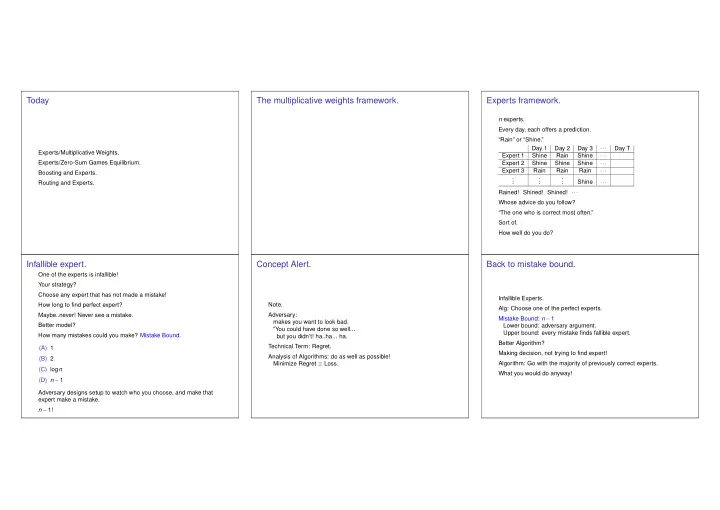
n experts. Every day, each offers a prediction. “Rain” or “Shine.” Day 1 Day 2 Day 3 ··· Day T Expert 1 Shine Rain Shine ··· Expert 2 Shine Shine Shine ··· Expert 3 Rain Rain Rain ··· . . . . . . . . . Shine ··· Rained! Shined! Shined! ··· Whose advice do you follow? “The one who is correct most often.” Sort of. How well do you do?
Infallible expert.
One of the experts is infallible! Your strategy? Choose any expert that has not made a mistake! How long to find perfect expert? Maybe..never! Never see a mistake. Better model? How many mistakes could you make? Mistake Bound. (A) 1 (B) 2 (C) logn (D) n −1 Adversary designs setup to watch who you choose, and make that expert make a mistake. n −1!
Concept Alert.
Note. Adversary: makes you want to look bad. ”You could have done so well... but you didn’t! ha..ha... ha. Technical Term: Regret. Analysis of Algorithms: do as well as possible! Minimize Regret ≡ Loss.
Back to mistake bound.
Infallible Experts. Alg: Choose one of the perfect experts. Mistake Bound: n −1 Lower bound: adversary argument. Upper bound: every mistake finds fallible expert. Better Algorithm? Making decision, not trying to find expert! Algorithm: Go with the majority of previously correct experts. What you would do anyway!
SLIDE 2 Alg 2: find majority of the perfect
How many mistakes could you make? (A) 1 (B) 2 (C) logn (D) n −1 At most logn! When alg makes a mistake, |“perfect” experts| drops by a factor of two. Initially n perfect experts mistake → ≤ n/2 perfect experts mistake → ≤ n/4 perfect experts . . . mistake → ≤ 1 perfect expert ≥ 1 perfect expert → at most logn mistakes!
Imperfect Experts
Goal? Do as well as the best expert!
Go with majority? Penalize inaccurate experts? Best expert is penalized the least.
- 1. Initially: wi = 1.
- 2. Predict with weighted majority of experts.
- 3. wi → wi/2 if wrong.
Analysis: weighted majority
- 1. Initially: wi = 1.
- 2. Predict with
weighted majority of experts.
wrong. Goal: Best expert makes m mistakes. Potential function: ∑i wi. Initially n. For best expert, b, wb ≥
1 2m .
Each mistake: total weight of incorrect experts reduced by −1? −2? factor of 1
2?
each incorrect expert weight multiplied by 1
2!
total weight decreases by factor of 1
2? factor of 3 4?
mistake → ≥ half weight with incorrect experts (≥ 1
2 total.
Mistake → potential function decreased by 3
4.
We have
1 2m ≤ ∑i wi ≤
3
4
M n. where M is number of algorithm mistakes.
Analysis: continued.
1 2m ≤ ∑i wi ≤
3
4
M n. m - best expert mistakes M algorithm mistakes.
1 2m ≤
3
4
M n. Take log of both sides. −m ≤ −M log(4/3)+logn. Solve for M. M ≤ (m +logn)/log(4/3) ≤ 2.4(m +logn) Multiply by 1−ε for incorrect experts... (1−ε)m ≤
2
M n. Massage... M ≤ 2(1+ε)m + 2lnn
ε
Approaches a factor of two of best expert performance!
Best Analysis?
Consider two experts: A,B Bad example? Which is worse? (A) A correct even days, B correct odd days (B) A correct first half of days, B correct second Best expert peformance: T/2 mistakes. Pattern (A): T −1 mistakes. Factor of (almost) two worse!
Randomization!!!!
Better approach? Use? Randomization! That is, choose expert i with prob ∝ wi Bad example: A,B,A,B,A... After a bit, A and B make nearly the same number of mistakes. Choose each with approximately the same probabilty. Make a mistake around 1/2 of the time. Best expert makes T/2 mistakes. Roughly optimal!
SLIDE 3 Randomized analysis.
Some formulas: For ε ≤ 1,x ∈ [0,1], (1+ε)x ≤ (1+εx) (1−ε)x ≤ (1−εx) For ε ∈ [0, 1
2],
−ε −ε2 ≤ ln(1−ε) ≤ −ε ε −ε2 ≤ ln(1+ε) ≤ ε Proof Idea: ln(1+x) = x − x2
2 + x3 3 −···
Randomized algorithm
Expert i loses ℓt
i ∈ [0,1] in round t.
- 1. Initially wi = 1 for expert i.
- 2. Choose expert i with prob wi
W , W = ∑i wi.
i
W(t) sum of wi at time t. W(0) = n Best expert, b, loses L∗ total. → W(T) ≥ wb ≥ (1−ε)L∗. Lt = ∑i
wiℓt
i
W expected loss of alg. in time t.
Claim: W(t +1) ≤ W(t)(1−εLt) Loss → weight loss. Proof: W(t +1) = ∑
i
(1−ε)ℓt
i wi ≤ ∑
i
(1−εℓt
i )wi
= ∑
i
wi −ε∑
i
wiℓt
i
= ∑
i
wi
i
∑i wi
W(t)(1−εLt)
Analysis
(1−ε)L∗ ≤ W(T) ≤ n ∏t(1−εLt) Take logs (L∗)ln(1−ε) ≤ lnn +∑ln(1−εLt) Use −ε −ε2 ≤ ln(1−ε) ≤ −ε −(L∗)(ε +ε2) ≤ lnn −ε ∑Lt And ∑t Lt ≤ (1+ε)L∗ + lnn
ε .
∑t Lt is total expected loss of algorithm. Within (1+ε) ish of the best expert! No factor of 2 loss!
Gains.
Why so negative? Each day, each expert gives gain in [0,1]. Multiplicative weights with (1+ε)gt
i .
G ≥ (1−ε)G∗ − logn ε where G∗ is payoff of best expert. Scaling: Not [0,1], say [0,ρ]. L ≤ (1+ε)L∗ + ρ logn ε
Summary: multiplicative weights.
Framework: n experts, each loses different amount every day. Perfect Expert: logn mistakes. Imperfect Expert: best makes m mistakes. Deterministic Strategy: 2(1+ε)m + logn
ε
Real numbered losses: Best loses L∗ total. Randomized Strategy: (1+ε)L∗ + logn
ε
Strategy: Choose proportional to weights multiply weight by (1−ε)loss. Multiplicative weights framework! Applications next!
Two person zero sum games.
m ×n payoff matrix A. Row mixed strategy: x = (x1,...,xm). Column mixed strategy: y = (y1,...,yn). Payoff for strategy pair (x,y): p(x,y) = xtAy That is,
∑
i
xi
j
ai,jyj
j
i
xiai,j
Recall row minimizes, column maximizes. Equilibrium pair: (x∗,y∗)? (x∗)tAy∗ = max
y (x∗)tAy = min x xtAy∗.
(No better column strategy, no better row strategy.)
SLIDE 4 Equilibrium.
Equilibrium pair: (x∗,y∗)? p(x,y) = (x∗)tAy∗ = max
y (x∗)tAy = min x xtAy∗.
(No better column strategy, no better row strategy.) No row is better: mini A(i) ·y = (x∗)tAy∗. 1 No column is better: maxj(At)(j) ·x = (x∗)tAy∗.
1A(i) is ith row.
Best Response
Column goes first: Find y, where best row is not too low.. R = max
y
min
x (xtAy).
Note: x can be (0,0,...,1,...0). Example: Roshambo. Value of R? Row goes first: Find x, where best column is not high. C = min
x max y (xtAy).
Agin: y of form (0,0,...,1,...0). Example: Roshambo. Value of C?
Duality.
R = max
y
min
x (xtAy).
C = min
x max y (xtAy).
Weak Duality: R ≤ C. Proof: Better to go second. At Equilibrium (x∗,y∗), payoff v: row payoffs (Ay∗) all ≥ v = ⇒ R ≥ v. column payoffs ((x∗)tA) all ≤ v = ⇒ v ≥ C. = ⇒ R ≥ C Equilibrium = ⇒ R = C! Strong Duality: There is an equilibrium point! and R = C! Doesn’t matter who plays first!
Proof of Equilibrium.
- Later. Well in just a minute.....
Aproximate equilibrium ... C(x) = maxy xtAy R(y) = minx xtAy Always: R(y) ≤ C(x) Strategy pair: (x,y) Equilibrium: (x,y) R(y) = C(x) → C(x)−R(y) = 0. Approximate Equilibrium: C(x)−R(y) ≤ ε. With R(y) < C(x) → “Response y to x is within ε of best response” → “Response x to y is within ε of best response”
Proof of approximate equilibrium.
How? (A) Using geometry. (B) Using a fixed point theorem. (C) Using multiplicative weights. (D) By the skin of my teeth. (C) ..and (D). Not hard. Even easy. Still, head scratching happens.
Games and experts
Again: find (x∗,y∗), such that (maxy x∗Ay)−(minx x∗Ay∗) ≤ ε C(x∗) − R(y∗) ≤ ε ——————————————————————– Experts Framework: n Experts, T days, L∗ -total loss of best expert. Multiplicative Weights Method yields loss L where L ≤ (1+ε)L∗ + logn
ε
SLIDE 5
Games and Experts.
Assume: A has payoffs in [0,1]. For T = logn
ε2
days: 1) m pure row strategies are experts. Use multiplicative weights, produce row distribution. Let xt be distribution (row strategy) on day t. 2) Each day, adversary plays best column response to xt. Choose column of A that maximizes row’s expected loss. Let yt be indicator vector for this column.
Approximate Equilibrium!
Experts: xt is strategy on day t, yt is best column against xt. Let y∗ = 1
T ∑t yt and x∗ = argminxt xtAyt.
Claim: (x∗,y∗) are 2ε-optimal for matrix A. Column payoff: C(x∗) = maxy x∗Ay. Loss on day t, xtAyt ≥ C(x∗) by the choice of x∗ . Thus, algorithm loss, L, is ≥ T ×C(x∗). Best expert: L∗- best row against all the columns played. best row against ∑t Ayt and T ×y∗ = ∑t yt → best row against T ×Ay∗. → L∗ ≤ T ×R(y∗). Multiplicative Weights: L ≤ (1+ε)L∗ + lnn
ε
T ×C(x∗) ≤ (1+ε)T ×R(y∗)+ lnn
ε
→ C(x∗) ≤ (1+ε)R(y∗)+ lnn
εT
→ C(x∗)−R(y∗) ≤ εR(y∗)+ lnn
εT .
T = lnn
ε2 , R(y∗) ≤ 1
→ C(x∗)−R(y∗) ≤ 2ε.
Approximate Equilibrium: slightly different!
Experts: xt is strategy on day t, yt is best column against xt. Let x∗ = 1
T ∑t xt and y∗ = 1 T ∑t yt.
Claim: (x∗,y∗) are 2ε-optimal for matrix A. Column payoff: C(x∗) = maxy x∗Ay. Let yr be best response to C(x∗). Day t, xtAyt ≥ xtAyr – yt is best response to xt. Algorithm loss: ∑t xtAyt ≥ ∑t xtAyr L ≥ T ×C(x∗). Best expert: L∗- best row against all the columns played. best row against ∑t Ayt and Ty∗ = ∑t yt → best row against TAy∗. → L∗ ≤ T ×R(y∗). Multiplicative Weights: L ≤ (1+ε)L∗ + lnn
ε
TC(x∗) ≤ (1+ε)TR(y∗)+ lnn
ε
→ C(x∗) ≤ (1+ε)R(y∗)+ lnn
εT
→ C(x∗)−R(y∗) ≤ εR(y∗)+ lnn
εT .
T = lnn
ε2 , R(y∗) ≤ 1 → C(x∗)−R(y∗) ≤ 2ε.
Comments
For any ε, there exists an ε-Approximate Equilibrium. Does an equilibrium exist? Yes. Something about math here? Limit of a sequence on some closed set..hmmm.. Later: will use geometry, linear programming. Complexity? T = lnn
ε2 → O(nm logn ε2 ). Basically linear!
Versus Linear Programming: O(n3m) Basically quadratic. (Faster linear programming: O(√n +m) linear system solves.) Still much slower ... and more complicated. Dynamics: best response, update weight, best response. Also works with both using multiplicative weights. “In practice.” Homework 2 out this week. See you on Thursday.