Injunctive Relief in Environmental Litigation: Leveraging Recent - - PowerPoint PPT Presentation

injunctive relief in environmental litigation leveraging
SMART_READER_LITE
LIVE PREVIEW

Injunctive Relief in Environmental Litigation: Leveraging Recent - - PowerPoint PPT Presentation

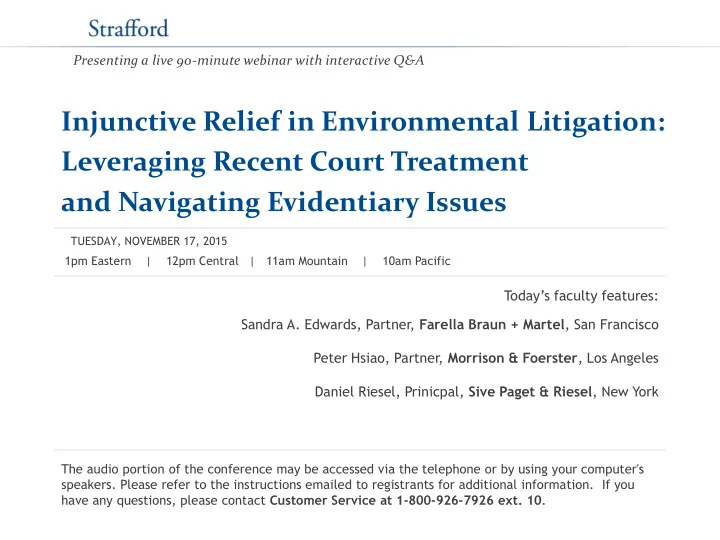
Presenting a live 90-minute webinar with interactive Q&A Injunctive Relief in Environmental Litigation: Leveraging Recent Court Treatment and Navigating Evidentiary Issues TUESDAY, NOVEMBER 17, 2015 1pm Eastern | 12pm Central |


slide-1
SLIDE 1

The audio portion of the conference may be accessed via the telephone or by using your computer's

  • speakers. Please refer to the instructions emailed to registrants for additional information. If you

have any questions, please contact Customer Service at 1-800-926-7926 ext. 10.

Presenting a live 90-minute webinar with interactive Q&A

Injunctive Relief in Environmental Litigation: Leveraging Recent Court Treatment and Navigating Evidentiary Issues

Today’s faculty features:

1pm Eastern | 12pm Central | 11am Mountain | 10am Pacific TUESDAY, NOVEMBER 17, 2015

Sandra A. Edwards, Partner, Farella Braun + Martel, San Francisco Peter Hsiao, Partner, Morrison & Foerster, Los Angeles Daniel Riesel, Prinicpal, Sive Paget & Riesel, New York

slide-2
SLIDE 2

Tips for Optimal Quality

Sound Quality If you are listening via your computer speakers, please note that the quality

  • f your sound will vary depending on the speed and quality of your internet

connection. If the sound quality is not satisfactory, you may listen via the phone: dial 1-866-755-4350 and enter your PIN when prompted. Otherwise, please send us a chat or e-mail sound@straffordpub.com immediately so we can address the problem. If you dialed in and have any difficulties during the call, press *0 for assistance. Viewing Quality To maximize your screen, press the F11 key on your keyboard. To exit full screen, press the F11 key again.

FOR LIVE EVENT ONLY

slide-3
SLIDE 3

Continuing Education Credits

In order for us to process your continuing education credit, you must confirm your participation in this webinar by completing and submitting the Attendance Affirmation/Evaluation after the webinar. A link to the Attendance Affirmation/Evaluation will be in the thank you email that you will receive immediately following the program. For additional information about continuing education, call us at 1-800-926-7926

  • ext. 35.

FOR LIVE EVENT ONLY

slide-4
SLIDE 4

Program Materials

If you have not printed the conference materials for this program, please complete the following steps:

  • Click on the ^ symbol next to “Conference Materials” in the middle of the left-

hand column on your screen.

  • Click on the tab labeled “Handouts” that appears, and there you will see a

PDF of the slides for today's program.

  • Double click on the PDF and a separate page will open.
  • Print the slides by clicking on the printer icon.

FOR LIVE EVENT ONLY

slide-5
SLIDE 5

Introduction

5

slide-6
SLIDE 6

Introduction to Cottonwood Environmental Law Center v. U.S. Forest Service (9th Cir. 2015)

6

slide-7
SLIDE 7

Cottonwood Decision: Underlying Facts

Cottonwood Environmental Law Center v. U.S. Forest Service, 789 F .3d 1075 (9th

  • Cir. 2015)
  • In 2000, U.S. FWS listed Canadian lynx as threatened species
  • In 2006, U.S. FWS designated 1,841 sq miles as critical habitat
  • In 2007, Forest Service adopted management plans for lynx
  • Forest Service initiated Section 7 consultation with FWS
  • FWS issued biological opinion in 3/2007

― Forest Service management plan did not jeapardize lynx

  • Four months later, FWS announced critical habitat designation “improperly

influenced” by DOI official

7

slide-8
SLIDE 8

Cottonwood Decision: Underlying Facts

Cottonwood Environmental Law Center v. U.S. Forest Service, 789 F .3d 1075 (9th

  • Cir. 2015)
  • 2009, FWS revised critical habitat designation to 39,000 sq miles

― Critical habitat in 11 National Forests

  • Forest Service declined to reinitiate Section 7 consultation
  • FWS issued biological opinion that two projects within Gallatin Forest unlikely

to adversely affect critical habitat

8

slide-9
SLIDE 9

Cottonwood Decision: Procedural History

  • CELC filed suit: Forest Service violated ESA by failing to reinitiate

consultation

  • District Court: revised designation required reinitiation of Section 7

consultation ― Granted summary judgment for CELC ― Ordered reinitiation of consultation ― Declined to enjoin any specific project

9

slide-10
SLIDE 10

Cottonwood Decision: Ruling

Ninth Circuit Affirmed:

  • “There is nothing in the ESA that explicitly, ‘or by a necessary and

inescapable inference,’ restricts a court’s discretion to decide whether a plaintiff has suffered irreparable injury.”

  • No presumption of irreparable injury where there has been a procedural

violation in ESA cases. “A plaintiff must show irreparable injury to justify injunctive relief.”

10

slide-11
SLIDE 11

Cottonwood Decision: Impact

Court declined to follow nearly thirty-years of precedent that relieves plaintiffs of traditional burden of establishing irreparable harm when seeking injunctive relief to remedy a procedural violation of the ESA.

11

slide-12
SLIDE 12

Context - Injunctions in Environmental Cases

12

slide-13
SLIDE 13

Introduction

  • Injunctive relief, including preliminary injunctions and interlocutory

injunctions, plays a key role in environmental litigation

  • Injunctive relief is primarily sought by government and

environmental groups

  • Although injunctive relief is rooted in common law principles of

equity, several environmental statutes explicitly provide for injunctive relief

13

slide-14
SLIDE 14

Introduction

  • Examining interlocutory injunctive relief in the context of

environmental litigation is appropriate because certain procedural elements of this remedy receive unique treatment in the environmental context.

  • A reason for this treatment could be that interlocutory relief touches

a fundamental aspect of environmental law, the tension between procedural fairness and the protection of the public from unreasonable risks. Compare Reserve Mining Co. v. EPA, 514 F .2d 492 (8th Cir. 1975) (en banc) with United States v. Rielly Tar & Chem. Corp., 546 F . Supp. 1100 (D. Minn. 1982).

14

slide-15
SLIDE 15

Clean Water Act

  • Section 309(b) of the Federal Water Pollution Control Act, 33 U.S.C. §

1319(b), P .L. 92-500, § 2, authorizes "[t]he Administra-tor . . . to commence a civil action for appropriate relief including a permanent

  • r temporary injunction . . . ."
  • Section 504 provides for injunctive relief in situations of “imminent

and substantial endangerment

15

slide-16
SLIDE 16

Clean Air Act

  • Section 113(b) of the Clean Air Act, 42 U.S.C. § 7413(b), P

.L. 91-604, § 4(a), as amended by P .L. 95-95, § 111(b), (c), specifically provides "[t]he Adminis-trator shall . . . and may . . . commence a civil action for a permanent or temporary injunction . . . ."

  • Section 303 provides for injunctive relief in situations of “imminent

and substantial endangerment

16

slide-17
SLIDE 17

Citizen Suit Provisions

  • Federal environmental statutes provide for citizen suits, allowing

private individuals, business entities and public interest groups to bring suits against the government or violators of specific statutory

  • provisions. See, e.g., Section 304 of the Clean Air Act, 42 U.S.C. §

7604; Section 505 of the Federal Water Pollution Control Act, 33 U.S.C. § 1365.

  • As a result, environmental groups often also seek injunctive relief

17

slide-18
SLIDE 18

Targets of Injunctions

  • These provisions have provided a fertile basis for suits which include

applications for interlocutory relief against the government as well as private entities. See TVA v. Hill, 437 U.S. 153 (1978); Wuillamey v. Werblin, 364 F . Supp. 237 (D.N.J. 1973); Sierra Club v. Ruckelshaus, 344 F . Supp. 253 (D.D.C. 1972).

  • Members of the regulated community have also utilized this

interlocutory remedy to frustrate governmental action. See, e.g., Industrial Park Dev. v. EPA, 604 F . Supp. 1136 (E.D. Pa. 1985).

18

slide-19
SLIDE 19

Analysis – What is the effect of Cottonwood on the law of environmental injunctions?

19

slide-20
SLIDE 20

Practical Tips

20

slide-21
SLIDE 21

INJUNCTION STANDARDS

Four-factor test for plaintiff by showing:

  • has suffered an irreparable injury;
  • remedies available at law, such as monetary damages, are inadequate to

compensate;

  • considering balance of hardships between plaintiff and defendants, a remedy

in equity is warranted; and

  • public interest would not be disserved by a permanent injunction.

[eBay, Inc. v. MercExchange, L.L.C., 547 U.S. 388 (2006)]

21

slide-22
SLIDE 22

INJUNCTION STANDARDS

  • Thomas v. Peterson, 753 F

.2d 754, 764 (9th Cir. 1985) (applying NEPA exception to traditional test to ESA cases; irreparable damage presumed to flow from procedural violation) “It is not the responsibility of the plaintiffs to prove, nor the function of the courts to judge, the effect of a proposed action on an endangered species when proper procedures have not been followed.”

22

slide-23
SLIDE 23

INJUNCTION STANDARDS

  • Winter v. NRDC, 555 U.S. 7, 22 (2008) (rejecting 9th Cir. test

for preliminary injunctions under NEPA)

  • Monsanto v. Geertson Seed Farms, 561 U.S. 139, 157 (2010)

(improper to “presume an injunction is the proper remedy for a NEPA violation except in unusual circumstances”)

23

slide-24
SLIDE 24

Defensive Tactics In Preliminary Injunction Proceedings

  • Roadmap of topics:
  • A. 1. On whose side is time?

B.

  • 2. Movant’s delay in seeking an injunction
  • C. 3. Litigating factual uncertainty
  • D. 4. Litigating the legal standard for injunctive relief

E.

  • 5. Bonds or other security for the injunction

F.

  • 6. Consolidation of the hearing with trial on merits
  • G. 7. Interlocutory appeal
  • H. 8. Litigate the required findings

24

slide-25
SLIDE 25
  • 1. On whose side is time?
  • From a tactical standpoint this is often the crucial question
  • The Respondent’s practical burden is increased when a Movant seeks

a TRO pending an accelerated hearing on a motion for a preliminary injunction

  • Purchasing time by a partial or full stipulation
  • A. Stay until decision

B. Stay until hearing

  • Agreement to accelerated discovery and trial

25

slide-26
SLIDE 26
  • 2. Movant’s delay in seeking an injunction
  • Where a movant does not immediately seek an injunction upon

gaining knowledge of the condition purportedly posing a risk of imminent harm, a respondent should take advantage of the lapse in time

26

slide-27
SLIDE 27
  • 3. Litigating factual uncertainty
  • Inaccuracies in the moving papers
  • Opposing affidavits
  • Demand for a hearing
  • Appear at application hearing with witnesses prepared to testify
  • Interim discovery pending hearing
  • Movant may seek interim discovery to “facilitate” hearing; no reason why

respondent can’t seek similar relief if there is a claim of significant inaccuracy A. (i) demand for documents B. (ii) deposition C. (iii) Discovery can go to the merits but also the elapsed time between notice of alleged injury and the commencement of action

27

slide-28
SLIDE 28
  • 4. Litigating the legal standard for injunctive relief
  • Roadmap of topics (Winter v. Natural Resources Defense Council, 555

U.S. 7 (2008))

  • A. Irreparable injury

B. Success on the merits

  • C. Balance of hardships
  • D. Public interest

E. Standing

28

slide-29
SLIDE 29
  • A. Irreparable injury
  • Injury that cannot be compensated for by money at end of case.
  • Does the nature of the underlying action alter the Movant’s burden?
  • A. ESA: Cottonwood Environmental Law Center v. United States

Forest Service,et ano. U.S. Docket No 13-35624 (June 17, 2015); Weinberger v. Romero-Barcello, 456 U.S. 305 (1987) B. RCRA: Imminent and Substantial Endangerment

  • C. NEPA: Commitment of irretrievable resources
  • D. CAA and CWA: Provisions for interlocutory injunctive relief (do

they work?)

29

slide-30
SLIDE 30
  • A. Irreparable injury
  • Some courts have held that the provisions in the CWA and CAA which

authorize preliminary injunctions operate to remove the requirement for demonstrating irreparable injury in enforcement cases

  • A. See e.g. United States v. City of Painesville, Ohio, 644 F

.2d 1186, 1194 (6th Cir. 1981) (dispensing with irreparable harm requirement in CAA enforcement case)

  • However, recent case law suggests a movement towards re-

establishing a requirement for demonstrating irreparable harm

  • A. See e.g. Cottonwood Environmental Law Center v. United States

Forest Service,et ano. U.S. Docket No 13-35624 (June 17, 2015); Weinberger v. Romero-Barcello, 456 U.S. 305 (1987)

30

slide-31
SLIDE 31
  • B. Success on the merits
  • Some Courts have lessened the Movant’s burden by requiring only a

fair question for litigation

31

slide-32
SLIDE 32
  • C. Balance of hardships / Public interest
  • This is a balancing test between the needs of the Movant and the

public interest (as opposed to the interests of the Respondent).

  • It is often a telling makeweight argument

32

slide-33
SLIDE 33
  • D. Standing
  • Can be tested on pleadings or on an evidentiary basis

33

slide-34
SLIDE 34
  • 5. Security for damages
  • Substantial body of law holding that if Movant is pursuing the public

interest that real bond or other security will be dispensed with, despite the rule to the contrary

  • Evidence of damages
  • A. Significant damages resulting from delay if injunctive relief is

granted. B. Loss of opportunity

  • Lack of Plaintiff’s pro bono public status

34

slide-35
SLIDE 35
  • 6. Consolidation of hearing with trial on merits
  • Rule 65(a)(2), Fed.R.Civ.P

.

  • Wouldn’t work where there is a jury demand

35

slide-36
SLIDE 36
  • 7. Interlocutory appeal
  • An exception to the Federal Rule against interim appeals
  • Mark up the papers and go upstairs
  • A stay of the Order may be obtained from the Clerk

36

slide-37
SLIDE 37
  • 8. Litigate the required findings
  • A mini-hearing will be involved in the required findings and hearings
  • This provides a further opportunity for defensive litigation

37

slide-38
SLIDE 38

Question & Answers

38

Sandra A. Edwards sedwards@fbm.com Peter Hsiao phsiao@mofo.com Daniel Riesel driesel@sprlaw.com