
SLIDE 1
RC2 RELIEF TOOL
OVERVIEW PRESENTATION
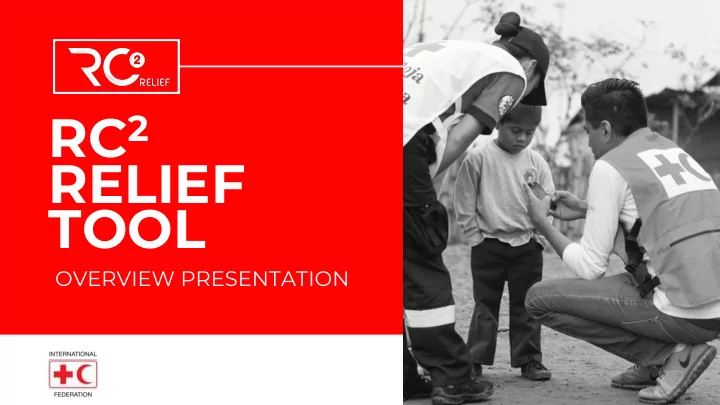
RELIEF TOOL OVERVIEW PRESENTATION OVERVIEW The RC2 Relief Tool is - - PowerPoint PPT Presentation
RC 2 RELIEF TOOL OVERVIEW PRESENTATION OVERVIEW The RC2 Relief Tool is a customized application built on the ODK-X Tool Suite. It facilitates the collection, storage, analysis, and visualization of data more quickly and efficiently. This
OVERVIEW PRESENTATION
The RC2 Relief Tool is a customized application built on the ODK-X Tool
storage, analysis, and visualization
This increases the effectiveness of field workers and thus, improves humanitarian interventions.
RC2 Relief improves relief cycle processes from emergency assessment through to distribution, reporting, and monitoring. Adaptable for a variety of humanitarian contexts including cash transfer programming and the distribution of relief items.
RC2 Relief Tool is applicable to many scenarios:
(e.g., serving a meal)
with criteria based on delivery of relief items.
“Beneficiary Entities” (e.g., households)
rebuilding programs
DOWNLOAD
The volunteer downloads the application
DATA COLLECTION
Field workers collect, update, or verify information from people who may receive assistance, all without the need for an internet connection.
DATA ANALYSIS
“Relief Officer” uses RC2 Relief modules to facilitate the management and analysis of the collected information.
DECISION MAKING
The analysis supports data-driven decision making for the planning and distribution of humanitarian aid.
Streamlines the collection and use
though bidirectional synchronization
User profiles aligned with the structure of the
control access to increase data security and privacy for the assisted people. The mobile application can store data on past assistance, without the need for an Internet connection. The ability to custom workflows based
conditions reduces errors and data duplication.
Improves efficiency of field workers, allowing more people to be reached in situations with limited resources. Facilitates accountability through improved record-keeping. Adaptable for a variety of humanitarian contexts including cash transfer programming and the distribution of relief items.
It is an open-source suite of tools that helps organizations create, administer, and manage mobile data collection solutions. ODK-X had an iterative requirements gathering process:
by a variety of organizations,
significant redesign from the original ODK-X vision
To validate the derived requirements, ODK-X has been tested in 6 case studies.
Childhood Pneumonia Chimpanzee Behavior Tracking HIV Clinical Trial Disaster Response / RC2 Relief Mosquito Infection Tracking Tuberculosis Patient Records Complex/Non-Linear Workflows X X X X X Link Longitudinal Data to Collected Data X X X X X Data Security and Use Permissions X X X X X Reuse of Data Fields Across Forms X X Bidirectional Synchronization X X X X X Customizable Form Presentation X X X Custom JavaScript Apps X X X X X Sensor Integration X Paper Digitization X Custom Data Type Update Multiple Fields in a Single User Action X X X X
CASE STUDY ODK-X FEATURE REQUIREMENT SUMMARY
SETUP MODULE DOWNLOAD MODULE
DISTRIBUTION
PLANNING ANDROID APP
MOBILE PC
Setup – Select the Relief Tool “Mode” and specify data to be collected for Registration. Download – Downloads data from
looking for data integrity issues. It generates CSVs to be used by modules. Distribution Planning – Used by “Relief Officer/Coordinator” to plan Distributions and Visit Programs. It also provides basic reporting functionality. Mobile App – Used by field workers to
register, visit, and deliver supplies to beneficiaries
Desktop Mobile External process
IM OFFICER RELIEF OFFICER FIELD
SUPERVISOR
FIELD WORKER
modules to configure RC2 Relief Tool.
“business” logic for the ODK-X Tool Suite
pipeline of smaller processing steps to enable National Organizations to customize their business logic.
connectivity is available
based on permissions
model
15
To support flexibility during deployments, where rule enforcement may need to be “overridden” Example Abilities:
filters)
connectivity
16
A design priority was making the RC2 Relief tool flexible so National Societies could customize RC2 Relief based on their available resources Modular design for changes to “disaster distribution pipelines.”
customize or share their forms and templates
human customization in the field
based on the needs of the disaster response or other field conditions can easily introduced
business logic while still remaining compatible with the rest of the application
standard user/groups providers. Examples are LDAP, ActiveX, etc.
limited with private networks created isolating the database from the public Internet.
TYPE OF WORKFLOW
REGISTRATION ONLY
DISTRIBUTION WITHOUT REGISTRATION
DISTRIBUTION WITH OPTIONAL REGISTRATION
DISTRIBUTION WITH REQUIRED REGISTRATION
DISTRIBUTION WITH ID ONLY
DISTRIBUTION WITH EXTRA FIELD ENTITLEMENTS
RUNNING A VISIT
DISTRIBUTION WITH DATA CAPTURED THROUGH A VISIT
https://media.ifrc.org/ifrc/rc2-relief-tool/
payment systems
improvements to meet standards
improve performance in challenged network environments
March 2020
CONTACT INFORMATION
Innovation Team Policy, Strategy and Knowledge Department International Federation of Red Cross and Red Crescent Societies Americas Regional office E-mail: innovation.americas@ifrc.org