SLIDE 1
Dutch Relief Alliance (DRA)
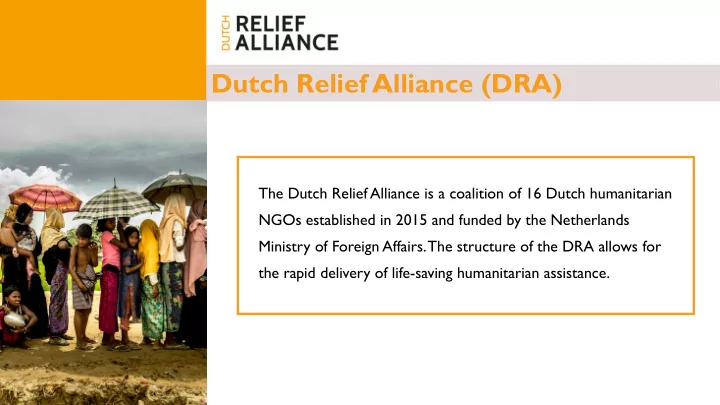
The Dutch Relief Alliance is a coalition of 16 Dutch humanitarian NGOs established in 2015 and funded by the Netherlands Ministry of Foreign Affairs. The structure of the DRA allows for the rapid delivery of life-saving humanitarian assistance.
SLIDE 2
Results:
€202 million: 12 million people in 17 countries Joint responses 2 mechanism : acute : max 6 months) protracted : 1 year - multi- annual
SLIDE 3 After WHS - interested DRA members ( esp Oxfam, Cordaid – ICCO) set up a localisation task force within DRA:
- Compiled a vision document on localisation ( it is
not limited to capacity building only)
- Supported discussion within DRA on localisation (
especially with member-implementors)
- Dialogue between MOFA & DRA on GB- group
input provided - > inclusion in strategy
2016-2017
SLIDE 4 I. More accountable humanitarian action II. Innovation and learning
- III. Collaboration for increased effectiveness
- IV. More effective support for locally-led responses
Strategic priorities 2018-2021
SLIDE 5
Localisation objectives strategic plan DRA 2020 FUNDING At least 25% of DRA funding will flow as directly as possible to local actors by the end of 2019 and by the end of the strategic period the DRA will aim for 35%. The DRA will focus on minimising transaction costs and ensuring funds flow as directly as possible to local actors in line with Grand Bargain commitments, whilst maintaining quality, strong risk management structures and accountability mechanisms.
SLIDE 6
Localisation objectives strategic plan DRA 2018-2021
Capacity strengthening:
Local actors will be more strongly supported through capacity strengthening enabling effective and accountable humanitarian action. The DRA will aim for 5% to 8% of Joint Response budgets to be related to strengthening the capacity of local actors by 2021.
SLIDE 7 Localisation objectives strategic plan DRA 2018-2021 Partnerships Better partnerships with local actors in conflicts
- context. The DRA will continue to innovate around
ways to support partners in conflicts through remote management and monitoring and negotiating and maintaining access. Amplifying local voices The DRA will serve to amplify the voice and capacity
- f local actors in international fora, coordination
systems and with other donors.
SLIDE 8 Localisation working group start 2018 7 members participate – 2 co-chairs, budget Action 1: baseline
- Analysis joint response proposals and budgets
2018 with KUNO (Dutch humanitarian knowledge platform)
- Interviews ( standard questions) with leads of
joint responses by WG members for more in depth understanding, practices, challenges in joint reponses
SLIDE 9 Baseline 2018
- from 19% in 2017 to 23% of funding to local
- rganizations. Aim is 35% by 2021.
- from 1.7% in 2017 to 1.9% in 2018. Aim is 5-
8% by 2021.
- Qualitative approach: context analyses
need more attention.
- Focus on sub-contracting local NGOs, less
- n other actors.
SLIDE 10 Localisation working group start 2018 Action: shared understanding develop a 4 pager to get shared understanding Action : strategic collaboration MOFA discussion with MOFA – how can we work more strategically on localisation
- pportunity: localisation is not main a priority, but
MOFA focusses on supporting DRA and report DRA results in their GB reporting. Joint advocacy opportunities (pooled funds) recognised but referred to embassy level.
SLIDE 11 Localisation working group Action involving local partners more
- Stress partners to be involved in all planning and
designing workshops -> is happening
- Launch ideas on co-leading of joint responses int-
local actor and direct funding in JR → DRA set up is not enabling
- set up advisory group of local partners: request of
interest set out –> not overwhelming response, needs more attention
SLIDE 12 Localisation working group Learnings & good practices:
- Foundation: taken time for dialogue to come to
shared vision and how different members can contribute even if they do not work with local partners (inclusiveness of self-implementing INGO members).
- Strategic priority in DRA strategy 2018- 2021 ->very
helpful, members can not ignore.
- Learning by doing, less focus on lengthy discussions.
- Budget for people that can spend time (co-chairs
working group).
SLIDE 13 Localisation working group Learnings & good practices:
- Baseline: what is really going on → real picture (not
bla bla), but also ideas , challenges, good practices that can be build on.
- Track progress: yearly analysis by KUNO.
- Local actors involved in all stages of Project Cycle
(from planning workshops to evaluations).
- Localization plans developed in 3 JRs: local actors
taking initiative.
- Inspiring instead of increasing the burden, no
additional requirements.
SLIDE 14 Localisation working group Opportunities / way forward:
- Link with innovation (data transparency, comparative
advantage of local partners in cash as modality).
- Joint advocacy needs attention.
- Local advisory group to be established.
- Ownership of Localization to the JR countries.
- Country specific support: internet in Nigeria, link
with national NGO fora, Localization as exit strategy, peer reviews between local and international NGOs, more emphasis on locally pooled funding (e.g. ‘own’ DRA local fund), co-lead of local partners.
SLIDE 15
Thank you for your attention!