Levels of quality versus achieved standards There is little - - PDF document

levels of quality versus achieved standards
SMART_READER_LITE
LIVE PREVIEW

Levels of quality versus achieved standards There is little - - PDF document

Learning Skills and Universal Services Liz Bradley, EYFS Improvement Manager, 0-11 Improvement Team Question: The attainm ent gap in Leeds 1. Do we have any information by ward/ SOA or Cluster which highlights where the biggest gaps are in the


slide-1
SLIDE 1

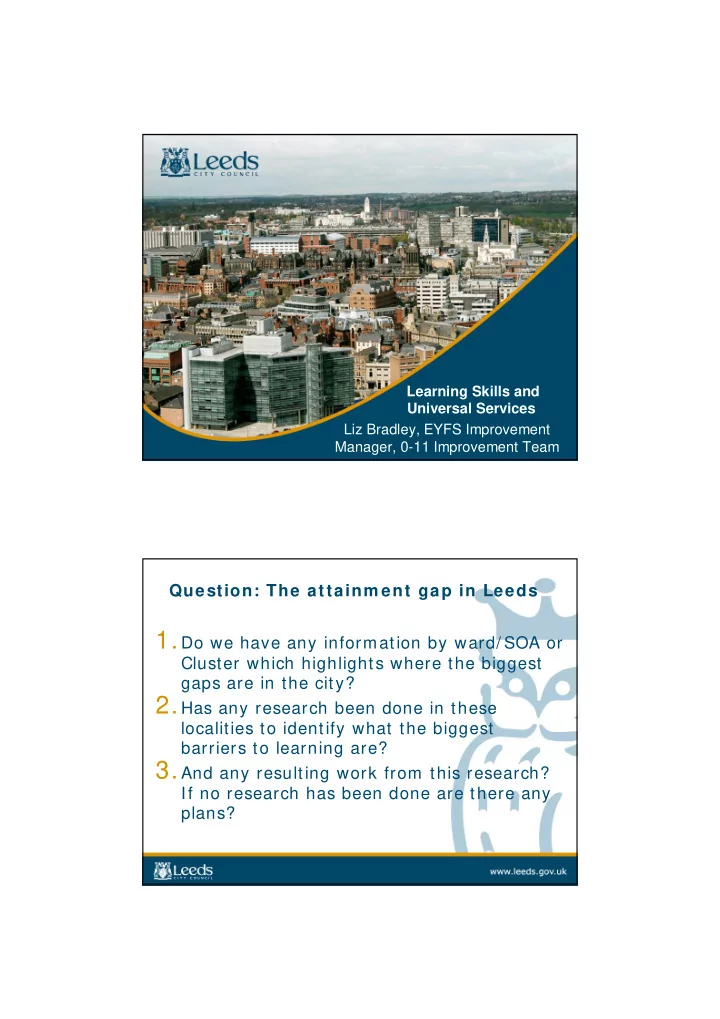
Learning Skills and Universal Services Liz Bradley, EYFS Improvement Manager, 0-11 Improvement Team

  • 1. Do we have any information by ward/ SOA or

Cluster which highlights where the biggest gaps are in the city?

  • 2. Has any research been done in these

localities to identify what the biggest barriers to learning are?

  • 3. And any resulting work from this research?

If no research has been done are there any plans? Question: The attainm ent gap in Leeds

slide-2
SLIDE 2

Levels of quality versus achieved standards

There is little continuity between the percent of early years settings rated good or excellent and the outcomes of children’s development in primary schools. In Leeds, 65% of childminders and 73% childcare settings are rated good or excellent, while only 63% of children achieve a good level of development at age 5. This pattern is exhibited across the country, whereby almost all good or excellent settings are not reflected in the percent

  • f children achieving good development for the same area.

31.9 30.1

33.6

32.7 31.4 35.0 33.2 32.7 35.7 Low Achievers gap** 63 64

63

60 59 58 57 56 53 % Good Level of

Development*

Stat Neigh * Nat Leeds Stat Neigh * Nat Leeds Stat Neigh * Nat Leeds 2012 2011 2010

EYFS Profile outcom es 2 0 1 2

slide-3
SLIDE 3

85

81

83 79 82 78 Creative Development (CD) 92

90

91 88 91 87 Physical development (PD) 86

82

84 80 83 77 Knowledge & understanding of the world (KUW) 86 83 85 81 84 79 Shape, space and measures 80 76 78 72 76 70 Calculating 91 89 90 86 89 86 Numbers as labels for Counting Problem Solving, Reasoning & Numeracy (PSRN) 71

69

67 65 65 62 Writing 79

76

76 74 74 71 Reading 83

80

79 76 77 75 Linking sounds and letters 87

84

86 81 84 79 Language for communication and thinking Communication, language and literacy (CLL): 85

81

83 79 81 76 Emotional Development 88

85

87 82 86 80 Social Development 92

89

91 87 91 85 Dispositions and Attitudes Personal and Social Development (PSED): Nat’l Leeds Nat’l Leeds Nat’l Leeds 2012 2011 2010

Percentage of Leeds pupils achieving 6 + points at the Foundation Stage 2 0 10 to 2 0 1 2

1.Do we have any inform ation

by ward/ SOA or Cluster which highlights where the biggest gaps are in the city?

slide-4
SLIDE 4

How is the gap calculated?

The gap indicator is calculated by looking at the difference between Median score of full cohort and Mean score of lowest achieving 20% . This is expressed as a percentage of the Median score of the full cohort.

A challenge

Narrowing the gap indicator doesn’t work at cluster levels and is best understood at a city level… however, the Children’s Performance Service have replicated the following at a cluster level showing how m any pupils fall into the bottom 20% cohort. However, schools have access to detailed gap data at an individual school level through their data disk. 1 8 2 3 children in Leeds were in the bottom 20% of the cohort in 2011/ 12. Of these, 17 were in SILCs and are not included in the table analyses.

slide-5
SLIDE 5

W hat do w e know ? GLD by cluster

□ 12/ 27 clusters have a good level of

development (GLD) lower than the Leeds average 64%

□ C.H.E.S.S lowest GLD at 45.7% (169 pupils) □ EPOS – Boston Spa and Villages highest

GLD at 79.2% (156 pupils)

W hat do w e know ? CLL by cluster

□ 65% of pupils in Leeds are working securely

in Communication and Language strand

□ 9/ 27 clusters have pupils working towards a

secure CLL score

□ C.H.E.S.S lowest secure CLL score at 48.4%

(179 pupils)

□ EPOS – Boston Spa and Villages highest

secure CLL score at 80.2% (158 pupils)

slide-6
SLIDE 6

W hat do w e know ? PSED by cluster

□ 77% of pupils in Leeds are working securely in

Personal Social and Emotional strand

□ 9/ 27 clusters have pupils working towards a

secure PSED score

□ J.E.S.S lowest secure PSED score at 58.0%

(328 pupils)

□ Aireborough highest secure PSED score at

89.6% (361 pupils)

W hat do w e know ? Bottom 20 % by cluster

  • 1 8 2 3 children in Leeds were in the bottom 20% of the cohort in

2011/ 12

□ The cluster with the highest number of pupils in the bottom

20% is C.H.E.S.S with 42.7% (158 pupils) followed by

  • JESS

39.6% 224 pupils

  • I nner East

33.9% 217 pupils

  • Bram ley

29.0% 112 pupils

□ EPOS – Villages W est and W etherby have the lowest

number of pupils in the Leeds bottom 20% = 7.6% (20 pupils)

slide-7
SLIDE 7
  • 2. Has any research been done in these

localities to identify what the biggest barriers to learning are?

  • 3. And any resulting work from this research?

If no research has been done are there any plans?

□ Not formally, as the statistical release has been

published within the last month.

□ Cluster level analysis will be added to the EYFS

Profile 2012 summary of statistical release report published on 17 October 2012.

□ This will be distributed to the clusters through the

School Improvement team and shared with early years providers through their cross sector meetings.

□ The report is tabled for the January meeting of the

0-11 Partnership Board, after which actions will be identified.

slide-8
SLIDE 8

Possible barriers to learning?

□ Consider the assessm ent process – teacher led, staff

retention and skills and though assessments are moderated by the local authority, this is over a four year cycle as required by the Standards and Testing Agency

□ The percentage of children receiving their free early

education entitlement in high quality settings.

□ Delayed PSED and communication and language skills on

entry to school.

□ Increased numbers of children entering formal education

with lim ited experience of early learning (e.g. from

  • ther countries).

□ Lack of a national ‘tracking’ tool from birth to the end of

the EYFS that all providers can use consistently.

W hat are w e doing now ?

□ Widened the ‘Every Child a Talker’ programme to a

cluster approach (2nd year for this model).

□ Bringing together preschool and school settings in local

clusters to moderate children’s assessments.

□ Introducing an integrated review for children aged 2

between health and education.

□ Bringing providers together for training on the three prime

areas of learning.

□ Stronger focus on ‘closing the gap’ across Children's

Centre reach areas.

□ Introducing a categorisation process for early years

settings delivering poor outcomes for children.

□ Effective tracking of children’s learning in our

Children’s Centres.

□ Plus…
slide-9
SLIDE 9

Revised Ofsted inspection framework … stronger emphasis

  • n children’s progress

and the quality of teaching and learning.

0 -1 1 learning im provem ent focus… Finalising early years im provem ent strategy (for group settings in the first instance)

  • Role of Quality Improvement

Partner

  • Levels of categorisation
  • Team around the Setting
  • Teaching and Learning focus
slide-10
SLIDE 10

Local guidance for m onitoring children’s progress for all providers The New EYFS Profile

17 early learning goals Reading W riting Exploring and using m edia and m aterials Being im aginat ive People and com m unities The w orld Technology Num bers Shapes, space and m easures Moving and handling Health and self care Listening and attention Understanding Speaking

slide-11
SLIDE 11

□ Practitioners must review their knowledge of

each child from all sources, and make a judgement for each ELG as to whether the child’s learning and development is best described by:

  • The description of the level of development

expected at the end of EYFS

  • Below this level (em erging)
  • Beyond this level (exceeding)

Levels of developm ent

  • High quality
  • Ensuring that all children making the

progress to which they are entitled to make

  • Engaging all parents
  • Keeping up to date and informed

especially on child development

  • To make that difference - to impact on

the outcomes for children and families

Responsibility