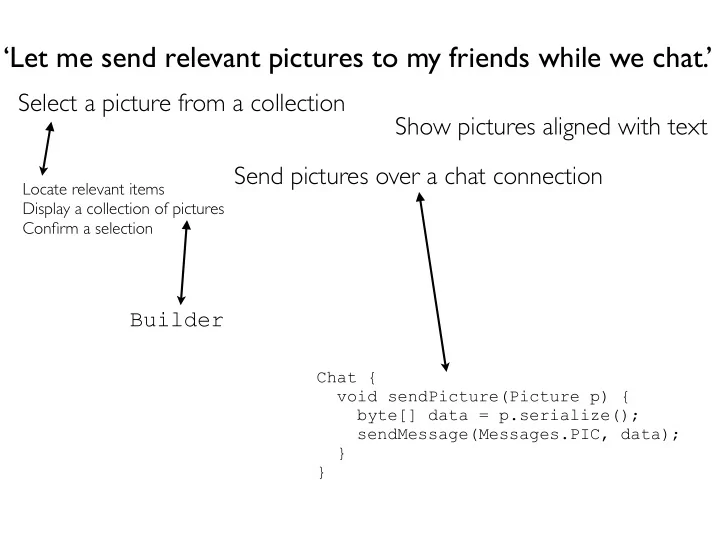
SLIDE 1 ‘Let me send relevant pictures to my friends while we chat.’
Select a picture from a collection
Locate relevant items Display a collection of pictures Confirm a selection
Show pictures aligned with text Send pictures over a chat connection
Builder
Chat { void sendPicture(Picture p) { byte[] data = p.serialize(); sendMessage(Messages.PIC, data); } }
SLIDE 2 ‘Let me send relevant pictures to my friends while we chat.’
Select a picture from a collection
Locate relevant items Display a collection of pictures Confirm a selection
Show pictures aligned with text Send pictures over a chat connection
Builder
Chat { void sendPicture(Picture p) { byte[] data = p.serialize(); sendMessage(Messages.PIC, data); } }
SLIDE 3 Let people specify their instructions informally
- avoid premature precision
- more helpful to programmers
- enable a new generation of flexible,
intelligent(?) programs FSE 2010
SLIDE 4 Managing Ambiguity by Example
Kenneth C. Arnold and Henry Lieberman MIT Media Lab & Mind Machine Project
{kcarnold,lieber}@media.mit.edu
SLIDE 5 Managing Ambiguity by Example
Kenneth C. Arnold and Henry Lieberman MIT Media Lab & Mind Machine Project
{kcarnold,lieber}@media.mit.edu
Informality
SLIDE 6 Informality vs. Ambiguity
- Specs and tests are formal but ambiguous.
- Formal = controlled semantics; incl.
programming languages.
SLIDE 7 Executing informal descriptions is hard!
Select a picture from a collection Show pictures aligned with text Send pictures over a chat connection
SLIDE 8 Strategy: Examples Clarify
Select a picture from a collection
Locate relevant items Display a collection of pictures
Send pictures over a chat connection
Builder
Chat { void sendPicture(Picture p) { byte[] data = p.serialize(); sendMessage(Messages.PIC, data); } }
Send relevant pictures to my friends while we chat
SLIDE 9 Strategy: Examples Clarify
Select a picture from a collection
Locate relevant items Display a collection of pictures
Send pictures over a chat connection
Builder
Chat { void sendPicture(Picture p) { byte[] data = p.serialize(); sendMessage(Messages.PIC, data); } }
Send relevant pictures to my friends while we chat
SLIDE 10 Strategy: Examples Clarify
Select a picture from a collection
Locate relevant items Display a collection of pictures
Send pictures over a chat connection
Builder
Chat { void sendPicture(Picture p) { byte[] data = p.serialize(); sendMessage(Messages.PIC, data); } }
Send relevant pictures to my friends while we chat
SLIDE 11 Two hard parts
- Acquiring and interacting with examples
- Zones: integrate intent into development
process
- Finding appropriate examples for new
queries
- use code features and natural language
background knowledge
SLIDE 12 Progress on both fronts
- Acquiring and interacting with examples
- Zones: integrate intent into development
process
- Finding appropriate examples for new
queries
- ProcedureSpace: relates code and informal
descriptions using code features and natural language background knowledge
SLIDE 13
Zones Demo
SLIDE 14 Backend: Code search?
- At the lowest level (directly to code), if
keywords match, maybe.
- Finding vocabulary is a large part of the
problem-solving process
- Need to understand the relationship
between code and statements of its purpose
SLIDE 15 ProcedureSpace Relates Code and Descriptions
chase
(forever (pointTowards: "mouse") (forward: 10)) forever > pointTowards: forever > forward: pointTowards: ~ forward:
follow
kind of movement
natural language descriptions background knowledge code fragments static analysis
SLIDE 16
Informal Inference
AnalogySpace (Speer et al., AAAI 2008)
SLIDE 17
Informal Inference
AnalogySpace (Speer et al., AAAI 2008)
SLIDE 18
Informal Inference
AnalogySpace (Speer et al., AAAI 2008)
SLIDE 19
Informal Inference
AnalogySpace (Speer et al., AAAI 2008)
SLIDE 20
Informal Inference
AnalogySpace (Speer et al., AAAI 2008)
SLIDE 21 Informal Inference
- AnalogySpace (Speer et al., AAAI 2008)
SLIDE 22
Can also blend multiple knowledge sources. Like code and descriptions.
Blending (Havasi et al., IEEE Intelligent Systems 2009)
SLIDE 23 ProcedureSpace Blends Code and Descriptions
- Zones Annotations
- Code Features
- static analysis now,
dynamic analysis soon?
- Commonsense Knowledge
- Domain Knowledge
English features code fragments English concepts code structural features Static Analysis Purpose Annotations ConceptNet domain-specific knowledge
SLIDE 24 Search Results
Users searched for
neither result was annotated
SLIDE 25 Related Ideas
- Keyword Programming: Match keywords,
align types, synthesize code. (Little and Miller, ASE ’07)
- Example-Centric Programming: integrated
search for examples (Brandt et al., CHI ’10)
SLIDE 26 Natural Language Programming
- Many attempts to formalize or restrict
natural language.
SLIDE 27 Natural Language Programming
- Many attempts to formalize or restrict
natural language.
- But that’s unnatural!
- Imprecision is a feature.
SLIDE 28
Tests, not code?
SLIDE 29 ‘Let me send relevant pictures to my friends while we chat.’
Select a picture from a collection
Locate relevant items Display a collection of pictures Confirm a selection
Show pictures aligned with text Send pictures over a chat connection
Builder
Chat { void sendPicture(Picture p) { byte[] data = p.serialize(); sendMessage(Messages.PIC, data); } }
SLIDE 30 ‘Let me send relevant pictures to my friends while we chat.’
Select a picture from a collection
Locate relevant items Display a collection of pictures Confirm a selection
Show pictures aligned with text Send pictures over a chat connection
Builder
Chat { void sendPicture(Picture p) { byte[] data = p.serialize(); sendMessage(Messages.PIC, data); } }
SLIDE 31
Let programmers be informal!
SLIDE 32 Have you heard of x?
- Probably not.
- Talk afterwards, or email:
kcarnold@mit.edu
- (thanks, Professor Forrest)
SLIDE 33
Getting familiar with existing programs
SLIDE 34
Try on Python, Java, ... the essence of the analysis is simple