Left-Corner Parsing Parsing Tricks Technique for 1 word of - - PDF document

left corner parsing parsing tricks
SMART_READER_LITE
LIVE PREVIEW

Left-Corner Parsing Parsing Tricks Technique for 1 word of - - PDF document

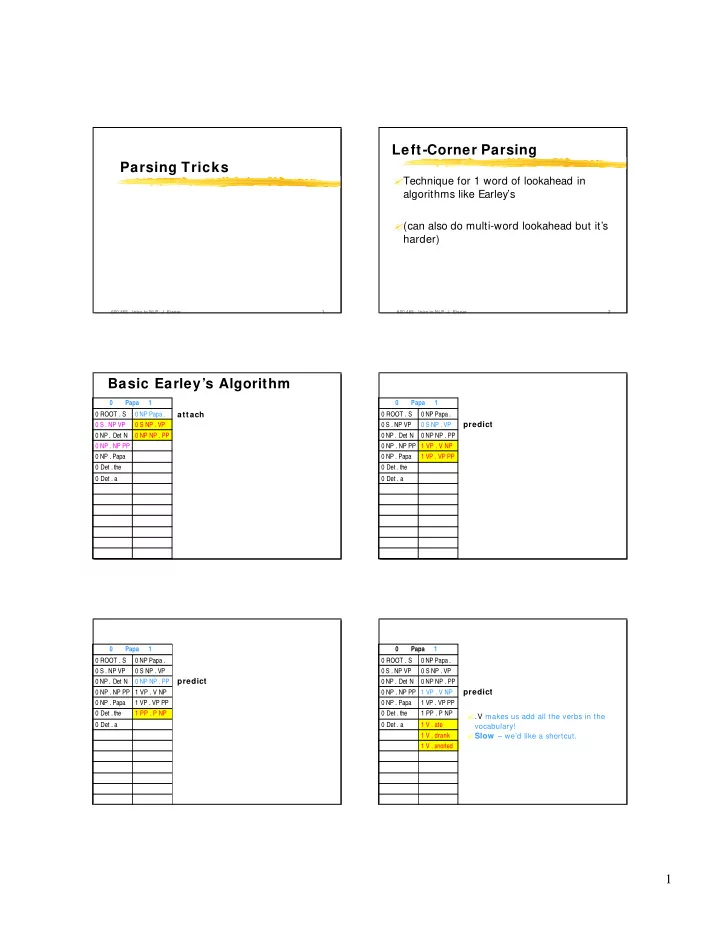
Left-Corner Parsing Parsing Tricks Technique for 1 word of lookahead in algorithms like Earleys (can also do multi-word lookahead but its harder) 600.465 - Intro to NLP - J. Eisner 1 600.465 - Intro to NLP - J. Eisner 2 Basic


slide-1
SLIDE 1

1

600.465 - Intro to NLP

  • J. Eisner

1

Parsing Tricks

600.465 - Intro to NLP

  • J. Eisner

2

Left-Corner Parsing

Technique for 1 word of lookahead in

algorithms like Earley’s

(can also do multi-word lookahead but it’s

harder)

0 Det . a 0 Det . the 0 NP . Papa 0 NP . NP PP 0 NP NP . PP 0 NP . Det N 0 S NP . VP 0 S . NP VP 0 NP Papa . 0 ROOT . S 0 Papa 1

attach

Basic Earley’s Algorithm

0 Det . a 0 Det . the 1 VP . VP PP 0 NP . Papa 1 VP . V NP 0 NP . NP PP 0 NP NP . PP 0 NP . Det N 0 S NP . VP 0 S . NP VP 0 NP Papa . 0 ROOT . S 0 Papa 1

predict

0 Det . a 1 PP . P NP 0 Det . the 1 VP . VP PP 0 NP . Papa 1 VP . V NP 0 NP . NP PP 0 NP NP . PP 0 NP . Det N 0 S NP . VP 0 S . NP VP 0 NP Papa . 0 ROOT . S 0 Papa 1

predict

1 V . snorted 1 V . drank 1 V . ate 0 Det . a 1 PP . P NP 0 Det . the 1 VP . VP PP 0 NP . Papa 1 VP . V NP 0 NP . NP PP 0 NP NP . PP 0 NP . Det N 0 S NP . VP 0 S . NP VP 0 NP Papa . 0 ROOT . S 0 Papa 1

predict .V makes us add all the verbs in the vocabulary! Slow – we’d like a shortcut.

slide-2
SLIDE 2

2

1 V . snorted 1 V . drank 1 V . ate 0 Det . a 1 PP . P NP 0 Det . the 1 VP . VP PP 0 NP . Papa 1 VP . V NP 0 NP . NP PP 0 NP NP . PP 0 NP . Det N 0 S NP . VP 0 S . NP VP 0 NP Papa . 0 ROOT . S 0 Papa 1

predict Every .VP adds all VP … rules again. Before adding a rule, check it’s not a duplicate. Slow if there are > 700 VP … rules, so what will you do in Homework 3?

1 P . with 1 V . snorted 1 V . drank 1 V . ate 0 Det . a 1 PP . P NP 0 Det . the 1 VP . VP PP 0 NP . Papa 1 VP . V NP 0 NP . NP PP 0 NP NP . PP 0 NP . Det N 0 S NP . VP 0 S . NP VP 0 NP Papa . 0 ROOT . S 0 Papa 1

predict .P makes us add all the prepositions …

1 P . with 1 V . snorted 1 V . drank 1 V . ate 0 Det . a 1 PP . P NP 0 Det . the 1 VP . VP PP 0 NP . Papa 1 VP . V NP 0 NP . NP PP 0 NP NP . PP 0 NP . Det N 0 S NP . VP 0 S . NP VP 0 NP Papa . 0 ROOT . S 0 Papa 1

1-word lookahead w ould help

ate No point in adding words other than ate 1 P . with 1 V . snorted 1 V . drank 1 V . ate 0 Det . a 1 PP . P NP 0 Det . the 1 VP . VP PP 0 NP . Papa 1 VP . V NP 0 NP . NP PP 0 NP NP . PP 0 NP . Det N 0 S NP . VP 0 S . NP VP 0 NP Papa . 0 ROOT . S 0 Papa 1

1-word lookahead w ould help

ate No point in adding words other than ate In fact, no point in adding any constituent that can’t start with ate Don’t bother adding PP, P, etc. 0 Det . a 0 Det . the 0 NP . Papa 0 NP . NP PP 0 NP NP . PP 0 NP . Det N 0 S NP . VP 0 S . NP VP 0 NP Papa . 0 ROOT . S 0 Papa 1

attach

With Left-Corner Filter

ate

PP can’t start with ate Birth control – now we won’t predict 1 PP . P NP 1 PP . ate either! Need to know that ate can’t start PP Take closure of all categories that it does start …

0 Det . a 0 Det . the 1 VP . VP PP 0 NP . Papa 1 VP . V NP 0 NP . NP PP 0 NP NP . PP 0 NP . Det N 0 S NP . VP 0 S . NP VP 0 NP Papa . 0 ROOT . S 0 Papa 1 ate

predict

slide-3
SLIDE 3

3

1 V . drank 0 Det . a 1 V . snorted 1 V . ate 0 Det . the 1 VP . VP PP 0 NP . Papa 1 VP . V NP 0 NP . NP PP 0 NP NP . PP 0 NP . Det N 0 S NP . VP 0 S . NP VP 0 NP Papa . 0 ROOT . S 0 Papa 1

predict

ate 1 V . snorted 1 V . drank 0 Det . a 1 V . ate 0 Det . the 1 VP . VP PP 0 NP . Papa 1 VP . V NP 0 NP . NP PP 0 NP NP . PP 0 NP . Det N 0 S NP . VP 0 S . NP VP 0 NP Papa . 0 ROOT . S 0 Papa 1

predict

ate

600.465 - Intro to NLP

  • J. Eisner

15

Merging Right-Hand Sides

Grammar might have rules

X ? A G H P X ? B G H P

Could end up with both of these in chart:

( 2, X ? A . G H P) in column 5 ( 2, X ? B . G H P) in column 5

But these are now interchangeable: if one

produces X then so will the other

To avoid this redundancy, can always use

dotted rules of this form: X ?

... G H P

600.465 - Intro to NLP

  • J. Eisner

16

Merging Right-Hand Sides

Similarly, grammar might have rules

X ? A G H P X ? A G H Q

Could end up with both of these in chart:

( 2, X ? A . G H P) in column 5 ( 2, X ? A . G H Q) in column 5

Not interchangeable, but we’ll be processing

them in parallel for a while …

Solution: write grammar as X ?

A G H (P| Q)

600.465 - Intro to NLP

  • J. Eisner

17

Merging Right-Hand Sides

Combining the two previous cases:

X ? A G H P X ? A G H Q X ? B G H P X ? B G H Q

becomes

X ? ( A | B) G H (P | Q)

And often nice to write stuff like

NP ? ( Det | ?) Adj * N

600.465 - Intro to NLP

  • J. Eisner

18

Merging Right-Hand Sides

X ? ( A | B) G H (P | Q) NP ? ( Det | ?) Adj * N

These are regular expressions! Build their minimal DFAs:

A B P Q G H X ? Det Adj Adj N NP ? N

Automaton states

replace dotted rules (X ?

A G . H P)

slide-4
SLIDE 4

4

600.465 - Intro to NLP

  • J. Eisner

19

Merging Right-Hand Sides

Indeed, all NP ? rules can be unioned into a single DFA!

NP ? ADJP ADJP JJ JJ NN NNS NP ? ADJP DT NN NP ? ADJP JJ NN NP ? ADJP JJ NN NNS NP ? ADJP JJ NNS NP ? ADJP NN NP ? ADJP NN NN NP ? ADJP NN NNS NP ? ADJP NNS NP ? ADJP NPR NP ? ADJP NPRS NP ? DT NP ? DT ADJP NP ? DT ADJP , JJ NN NP ? DT ADJP ADJP NN NP ? DT ADJP JJ JJ NN NP ? DT ADJP JJ NN NP ? DT ADJP JJ NN NN

etc.

600.465 - Intro to NLP

  • J. Eisner

20

Merging Right-Hand Sides

Indeed, all NP ? rules can be unioned into a single DFA!

NP ? ADJP ADJP JJ JJ NN NNS | ADJP DT NN | ADJP JJ NN | ADJP JJ NN NNS | ADJP JJ NNS | ADJP NN | ADJP NN NN | ADJP NN NNS | ADJP NNS | ADJP NPR | ADJP NPRS | DT | DT ADJP | DT ADJP , JJ NN | DT ADJP ADJP NN | DT ADJP JJ JJ NN | DT ADJP JJ NN | DT ADJP JJ NN NN

etc.

regular expression DFA ADJP DT NP ? NP ADJP ? ADJ P ADJP

600.465 - Intro to NLP

  • J. Eisner

21

Earley’s Algorithm on DFAs

What does Earley ’s algorithm now look like?

(2, ) …

Column 4

VP ? …

PP NP … predict

600.465 - Intro to NLP

  • J. Eisner

22

Earley’s Algorithm on DFAs

What does Earley ’s algorithm now look like?

(4, ) (4, ) (2, ) …

Column 4 Det Adj Adj N NP ? N PP

VP ? …

PP NP … predict

PP ? …

600.465 - Intro to NLP

  • J. Eisner

23

Earley’s Algorithm on DFAs

What does Earley ’s algorithm now look like?

(4, )

Column 7 …

(4, ) …

Column 5

(4, ) (4, ) (2, ) …

Column 4 Det Adj Adj N NP ? N PP

VP ? …

PP NP …

PP ? …

predict

  • r attach?

600.465 - Intro to NLP

  • J. Eisner

24

Earley’s Algorithm on DFAs

What does Earley ’s algorithm now look like?

(2, ) (7, ) (4, )

Column 7 …

(4, ) …

Column 5

(4, ) (4, ) (2, ) …

Column 4 Det Adj Adj N NP ? N PP

VP ? …

PP NP …

PP ? …

predict

  • r attach?

Both!

slide-5
SLIDE 5

5

600.465 - Intro to NLP

  • J. Eisner

25

Pruning for Speed

Heuristically throw away constituents that probably won’t make it into best complete parse. Use probabilities to decide which ones.

So probs are useful for speed as well as accuracy!

Both safe and unsafe methods exist

Throw x away if p(x) < 10-200 (and lower this threshold if we don’t get a parse) Throw x away if p(x) < 100 * p(y) for some y that spans the same set of words Throw x away if p(x)* q(x) is small, where q(x) is an estimate of probability of all rules needed to combine x with the other words in the sentence

600.465 - Intro to NLP

  • J. Eisner

26

Agenda (“Best-First”) Parsing

Explore best options first

Should get some good parses early on – grab one & go!

Prioritize constits (and dotted constits)

Whenever we build something, give it a priority

How likely do we think it is to make it into the highest -prob parse?

usually related to log prob. of that constit might also hack in the constit’s context, length, etc. if priorities are defined carefully, obtain an A* algorithm

Put each constit on a priority queue (heap) Repeatedly pop and process best constituent.

CKY style: combine w/ previously popped neighbors. Earley style: scan/predict/attach as usual. What else?

600.465 - Intro to NLP

  • J. Eisner

27

Preprocessing

First “tag” the input with parts of speech:

Guess the correct preterminal for each word, using faster methods we’ll learn later Now only allow one part of speech per word This eliminates a lot of crazy constituents! But if you tagged wrong you could be hosed

Raise the stakes:

What if tag says not just “verb” but “transitive verb”? Or “verb with a direct object and 2 PPs attached”? (“supertagging”)

Safer to allow a few possible tags per word, not just one …

600.465 - Intro to NLP

  • J. Eisner

28

Center-Embedding

if x then if y then if a then b endif else b endif else b endif

STATEMENT ? if EXPR then STATEMENT endif STATEMENT ? if EXPR then STATEMENT else STATEMENT endif But not: STATEMENT ? if EXPR then STATEMENT

600.465 - Intro to NLP

  • J. Eisner

29

Center-Embedding

This is the rat that ate the malt. This is the malt that the rat ate. This is the cat that bit the rat that ate the malt. This is the malt that the rat that the cat bit ate. This is the dog that chased the cat that bit the rat that ate the malt. This is the malt that [the rat that [the cat that [the dog chased] bit] ate].

600.465 - Intro to NLP

  • J. Eisner

30

More Center-Embedding

[What did you disguise

[those handshakes that you greeted

[the people we bought

[the bench [Billy was read to]

  • n]

with]

with]

for]? [Which mantelpiece did you put

[the idol I sacrificed

[the fellow we sold

[the bridge you threw [the bench [ Billy was read to]

  • n]
  • ff]

to]

to]

  • n]?
slide-6
SLIDE 6

6

600.465 - Intro to NLP

  • J. Eisner

31

[For what did you disguise

[ those handshakes with which you greeted

[the people with which we bought

[the bench on which [Billy was read to]?

Center Recursion vs. Tail Recursion

[What did you disguise

[those handshakes that you greeted

[the people we bought

[the bench [Billy was read to]

  • n]

with]

with]

for]? “pied piping” – NP moves leftward, preposition follows along

600.465 - Intro to NLP

  • J. Eisner

32

Disallow Center-Embedding?

Center-embedding seems to be in the grammar, but people have trouble processing more than 1 level of it. You can limit # levels of center-embedding via features: e.g., S[S_DEPTH= n+ 1] ? A S[ S_DEPTH= n] B If a CFG limits # levels of embedding, then it can be compiled into a finite-state machine – we don’t need a stack at all!

Finite-state recognizers run in linear time. However, it’s tricky to turn them into parsers for the original CFG from which the recognizer was compiled.

600.465 - Intro to NLP

  • J. Eisner

33

Parsing Algs for non-CFG

If you’re going to make up a new kind of

grammar, you should also describe how to parse it.

Such algorithms exist! For example, there are parsing algorithms

for TAG (where larger tree fragments can be combined by substitution & adjunction)